

Newsletter Subscribe
Enter your email address below and subscribe to our newsletter
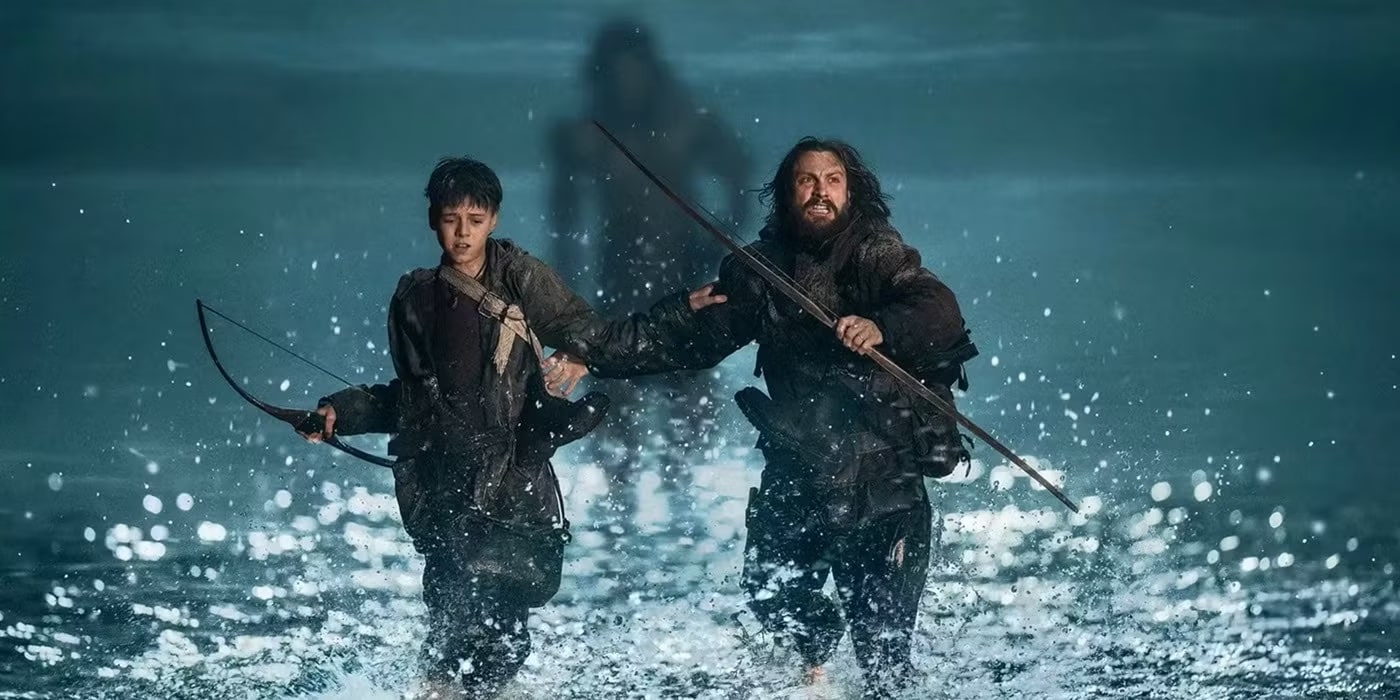
The 28 movies all use the opening prologue to introduce the core thesis of the film.
28 Days Later uses the primate forced to watch nonstop footage of rage and violence to establish the theme of animal instinct vs civilized behavior. How do people, how do societies, handle this conflict that’s at the core of the human experience? What happens if the animal instinct wins out? If our base emotions take over?
28 Weeks Later uses a husband abandoning his wife to save himself to set up its larger political statement about leadership and the foreign policy of the United States. Specifically, it’s a condemnation of George Bush and America’s War on Terror.
So what do we see at the start of 28 Years Later?
The first shot is of the Teletubbies, a 90s show for kids. Sure enough, a cut shows us a bunch of kids in front of the TV, watching this ridiculous program. Outside, adults yell. Jimmy wonders if his dad is at the door. Then an infected smashes in and attacks.
Jimmy escapes the house and makes it to the church where his dad’s at. The infected pursue him. Inside, his dad’s just hanging out, kind of overjoyed by what’s going on because he believes this is the rapture and the victims have actually been saved. So dad’s thrilled when the infected break in and devour him. All while Jimmy hides in the floor, not thrilled.
The primate scene in 28 Days Later establishes the idea that what we see influences us. Especially the media we consume (which is kind of more relevant in 2025 than it was in 2003). 28 Years Later starts with the TV to callback to the idea of influence.
If things were normal, the kids would just get to watch Teletubbies and have that shape their view of the world. Watch the scene closely and you’ll see how the kids start off seemingly fine then slowly lose their composure. That’s because of the yelling going on outside. The stressed out adults. The kids know something is wrong and it’s causing them to lose focus on the program, lose focus on what it means to be a kid, to be innocent.
28 Years Later wants us to think about influence but not in the same way as the original. The influence isn’t from the screen but from adults, parents, and how a child’s world can be completely broken open by adults and adult problems. When Jimmy turns to his father for guidance, for comfort, his father isn’t there to support him. That leaves Jimmy on his own.
That’s everything I took away from just the opening prologue. We then test it by asking a series of questions and seeing if the rest of the movie supports those questions.
So, yeah, the quick answer is that 28 Years Later is about the influence parents have on children. But there’s a lot more to talk about.
I know a lot of people have found the very end of 28 Years Later to be jarring, if not downright bizarre, but it makes perfect sense when you understand the theme.
Jimmy and Spike are two sides of the same coin. Both were kids who had their childhoods interrupted: Jimmy by the infection, Spike by his mother’s illness. Both had fathers with strong belief systems who tried to pass on those beliefs. Both lose their mothers and feel abandoned (in different ways) by their fathers.
The biggest difference between them is one has emotional catharsis and the other doesn’t.
Spike, through Dr. Kelson, has the opportunity to grieve his mother, to honor her, to come to terms with her death.
Later, Kelson tells Spike that “There are many kinds of death. And some are better than others. The best are peaceful, where we leave each other in love.” He’s preparing Spike for her passing, which happens mere moments later. Spike waking up and placing his mother’s skull at the top of the monument is a visualization of his healthy acceptance of death and this lesson about life.
A lot of people will take the memento mori scene at face value and think 28 Years Later is ultimately about grief and acceptance. But I would argue the scene has more depth than that. It’s not just about physical death. It’s about the demise of parental influence. Physical death was merely a way to represent that concept on screen. Let me explain.
In literature, you get both interiority and exteriority. Exteriority: “Bobby walks through the front door. He takes off his shoes..” Interiority: “He is happy to finally be away from work and have time to decompress.”
In film, you really only have exteriority. We watch Bobby come through the front door and take his shoes off. There’s no consistent mechanism for interiority. You could have a voice over that tells us “He was happy to finally be away from work and have time to decompress,” but that gets tiresome. Dialogue often functions as a way to deliver interiority. Another character could ask Bobby “How was your day” and Bobby would respond, “I’m happy to finally be away from work and decompress.” But that’s exposition and it’s usually the less skilled way of handling things.
What skilled filmmakers do is convey interiority through exteriority. The actor playing Bobby might make a show of taking his shoes off, sighing in relief. He might then go over to the couch and collapse and smile. From the actions, we pick up on the fact Bobby’s relieved to be home and ready to relax.
This gets progressively more advanced. For example, a character is excited about a job they interviewed for. They believe this is the start of a grand new chapter. So they cook a romantic candle-lit dinner for their partner. During dinner, their phone buzzes. It’s an email from the company. We get a shot of the character looking at their phone. They’re reading it but we don’t know what it says. The partner asks the question the audience is thinking, “Well, what does it say?” Just then, the candle goes out. We cut to the next day.
In that scenario, the candle going out represents the negative contents of the email. We don’t have to read it. We don’t need the exposition. Or the interiority. The candle is an external way to visualize the character’s crushing disappointment.
In the movie The Babadook, the mother’s grief over the loss of her husband (at the very start of the movie) manifests in the form of the titular monster. Our candle example was a single moment. But the mother’s interaction with the Babadook is a complex dynamic played out over dozens of scenes. Through their interactions, we witness someone working through grief and how ugly and scary and hard it can be.
In 28 Years Later, Spike’s story starts with his coming of age ritual, his transition from child to adult. But he was scared and not ready and would have died if not for his father. But what’s his father do? Lie to everyone back in the community. He tells tall tales about Spike’s bravery and skill. Spike knows better. We know better.
When Spike tries to save his mom, it’s the ritual all over again. Except influenced by the other parent. This time, what he experiences is authentic and truly marks a transition from childhood to adulthood.
There’s this thing called separation-individuation that occurs in teenagers. From Psychology Today: “The process of separation-individuation is a natural and normal part of adolescence. It involves separating from one’s family of origin and childhood influences enough to figure out who one is and further become one’s own person. In seeking greater independence, teenagers increasingly pull away from their families…. This separation involves a certain amount of experimentation, risk-taking, and direct as well as indirect limit-testing and rebelliousness, including not paying attention to/disregarding the words of their parents.”
Think back to the initial dynamic between Spike and Jamie. Jamie’s the teacher and Spike’s the student. The son wants to be like the father. And believes in his father’s version of the world. Until Spike discovers his dad’s infidelity. That shatters his image of his father as an ideal.
Remember our candle example? The infidelity is the candle. It’s just a way to externalize the start of the separation process, to break Spike’s connection to his dad. Kelson is another candle. Prior to the separation, Spike believed Kelson couldn’t help Isla because that’s what Jamie told him. After the separation, Spike takes Isla to Kelson. Sure enough, Spike was right. Kelson does help, just not in the way Spike had hoped. His mother finds peace and is able to leave Spike with love. Spike achieves what his father couldn’t.
That’s what I mean when I say that Isla’s death is about more than grief. Jamie said Kelson couldn’t help. Spike defied his father and was right. That’s separation-individuation. Which often marks the end of childhood and the start of adulthood. How do you externalize the internal idea that a child no longer needs his parents to protect him from the world?
Garland and Boyle show that transformation in two ways. One, with Isla’s death, which is the big, emotional, melodramatic, filmic choice. Second, with Spike leaving the community and going out into the world. Which is the more grounded choice. Keep that in mind as you read the letter Spike leaves for his father.
Spike: Dad. I’m okay. You don’t need to look for me. I’ll come back when I’m ready. I want to keep walking, until I can’t see the sea. We found Dr. Kelson. He’s not insane. He’s a kind man. The baby’s from an infected. But she’s not. She’s okay. Please be kind to her. Her name is Isla.
Isla’s death externalizes the internal transition in Spike. His letter to his father is the practical demonstration of someone who has gone through that shift in perspective.
The baby becomes an important symbol. It’s not just filler or a macguffin to drive the plot. It had infected parents but it wasn’t born infected. That’s the message of the film. Just because your parents have baggage doesn’t mean you’ll be like them.
Spike is the best case scenario. He fully separates and is on his way to becoming a strong individual. Jimmy is the worst case scenario. Even though he rejects his father by wearing the cross upside down, wearing the cross at all shows a lack of separation. And dressing his crew (kids?) like the Teletubbies calls back to the trauma of that day when he lost his mother, sister, and father. The film even reinforces that connection by including, non-diegetically, the Teletubbies counting like we heard at the very start of the film.
Jimmy has no individuality. His look is inspired by a famous British personality, Jimmy Savile. His crew is the teletubbies. He’s a performer. The byproduct of media. So it’s fitting that the opening shot for him was a TV. Which gets right back to what we talked about at the beginning: the forces that influence the development of children. And it dovetails nicely with 28 Days Later, as you can almost see Jimmy as a different version of the rage virus. Afterall, the virus was born from a primate that had consumed too much ugly media.
I’m excited to see what Bone Temple does and if Garland finds a new theme or expands on this one.


Film Colossus Supporters get access to the Frameshift and Active Viewing courses, an ad-free site, the Watch More Films newsletter, and the ability to request movies for analysis. Your support also directly keeps Film Colossus alive while I try to scale it into something sustainable, as it's just me, Chris, who does everything here.
Or create a free account. You gain access to the Active Viewing course and Watch More Films.
Join the Film Colossus community, get the newsletter, and unlock member features as they're added.
Excellent stuff as ever, thank you.
While nowhere as film literate and articulate as you are, I think there might be something to be explored about the choice of Jimmy Savile as Jimmys sartorial influence.
Savile has posthumously (in the 2010s) been exposed as a horrific sexual predator, but back in the 1970s though to 90s he was an icon of youth TV (unlikely as that seems if you see images of him without prior knowledge), he presented Top of the Pops, our weekly music chart show, and a show called Jim’ll Fix It, where children would write in asking for all kinds of dreams to come true and he’d arrange for them to happen.
So, on one hand, choosing him as an influence of Jimmy (perhaps even going as far as taking his name) reinforces the timeline of the film/trilogy as our world up to the 1990s, then it diverts off so in the films timeline our 2010s hasn’t happened so Savile hasn’t been exposed for what he truly was. There are other visual defences to this such as the Happy Eater restaurant where Spike and Isla meet Erik was a real chain that went bust in the 1990s.
However, there’s perhaps also a warning of beware of the truth/heroes the media give you, and/or don’t put people on pedestals, given how we (in the UK) now know how evil Savile turned out to be.
I wonder if the next film will continue to explore Jimmy’s arrested development and clinging to media fed childhood heroes compared to Spike’s real experiences of coming of age through the film.
Great analysis! I didn’t take this much from the film, but now I want to rewatch it through the explanation you gave. I’m learning a lot by reading your analysis, pkeep up the great work!