
I think one of the reasons the ending of The Lobster leaves people so bemused and unsure is because it’s a philosophical ending rather than a resolution. Movies and books have trained us to expect resolution. Ask anyone what the parts of a story are and they’ll say, “Beginning, middle, end.” And typically that end takes the form of a conclusion. The hero is victorious or defeated. The authoritarian institution triumphs or gets brought down. Someone finds love or they don’t.
The resolution ending is standard when telling a story for the sake of telling the story. But it’s less standard when the story is a tool for an examination of humanity.
That sounds pretentious, but that’s the realm of art, right? To explore and examine what it means to be alive. To try to make sense of the world, even if that’s through a defamiliarization of the world.
In the case of The Lobster, the world is very defamiliarized. It’s a full-blown dystopia. But the details of the society are thin. Over the course of the movie, we realize that couples are forced to have something in common; that it’s the government that turns people into animals; that there’s a normal-but-stilted society where people live in the city, have homes, go to the mall, and live semi-basic lives if not kind of emotionally reduced lives. You can exist in this society as long as you follow their very stringent rules.
The Lobster isn’t telling us a story about this weird and whacky world. It’s using this weird and whacky world as way to ask us a question. “If you were in the situation David is in, what would you do? Do you blind yourself? Do you not and become an animal? Why?”
The end of The Lobster
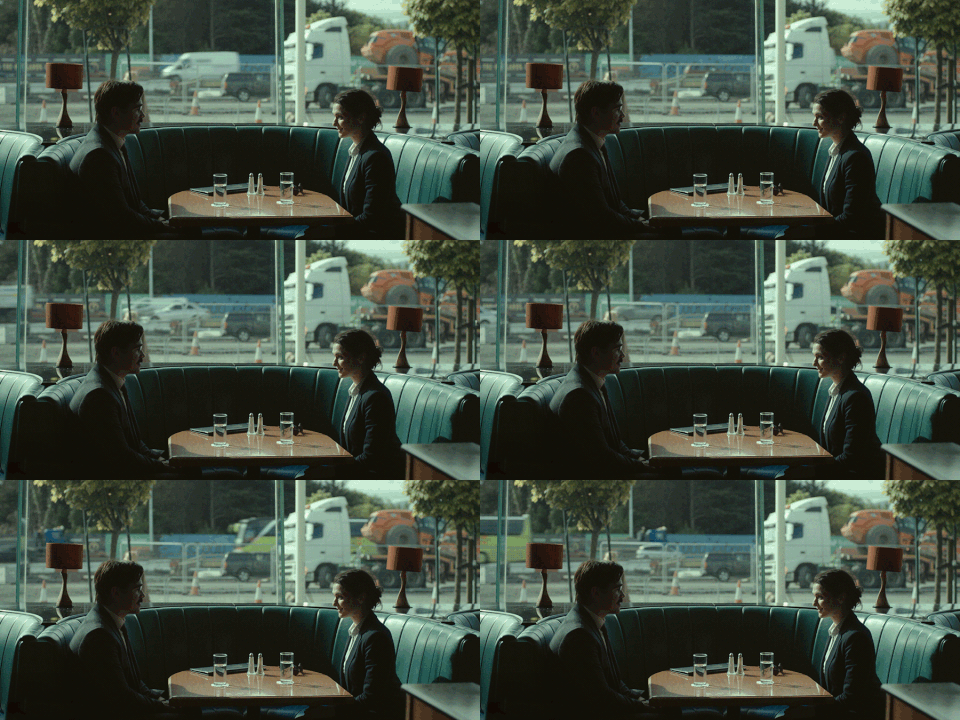
At the end, we see David (Colin Farrell) and the woman he loves (Rachel Weisz) at a diner. They’ve escaped the Loners, which means now they have to blend into normal society.
But the problem is that, in this society, everyone has to have a defining characteristic, and every couple has to share that characteristic. Fair enough. This had been fine when David and Rachel (she’s otherwise nameless) were both shortsighted. But now that Rachel has been blinded…David’s only real choice is to blind himself.
If this weren’t a weirdly specific movie where everyone is a little bizarre, David would have other options. But writer/director Yorgos Lanthimos doesn’t want us to consider other options. He wants to bring us to this moment of truth where Rachel waits at the diner table while David goes to the bathroom to blind himself with a steak knife by stabbing his eyes.
The last shot is of Rachel, at the table. Waiting.
Why end The Lobster like this?
Clearly this is not a resolution. The story’s main consideration had been whether David could find love. He has, but the duration of that relationship depends on him inflicting these wounds on himself. Should he go through with them…then he’ll be able to spend the rest of his life with Rachel. Should he not go through with it…he’ll not only break the heart of the woman he loves, he’ll probably become a fugitive wanted by the state for being a “loner.” This increases the odds that he and Rachel will each be turned into animals. The fact that we don’t know what happens to David means the story does not wrap up.
If this was a story designed to have a resolution, this would be a bad one.
But if this was a story designed around a philosophical question, then this is a perfectly fine ending.
The meaning of The Lobster‘s ending
In storytelling, there’s a basic need to bring the narrative to a moment of climactic choice. Stories that want to resolve will show this choice and then show the reaction of the world to that choice. So in Star Wars, Luke has to decide whether or not to help the Rebel forces blow up the Death Star. He chooses to. Then we watch that play out. He succeeds. The Death Star explodes. Everyone is happy. That’s some resolution.
But if Star Wars was an exercise in philosophy then it would end with Luke having to decide whether or not to join a Rebel army and take the lives of the enemy. We’d be left without an answer. We’d never know if the Empire wins or loses. If Luke becomes a hero, or loses his life trying, or scurries away out of fear. We’d just have endless debates.
Why do philosophical endings deny us the satisfaction of a character making a decision?
Because it begs the question, “What do you think happens? “
Which is a different way of asking, “What would you do in this situation?”
To eye or not to eye, that is the question
If you were in a society where you could only marry someone who had the same defining feature as you…would you blind yourself to be with the person you love?
That’s really the mental exercise that The Lobster is. All of the hotel stuff. All of the Loner resistance stuff. All of the dystopian society. The entire purpose of it is to build the final moment of choice and leave the audience asking themselves: What did he do?
And then: What would I do?
From there, the question gains nuance.
If you’re in David’s world…
If you’re in David’s world, what are your choices? Blind yourself to be with this person? Or don’t do that and get turned into an animal?
Either way is kind of bleak. If you blind yourself, you’re no longer living the same life as before, or capable of the same things as before. Your life fundamentally changes. But if you’re turned into an animal, you’re also not living the same life as before, or capable of the same things as before. So is it better to be blind and living with the person you love, or is it better to be an animal with all five senses?
If we were in our world…
So in real life we don’t have to have a defining characteristic. No one is going to turn us into an animal if we’re single. The stakes are much much much lower. If anyone was trying to make you blind yourself out of love…well, they’re probably a psychopath and you should run away.
But we can extrapolate. When you commit to a relationship, there’s always a cost. In most cases, this is a matter of losing a bit of your individuality. Instead of being a single entity, you’re now part of a couple. You can’t just move into whatever apartment you want. You have to consider how the move will affect the relationship. If the apartment you want is 30 minutes away from where your significant other lives, that could be a problem. If you want to live in the middle of downtown and they don’t, that could be a problem. You have to compromise.
But this can be bigger than compromise. If you love NYC but your significant other gets a job in San Francisco, do you move? What if you go on a few dates with someone, are falling for them, then they tell you they have a child? Does that change things for you? Do you flinch? Or are you fine with it?
None of these things are as serious as having to blind yourself, but they are examples of the cost of a relationship and accepting the conditions of being in that relationship.
The Lobster and 1984
“That’s all well and good, Chris. But is there a resolution? Can’t a movie do both resolution and philosophy?”
Oh, yeah, certainly. I think something like Blade Runner is a good example of mixing resolution and philosophy. We get the initial conclusion to the showdown with the replicants, but there’s the philosophical with Deckard making a choice to run away with Rachael. The question there isn’t would we choose to run or not…it’s would we be able to love an android as though it were a human. Deckard can because he now believes there’s no difference between humans and replicants. Or at least doesn’t care.
If we’re looking at the resolution of The Lobster then I would argue that the conclusion is in the title itself. A lobster is the animal David chose to become if he were turned in to one. If David chose to blind himself, then the title is a very limited one, as it only applies to the theoretical of what David would become. But if David ops to not blind himself, it’s probably safe to assume he gets captured and is returned to the hotel to become an animal. In which case, he would become the lobster.
I also can’t help but compare The Lobster to 1984 and Brazil. All three are dystopian society films that follow very similar narrative arcs. The character starts within a cruel dystopian system. They start to doubt the system. They break out of the system and meet up with a resistance force. The woman they love is part of the resistance force. But the resistance force ends up falling apart. In 1984 and Brazil, the main characters are caught, tortured, and ultimately rehabilitated into the system. They’re alive but have lost the essence of their individuality.
For much of its narrative, The Lobster follows the exact trajectory of 1984 and Brazil. That means it is either using their basic structure to eventually diverge, which is something V for Vedetta does, or it’s using the exact same structure because The Lobster is a retelling of 1984.
If The Lobster wanted to borrow in order to set-up the divergence, then we never see it actually diverge. And there’s no real implication of diverging. Which I think would support the reading that David fails to blind himself and ends up subjugated by the system. Just like the endings of 1984 and Brazil. In this world, that means becoming a lobster.
Rachel is waiting
I do think it’s worth noting that there’s a bit of a hold on Rachel while she waits for David to return. The shot maintains for enough time to create the doubt he may not return. To the point where we may be looking out the huge window behind Rachel, expecting to see David running down the street, abandoning her to her fate. The hold here functions as a dramatic moment to make us wonder what’s taking so long. We start to expect David to come back any second…any second… But the more time that passes the more we’ll worry he won’t show up. It’s a nice use of tension building that really drives home the philosophical question.


Wow! Reading all of the different perspectives here made it worth watching this strange movie! So glad I stumbled across this page in trying to learn what the hell did I just watch?? I agree that there is lots of room for interpretation of the ending, although after considering the numerous and varied opinions offered here, I lean toward the version where David chooses not to blind himself. I think that’s what the title is suggesting, and it’s the best explanation for assigning that title. But that’s just my opinion. ?
I think the sound of the ocean washing over the end credits says alot
The crashing waves at the end is what a LOBSTER would here.
The entire movie makes you think and question. What animal would you choose to be? Would you break your nose? Would you strike back at someone who killed your dog/brother? Would you just let him lie there bleeding? What did he turn the heartless woman into? Would you shoot your wife? Would you bring in your friend from the hunt if you only had a few days left or let him go? Who was that donkey at the beginning? Even the start of the movie, you are asking “what is going on here?” The ending is just a continuation of questioning you. What did David do? What would you do?
I doubt David blinded himself. I believe the shortsighted woman and David formed a lasting relationship as a couple in the city – him continuing to refuse to tell her into what animal he transformed the cold-hearted woman and skillfully lying to authorities that he has no sight.
I wrote a long reply above somewhere about how I think David definitely blinded himself not for love but to survive… but someone raised a VERY good point that David may have well killed himself by accident (either bleeding out, or gauging himself too deeply), and I have to say that’s my favorite theory so far. It makes sense of everything — his intentions to blind himself to be with her, to survive, the fact that he has nowhere else to go at this point… and in this interpretation, the title and the sound of the water become haunting reminders of the path not taken. The Lobster would have been a very good alternative to death… but because David fears losing his humanity (wonderfully absurd considering how emotionless/animalistic the characters are all written) he attempts to blind himself to live his life out with the girl. Only to accidentally kill himself. I feel like that’s the perfect ending to this very depressing allegory about “love.”
IMHO this explanation, along with the actual ending, betrays the whole tone and theme of the film. We should have just seen him hanging off the back of one of the tractors passing by, hitching a ride off. I loved this movie and hadn’t laughed like this in so long. I made my father watch it with me and the frequent contorted looks he gave me, questioning my sanity was right in tune with the film…
There is dark humor to it, that’s for sure. But I guess the explanation and actual ending fits more of you’re looking at the comedy as secondary to the bleakness, rather than primary. But I get what you mean if the humor is primary for you. I feel about Brazil the way you feel about The Lobster—in terms of it being funnier rather than darker, even though there’s obviously a lot of darkness to it.
He did NOT go through with it; he did NOT blind himself. He left her sitting there at the table & he ran away (as he should have). What would be the point of them both being blind? They’re fugitives on the run so his sight is valuable to them. How could he/they get around if they’re both blind. They had just jumped the retaining wall & hid when he saw the hotel bus coming down the road. He would want his sight in order to continue to be able to run from the hotel/gov & the Loners who would want retaliation for him killing the leader; so no, he didn’t do it.
He didn’t love her (& she didn’t love him). He so easily became disinterested in her & even stopped coming to see & helping her once she refused to kiss him & said they could no longer have a sexual rationship. She quickly was willing to throw him under the bus about her being blinded instead of him.
He simply wanted a physical relationship as evidenced when he got with the evil short haired woman. He knew beforehand that the short haired woman was “heartless”, that is what he remarked but he still wanted the physical ralationship & found her the best choice out of the lot to pick from. Of all the women, she was the most masculine which he preferred.
He was an emotionless, cold-hearted, unempathetic human too & didn’t care for anyone just like the short haired woman didn’t; the exception being his dog brother.
The short haired woman was purely psychotic. She reveled in the hunt. Her eyes literally lit up at hunting time. David wasn’t far from that. I think he was homosexual to be honest & just thought being with a woman would be easier in society but I think he preferred men.
Instead of him immediately going out to mingle with & find a female mate, he hung out with the 2 males. That was the strongest relationship he built while at the hotel.
I don’t believe he cared for women at all. They were just a means to an easier end.
I really enjoyed all of the commentary and while I was originally inclined to believe that David did blind himself. If you let the ending credits roll all the way through, you hear waves gently breaking on the coast. The coast is where Lobsters live…
Don’t Lobsters mate for life….?
Seemed like that was him driving the tractor outside the diner at the end.
Correct. I’m surprised nobody took the literal metaphorical here. David’s true love is blind. Which is a twist on the core message of the film – true love is blind. We see David and Rachel as rebels to this strange oppressive world and part of the reason it is weird is because the confines of this world are that one must explain that which is inexplicable – they must provide a superfluous reason why the person is their true love.
If we accept that this woman is David’s true love there is really only 2 options – 1. David blinds himself and confirms to society or more likely and meaningful in my opinion is 2. He pretends to blind himself to support and protect his true love, bc true love is blind. He doesn’t need to explain his love to anyone it is just for themselves to lead their own lives together. There are implications in this dystopian construct but I believe he doesn’t blind himself but pretends to be blind to protect his true love.
I was wondering if part of the reason the short-sighted woman asked if he wanted to see her belly is that she was alluding she was pregnant, and he missed the reference because he is “short-sighted”. This is because there were consistent references to procreation throughout: the couple’s code suggested that they snuck away for sex, the leader reminded the maid about taking birth control, he wants to be a lobster because they are “always fertile”, and children “fix problems in relationships” and her blindness had certainly caused a problem, etc. At no point in the government checks did I see them ask about stomachs and I read that scene as him giving her a last check for dirt before he took his eyesight away. This would also solve the problem of why narration is happening and why it is centered around this otherwise fairly unremarkable loner — the narration is telling her child about their father.
It was so great to read alternate takes on different details here — I initially read him lying to her about the tennis ball being a kiwi as trying to cheer her up and to be humane, not to prove he lies, and the unraveling of their relationship not because they were falling out of love but because it was stressed by the brutal change. I didn’t read her asking why his eyes hadn’t been taken instead of hers as anything other than the kind of angry nonsense you would say if you just found out you were blinded for life, but I agree that it does make a neat parallel to the act of terrorism with the hotel manager. I also think it is lovely foreshadowing that knives came out during the yacht attack halfway through, and we didn’t see what that family chose to do with them then, either.
Finally: if we are to believe that he did not blind himself, then the movie is more bleak than I originally thought. It would mean the audience was shown that basically no option — forced love, organic love, nor elected celibacy — works out. However, the lack of emphasis on the movie’s society makes me think the audience is supposed to focus on the relationship/this being a love story and that he probably went through with it.
Sorry if none of this makes sense — these are my 2 am thoughts haha.
I just don’t see why David could not have pretended to be blind like Limping Man did with the nosebleeds? He wouldn’t have to lie to the Short-Sighted (now blind) woman, but lie about it to everyone else. I guess this is just another case of my hunger for a resolution, but it seemed very doable.
I felt the same, since he was lying with the short-hair woman for such a long time, i feel like it is a very likely possibility. He could just lie for some time, until she endup getting caught and then who knows where the story could lead ? But thats the end I feel.