
Weapons | Quick Explanation
If you want a quick, practical explanation of Weapons in terms of story, let me get that out of the way for you. Gladys is a witch who behaves like a parasite, which is why Zach Cregger included multiple mentions of parasites. In the “Marcus” chapter, a TV narrator discusses Cordyceps, the parasitic fungi that possess ants (made popular by The Last of Us game and TV show). Then in Alex’s flashback, Justine teaches about parasites, asking the class, “Who else can think of a parasite?”
This is a form of slant exposition. Instead of having a character come out and say “Gladys is like a parasite!” the film includes references to parasites, establishes their behavior, then shows that Gladys’s is similar.
The parasite exposition implie that Gladys possesses people then feeds on their vitality. She thought feeding on Alex’s parents would cure her of whatever is going on (age, sickness, whatever), and while it helps, somewhat, it doesn’t do the trick. That’s why she pressures Alex to help her bewitch his classmates. She’s counting on their youth and sheer quantity. Except they don’t work either.
In terms of her being in dreams and appearing in visions, who knows? There is a moment where Alex finds her meditating in the room, in front of the tree. You could argue that’s her astral projecting. Ultimately, I don’t think the mystery here is a big deal. It falls into the “would be interesting to know” rather than the “need to know” category for me.
Gladys’s process for control isn’t fully developed. Her little tree has some sort of magic to it. The branch combined with an item from the target and her blood allows her to take possession of the target. Once she breaks the branch, whatever she wills the person does: whether that’s violence or clipping someone’s hair or guarding a line of salt.
To direct the violence, Gladys needs the hair of the target (or maybe something personal but it always seems to be hair). Alex uses the same trick to send his classmates after Gladys.
Practically speaking, that’s everything. Thematically, there’s more to discuss.
Weapons Literary Analysis | Themes, Meaning, Ending
I think a lot of people looking to understand Weapons will focus on the kids and school because that’s how the movie opens. But that’s probably a trap that keeps us looking at the film too narrowly.
Usually when I deconstruct a movie, the first thing I do is compare the beginning to the end. A majority of movies, like 99%, follow the same century-old formula where the opening scene establishes the primary theme and the closing scene makes the final point.
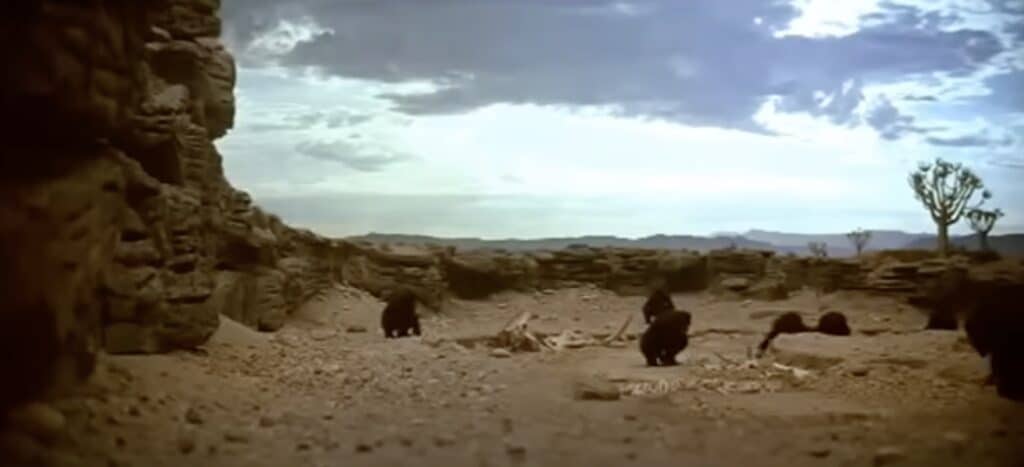
That’s as true for something like The Land Before Time as it is Happy Gilmore or The Godfather or 2001 Space Odyssey. 2001 starts with shots with vast open landscapes that make our ancient primate ancestors feel small, vulnerable, and powerless. It ends with a transcended human floating through space, towards Earth, shot in a way to appear similar in size to the Earth. That contrast, starting small and ending large implies a journey, that the film is about our evolution, an idea reinforced by the word “Odyssey” in the title.
Given how Weapons opens, it’s easy for me, and others, to think the main commentary is about schools. When Archer has the dream and there’s a giant gun in the sky, it’s easy to think school shootings. But there’s more going on. Because the victims aren’t just kids. When the opening-closing scene approach leaves me puzzled, the next thing I do is look at the title. So let’s do that.

Technique Discussion: Titles
Some titles are just for marketing, or just because they sound cool. Tron. Jurassic Park. Jaws. 28 Days Later. But many signal a work’s key concern. No Country For Old Men is about aging. Get Out applies to white occupation, commodification, and appropriation of Black culture. Even something seemingly simple like Tár has deeper meaning because that movie is about demythologizing people, spaces, things. Near the end, we find out “Lydia Tár” isn’t even the character’s real name. She changed it from Linda Tarr to sound more refined and important.
So if the opening-closing trick doesn’t provide a solid in-road to a film, the next step is the title.
Weaponized
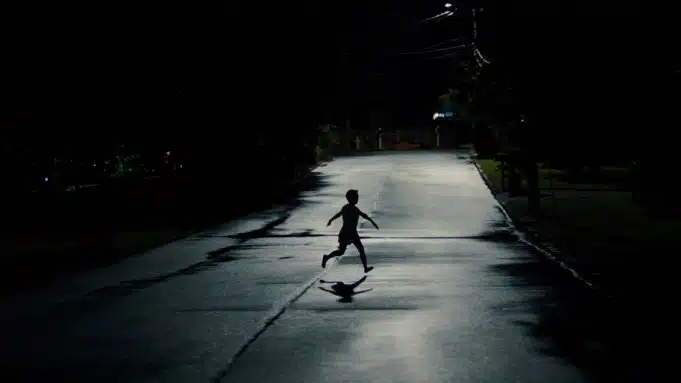
A good rule of thumb in understanding titles is to check if they’re said anywhere in the film. In this case, someone does. When Archer talks to Justine about Marcus’s attack, he says, “The way he was running. I’ve seen that before. Can I show you something? Their little girl ran the same way Matthew did. Same posture, same exact way, just like Marcus ran after you today. He was weaponized, like a heat-seeking missile, just locked onto you.”
If the film’s main theme was about the children, then we’d probably only see the kids used as weapons. But we don’t. Instead, it’s Marcus, Alex’s parents, Paul, James, and Archer. Only at the end do the kids turn into weapons and it’s an act of revenge that many will cheer on.
Characters who become weapons commit extreme acts of violence. Whenever there’s a fantastic element like this, I like to check if there’s a realistic parallel.
Technique Discussion: Fantastic/Grounded Parallels
Part of telling stories for mass consumption is not losing your audience. That’s especially true if the story involves any fantastic component, which horror, sci-fi, and fantasy always do. To that end, artists usually rely on grounded elements that parallel the fantastic ones. What’s that mean?
28 Days Later is a good example. The movie is concerned with how society balances animal instinct with civilized behavior. That’s why it opens with TV clips of riots and violence in various places throughout the world. Those clips ground the conversation: people already sometimes act like feral zombies. Having established that, the film can easily introduce the fantastic virus that turns humans into feral beings who destroy society. The rest of the movie is concerned with whether the main characters can actually restore civility in a world where so much anger exists.
It’s the same thing with Hereditary. We get a scene where a protagonist goes to a grief group and talks about her parents dealing with schizophrenia and bipolar disorder, and how her brother suffered as well, because these things are inherited (thus the film’s title), and then we see her, shortly after, disassociate and bring her family down. Except Ari Aster doesn’t stay grounded. He jumps to the fantastic and has the character’s mental illness take the form of demonic possession.
Violence in Weapons
In the more grounded portions of Weapons, we see Archer angry about Justine. Paul angry at James. Alex’s parents argue over Gladys coming to stay with them. Marcus has slight conflict with Justine (over her interest in Alex) and his partner (for letting Gladys in). James isn’t necessarily angry at anyone but he causes harm (the needles, breaking & entering, theft).
Remember when Paul’s wife comes after Justine? The camera is in front of Justine and we watch Donna pursue her through the store…like a heat-seeking missile? Then she attacks Justine. That’s a grounded version of anger and violence. When Paul next sees Justine, he’s possessed and attacks her. That’s the fantastic version of the anger he probably feels for her after she pressured him to drink (even though he went looking for trouble).
At this stage, I usually launch into a more defined theory, supported with shots, dialogue, even director commentary. But…I don’t know if Weapons achieves a more coherent message? Though there is one more angle.
Old vs Young
Say I step back and tell myself, “Chris, you need to relook at the beginning and the ending.” The thing that jumps out to me as the end is that it’s kids tearing apart this old woman who had locked them away.
The movie starts with the youth disappearing. And then a bunch of people between childhood and old age arguing. But it really comes down to a child versus an old person. So is there something to be said about that? Weapons wouldn’t be the first movie to comment on how Baby Boomers refuse to relinquish power and the impact that’s having on younger generations (Megalopolis, Saturday Night).
You could maybe extend that to Baby Boomers being so NRA-pilled that nothing can change regarding gun violence and assault rifles, which could explain the AK-47 imagery.
It feels like there’s something there, but I struggle to see how that then applies to anything the other characters are going through.
Time To Read Zach Cregger Interviews
Welp. Yup. Okay, I feel more justified in my bewilderment. Know that I wrote everything in the analysis before I read any interviews. I won’t go back and make any content changes. The analysis is set in stone.What’s ahead is a “live” reaction.
I found this interview Cregger did with Polygon. From the interviews: “I’m a huge fan of the David Lynch process of transcendental meditation. Incorporating what you get from your subconscious into your art and leaving it alone.” One of the film’s most indelible shots — the specter of an assault rifle floating in the night sky — defies obvious symbolism. “The fact that I don’t understand it is what makes it so important to me.”
So Cregger was just vibing on this one. He also said that writing the movie was a form of therapy after the passing of Trevor Moore, Cregger’s friend and collaborator.
Later, Cregger talks about applying logic to the story. Quote: “You have a great time having your woo-woo spiritual, emotional like, oh, I’m just following my subconscious,” he laughs. “And then you get a 70-page mess and you have to become a nerd and put on your thinking cap and get really analytical. That’s when it becomes a lot less fun.”
I think that’s where the thematic tension comes from. Speaking as someone who has written two novels and a lot of short stories and poetry, it can be difficult when you start with sprawl and then try to find the through-line. You’re prone to keep a lot more than you cut because it’s already there and you’ve grown close to it.
The alternative is starting with a more defined point and writing to that. You can lose out on some of the inspired subconscious moments, but it’s easier to maintain story and theme.
Barbarian is a good example of this. From my analysis of it: Zach Cregger, the writer and director of Barbarian, was a guest on a podcast called The Boo Crew. There, he explained how he had been reading a book called The Gift of Fear: Survival Signals That Protect Us From Violence. One part of the book talked about the day-to-day red flags women encounter from men. This led to him writing a scene loaded with “harmless” red flags and a woman trying to decide what to do with the information. The exercise snowballed into a full-fledged feature.
He had a very defined concept: women and violence from men. And that concept carries through the entirety of Barbarian. It’s that picture’s main motif.
With Weapons, Cregger started with his own emotions, sprawled, and was okay with the final cut having ambiguity and rough edges. And there’s nothing wrong with that. Art doesn’t have to have a coherent point to be good. Art doesn’t need a reason to exist. Being a vibe, being an earnest outpouring of emotion—it’s all wonderful. And necessary. So I’m not trying to judge Weapons as some kind of lesser work because it retained a degree of earnestness and subconscious. I think many people would argue more movies need to be Lynchian and maintain earnestness and subconscious.
The reason I can often so easily deconstruct a movie is because most of them follow the established patterns and techniques that appeal to wide audiences. The difference usually comes down to visual style and how much is said outright versus left as subtext (mainstream movies tend to say more outright while artistic films rely heavily subtext). If you know the patterns, if you know the techniques, the underlying narrative and film theory, then it’s easier to recognize what’s going on, why it’s going on, etc. That’s the whole point of Film Colossus, to help people learn active viewing techniques in order to have a deeper relationship with the movies they watch.
Cregger did what he needed to do to make sure the story of Weapons had all the logic it needed to address major plot questions and concerns. But he left the theme up in the air, allowing it to be reader-centric rather than auteur-specific. He gave us a mosaic, not a thesis.
Cast
- Justine Gandy – Julia Garner
- Archer Graff – Josh Brolin
- Alex Lilly – Cary Christopher
- Paul Morgan – Alden Ehrenreich
- James – Austin Abrams
- Marcus – Benedict Wong
- Gladys – Amy Madigan
- Police Captain – Toby Huss
- Donna – June Diane Raphael
- Alex’s dad – Whitmer Thomas
- Alex’s mom – Callie Schuttera
- Andrew’s husband – Clayton Farris
- Written by – Zach Cregger
- Directed by – Zach Cregger


