
In the end, Nocturnal Animals barely feels like a film made by a human being. You could just dub it a “stylish exercise” and call it a day. But I just can’t shake the fact that Ford somehow wants it to be more. The movie feels glazed and remote, a surface with all the identifying fingerprints polished off. What would it look like if Ford had left them on?
-Stephanie Zacharek, TIME
The somewhat enigmatic ending of the film annoyed some of the people around me at the press screening — and I confess I’ll probably need to sit with it for a while to fully understand what Ford was going for with it — but “Nocturnal Animals” packs a real punch and confirms that “A Single Man” was no fluke.
-Alonso Duralde, THE WRAP
I included the first quote because it’s frustrating. And the second quote because I want this piece to help clarify the end of Nocturnal Animals.
A lot of viewers and critics have rightly pointed out the metaphor that is Edward Sheffield’s novel. The story of Tony Hastings represents how Edward felt about what happened between him and Susan (Amy Adams)—another man came and took Susan from him. Content aside, our main clue is that Jake Gyllenhaal plays both Edward and Tony.
In the film’s middle, Susan has flashbacks to her time with Edward, when they were in their 20s. During one flashback, she reads a draft of a story and tells Edward that he needs to not write about himself. Which could seem harsh but… Think about where he was and who he was at the time: a struggling writer in NYC. Given her criticism, he probably had been writing about a struggling writer in NYC. That can work, but it’s also too easy. And has been done to death.
At this point, two or more decades later, Edward has managed to write about himself in a way that would, to anyone who didn’t know him, seem completely fictional. That is, to me, absolutely a sign of mastery—when you can make the real into the surreal and the surreal resonate with someone else’s reality.
Ostensibly, Edward’s using the story of Tony to not only express and exorcise the pain he felt at losing Susan but also fantasize about the revenge he would take on her husband/his replacement, Hutton Morrow (Armie Hammer). The novel is an act of catharsis, as most art is.
With that said, let’s dive into that enigmatic final scene.
The ending
Susan has asked Edward to get dinner with her. Edward says some nice guy thing in the vein of, “Name the time and place and I’m there”. We see Susan get dressed up. She does her make-up. Then arrives at the restaurant. This fancy, fancy place. She enters. The sever sits her at an empty table.
She waits.
Has a drink.
Waits more.
We hear a hostess say, “This way, sir,” and Susan smiles, thinking it’s Edward, but the person goes to another table. Time passes. The tables clear. She drinks more. And Edward never shows up. THE END.
There are two meanings to take away from this ending. Let’s start with what might be the simpler of the two.
Edward’s novel was a classic revenge plot that the 90s and Mel Gibson would be proud of. You’ve probably seen a revenge movie before. The Crow, I Spit On Your Grave, Kill Bill, Payback, Braveheart, Apocalypto, Mad Max, Edge of Darkness, The Lion King, Taken, John Wick. Essentially, in the first 20 minutes someone is killed or kidnapped or the main character gets attacked and left for dead or barely escapes a murder attempt. The main character ends up being really sad then decides to get revenge. Most of the narrative deals with the machinations of revenge, usually ending with the main character winning and moving on, or winning then dying, or winning and reuniting with whoever was kidnapped.
In reality, most of us won’t, can’t, and don’t seek physical payback. If my girlfriend cheats on me with some jerk, I’m going to write a mean text message, delete her from Facebook, be sad, drink a lot of milkshakes, and that’s that. I may hate them, but I’m not going to slash either of their tires or steal his dog or even fight him. That’s why revenge stories can make for such great cinema or literature. We get to safely and vicariously experience someone else taking extreme retribution against people so evil they deserve it. Those stories tap into not only the anger we’ve felt at some point in our life but also the powerlessness.
Nocturnal Animals actually juxtaposes the difference between revenge in fiction and revenge in reality. By having the novel-within-a-movie it makes Susan’s and Edward’s “reality” seem closer to our own, and Tony’s all the more distant. Tony’s story deals with this very emotional and heightened tale of terror, survival, and revenge. Where all we see with Susan is her at work, at a boring party, sitting at home, her at work again, a lot of baths, and then alone at a restaurant.
Edward’s character Tony can end up murdering the killer of his wife and daughter, since Tony is a work of fiction. But all Edward (who, in the movie, is “real” when compared to Tony) gets to do is write a book, send it to his ex, and then stand her up. Compare how one makes you feel to how the other makes you feel. For most of us, Tony’s form of vengeance is visceral and feels like justice. Where Edward’s is kind of petty, especially when we know how awful Susan already feels about her life. It’s just another loss for Susan. Edward’s act is far less dramatic. But that doesn’t mean it wasn’t satisfying.
If Nocturnal Animals‘s theme of revenge wasn’t evident enough in Edward’s novel, we have the scene where Susan’s at work and stops before a giant picture that says:
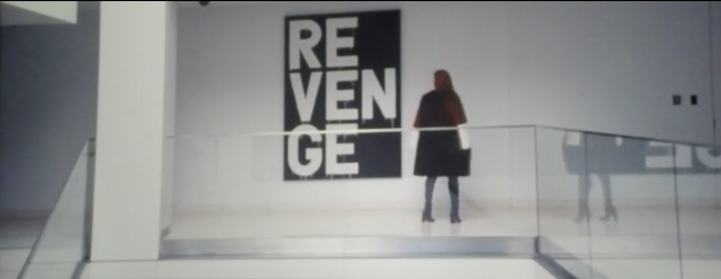
Cinema has always been a medium of symbolic meaning, and here that symbolism is pretty strong. It not only reinforces that this is a film about revenge but offers a suggestion for how we should look at the act. Not as a singular thing, but as something fractured and protracted.
It may not seem all that climactic that Edward stood Susan up. But Susan is miserable. Her marriage sucks. We see she gets no joy from her job. She doesn’t sleep. Her daughter is off somewhere. It feels like she isn’t living in a house so much as a mausoleum. The one moment of joy we see her have is when she thought her and Hutton might go to the beach. Then Hutton shuts her down and leaves for NYC to spend time with some other woman. Because Susan’s life is so miserable, she ends up seeking refuge in Edward’s novel, because Edward’s novel is a connection to Edward, which is a connection to something outside of her current life. That’s why we get those flashbacks. She’s caught up in the nostalgia of her relationship with Edward, what had been, what could have been, and what wasn’t.
So when Edward agrees to meet Susan, that’s like…the first meaningful thing that’s happened for her in the movie. We can tell she’s hopeful. Through her flashbacks, we know she saw Edward as the nice guy, the sensitive soul. After she’s spent around two decades with Mr. Business Man, building this empty, debilitating life—Edward is such a promise of warmth, of humanity. And here she’s read this book that is so obviously about how much the loss of her crushed him. That means he must still love her, right?
So as she puts on her green dress, puts on the make up, prepares to go meet Edward, she must have such a sense of hope. But beyond that, satisfaction. Early in the movie, she tells Hutton that Edward never re-married and that’s sad. We can tell she pities Edward. He loved her. She left him, broke him. In her mind she’s always had power over Edward. She even inspired this great work of fiction, a book dedicated to her and her alone, even titled after the nickname she had because she could never fall asleep. She must think she’s going to do Edward a favor by having dinner with him.
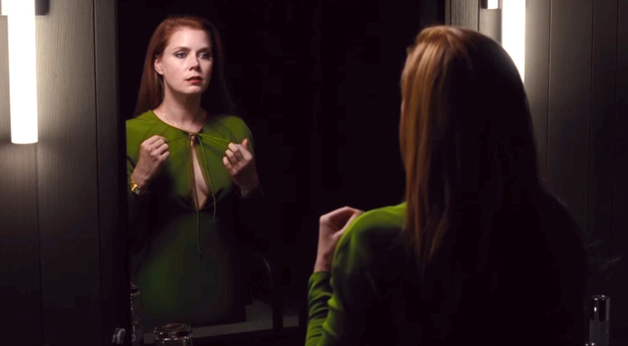
Imagine the ego boost that must have been for her?
If, at that dinner, Edward had told her to run away with him…she might have.
Except Edward never shows up. And that crushes Susan, because it destroys the fantasy she had. The one where she still meant something to Edward. Where she still meant something to anyone. Without Edward she has no one. At least before he reached out to her, she could think to herself that, no matter how bad things were with Hutton, at least one person out there still desired her.
With that context, Edward not showing up is actually brutal. It’s not the physical act of vengeance most of us crave. It’s the much more diabolical mental and spiritual fatality, that “I’m going to take away every last bit of hope you have and leave you with absolutely nothing so that life has no meaning to you whatsoever. F*ck you.”
And that’s where we get into what’s probably the more complicated dynamic of the final scene.
Through Edward’s arc, Nocturnal Animals gets at the role emotion plays in creating art and the role creating art plays in emotion.
When Edward was happy with his life, his writing was, according to Susan’s judgment, mediocre. And it seems from the success she eventually had in the world of art that she had a strong eye. After Susan destroyed Edward’s heart, he used that pain, transmuting the very common and mundane acts of infidelity and divorce that happened in NYC into a thrilling revenge narrative set in West Texas. That’s the inspiring role emotion plays in creating art.
After writing the novel, Edward sends it to Susan, the first communication they’ve had in years. He felt empowered to do that. He felt so empowered that he then stood Susan up. Where Susan saw the book as a statement of how much Edward still cared about her, the novel was actually a sign that Edward had finally come to terms with what had happened between them. All those emotions inside of him became words on a page. That’s the cathartic role creating art plays in emotion.
Creating art draws from the abstract and ethereal and complicated sea of emotion inside of us and pours that emotion into a form outside of us. That’s one of the powers of art, to help us not only process our emotions but to get rid of them. It’s like when you finally take the time to do the dishes that have been piling up, to take out the garbage, wash those clothes, and throw out some of the things you know you haven’t needed or wanted for years. After doing those things, the sense of relief is massive. You feel a weight is off your shoulders and your home looks better and feels better to exist in.
Except Susan doesn’t have that. Multiple times, Susan says that she isn’t creative, that she can’t create. That’s why she switched from being an art major to art history. That’s why she manages a gallery and helps other artists. She can’t express her feelings. All of her fear, her pain, her stress, etc., it all stays inside of her. When it became too much with Edward, she bolted for Hutton. And even though she has all this money, all this success, she’s miserable. She has no means of catharsis. For anything she feels. That’s the equivalent of never cleaning the dishes, of never taking the trash out, and never washing clothes. What would that home look like?
This is why she can’t sleep, why she is a nocturnal animal. There’s too much on her mind.
So where Edward could work through his emotions and find, eventually, closure…that probably won’t happen for Susan. In all likelihood, things will not improve for her. Which makes Nocturnal Animals an existential revenge film. Edward doesn’t physically hurt Susan. He just destroys any hope she had for her still finding happiness.
Alonso was right to say Nocturnal Animals “packs a punch”. It’s as much a story of triumph as it is annihilation of heart and soul and psyche. That does take time to process, to unpack and appreciate. And that’s why the first quote frustrated me so much. There’s nothing glazed or remote or barely human about Nocturnal Animals. It’s dealing with the core of what humanizes and dehumanizes us, of the forces that erode and those which heal.
Update: The Concept of Forgiveness
I talked with my friend and fellow film fanatic, Jo Ro, and she made a great point about Susan, one that Vela Roland and Shakira Wade also discussed in the comments (see the bottom of the page). I had completely missed the concept of forgiveness and closure in Nocturnal Animals.
It’s funny because there’s an interview Tom Ford did where he said that he thought the film’s ending signified change and hope for Susan. At the time, I had laughed because it seemed ridiculous. I had already written this article about how tragic the end was. I had legitimately thought, “If that’s what Ford was going for, I don’t think he hit his mark.” But then talks with Jo and comments like Vela’s and Shakira’s really echoed what Ford had said.
I had initially viewed Susan reminiscing about the rise and fall of her relationship with Edward as a means of romanticizing what they had in order to transition from her dead life with Hutton to a rekindled love with Edward. I saw it as an act of an unhappy person who operated like a hermit crab, moving from one shell to another. That’s why the end of the movie would be so tragic—Susan now had no where to go. Hutton didn’t want her. And the first love she thought she could recapture: also a no go.
But the reminiscing isn’t just romanticizing the past, it’s understanding the pain you caused someone and feeling guilty about that pain. In that context, Susan isn’t reaching out to Edward for validation or hope for a rekindled romance—all she wants is to alleviate the guilt. She doesn’t want to feel responsible for having broken him or ruined him. So her e-mails aren’t necessarily romantic gestures. They would be an olive branch. Same with the dinner. It’s not about her wooing Edward, it’s about apologizing, seeing he’s okay, and finding closure. The same kind of closure we see Tony trying to gain in Edward’s novel.
Edward not showing up becomes a bittersweet victory for Susan. On the one hand, it’s brutal because she’s been stood up. On the other hand, it’s Edward’s first relatively cruel act to Susan. He had the confidence and the backbone to stand her up. He wasn’t weak. As petty of an action as that is, it’s a strong action for Edward to take and something that Edward 20 years ago would have never done. Add this in with him having written a novel Susan found impressive…and it seems like Edward has moved on to a new chapter. One where he doesn’t need her. The assumption here is that Susan can forgive herself, because even though she hurt Edward, she didn’t destroy him. He’s alive. He’s writing. He’s confident enough to stand her up. That’s enough for Susan to find closure in what happened between them. No longer worried about her past, Susan has the potential to focus on improving her present.
I think most of us can relate to that on some level. Forgiveness and closure, together, can be great. But getting forgiveness doesn’t always mean you get closure, and getting closure doesn’t always mean getting forgiveness.
Update 2: Romantic Interest?
After my first update, Barkley Obar commented about Susan removing her wedding ring and still dressing up for her dinner with Edward. Barkley saw these as signs of romantic interest, not just in forgiveness. I agree with that.
In the first Update, I had meant to show there’s an argument to be made for reading the end as Susan dealing with forgiveness and guilt. Instead, it seems more like I changed my stance entirely. Not the case. I think the truth is somewhere between my initial woo-and-doom scenario and the guilt-forgiveness situation.
I think if Edward had shown up and been his charming self, told Susan he still loves her, asked her to leave with him—she would have. I think she did have expectations that something could happen between them. But reality dashed that hope. Edward is done with her. His “you can’t get it back again” line proved prophetic. Yes, Susan would be saddened by this and hurt by this, however I no longer see her as totally doomed. I think she does have a better sense of closure, and while Edward hasn’t forgiven her, the novel puts to rest what had transpired between them. I think she probably does feel a weight off her shoulders. With her wedding ring removed, we could extrapolate she’ll leave Hutton and draw on some inner strength she’s denied herself because of her guilt? Or she could still be doomed. I’m okay with the vagueness because I think that’s part of interacting with art—we supply some of the meaning. Depending on your own life, you could read the end as hopeful. You could read the end as tragic. You could think Edward killed himself and Susan will do the same. The important thing at this point isn’t the right answer. It’s your answer. And the fact that the end could mean something new and important to you every year of your life. That’s pretty cool.


I love your review! Thank you so much for taking the time and writing down all your thoughts. It really did shed some new light onto the movie for me. I have three things I’d like to add:
I believe that Edward gave Susan closure and forgave her in a way. What he did, shook her. It woke her up. It showed her that there is nothing left for her and it’s her obligation to change her life. Nobody will be coming. Nobody will change her life for her. Nobody but her. It’s time for her to wake up and start reaching for those dreams if she is so unhappy. Time to step out of her comfort zone. In a way, he did her a favour in making her realise that nobody will be coming to aid her.
I think Tony dying in the end could be symbolising Edward finally setting himself free from Susan and killing that last part of him that longed for her. This part of his life is over, his alter ego Tony is dead and Edward is set free.
In addition, what is most cruel is that Tony’s wife and baby girl are being taken from him. They are killed. In the case of Hutton, he takes Edward’s wife Susan and his unborn child from Edward. He supported Susan’s decision to abort and probably persuaded her even if the marriage already had been in pieces and Susan probably made the finally decision herself, Edward believes that it is partially Hutton’s fault who took this future from him. Tony’s daughter was the child Edward and Susan never had the chance to have but Hutton and her did.
I’m glad it helped! And, yeah, I agree with all of those thoughts. There’s so much symbolism. It’s awesome.
Wonderful article Chris. Well put.
I have a bit of a different take on this. I agree Edward was writing him as Tony, BUT I think he was working through his loss of Susan and his child she aborted (can’t believe how many people missed that!). His wife in the novel was a clear representation of her and they had a child. Crazy “nocturnal animals”, which is what he called her, took them from him.
She is realizing while reading the book just how badly she hurt him (which I believe was his intention) and that she in fact turned out just like her mother and as her mother said she would. She leaves him for an alpha male and pretty things and even she looks shocked, as if she’s realizing for the first time that the painting of the white guy aiming a rifle at a Hispanic man is racist af.
She may think Edward has forgiven her, is still interested in her or at the very least values her opinion. In truth I think he sent her the manuscript for his own closure. Like,, look how bad you hurt me, I worked through it AND wrote a great novel! And on top of that stands her up as if to say, You REALLY thought I would wanna see YOU hahaha.
I just saw the movie and have a theory about the daughter who she calls. My theory is that the daughter phone call was a dream (but quick since it’s someone who doesn’t sleep).
Susan is the reader so she gets to imagine what the mother and daughter look like. Naturally they’re all redheads. When Susan calls her daughter, it is after the scene when Tony’s wife and daughter are found dead. She calls her daughter, who just happens to be laying naked on her side in the exact same position as the dead daughter in the book. Throughout the movie Susan denies that anything is wrong in her perfect life (e.g. catching her husband cheating on her but believing he’s just tired and denying everything she’s told her friend at the party “I shouldn’t have told you. I’m embarrassed.”) So she convinces herself that the abortion never happened and imagines her and Edward’s daughter not dead but away somewhere. The daughter says something that reinforces this to me: “I was asleep and you woke me up.” She “woke up” the memory of a dead child that she hadn’t thought about in years.
Also, nothing about her and Hutton’s life together gives any indication that they would have had kids (that house, for one).
This was so well written and articulated. Thank you for the perspective shared here.
I don’t know if this has been mentioned but there is a scene when Susan first comes home after her gallery showing. Her gate closes then a car drives up, the same car Edward drives in the novel alluding to Edward delivering the manuscript to her house himself.
The effort Edward puts into the novel, dedicating it to Susan, personally delivering it makes it seem like his feelings are still very strong but the now the flip side of the coin. It reminds me of the saying it’s a thin line between love and hate. “These emotions don’t displace each other, but rather coexist together.” Imo Edward hasn’t let go, he’s attempting to kill these emotions but is left only with revenge by holding up a mirror to Susan’s life and showing her how miserable she is and how it could have been different. In the end he’s able to hurt her as she hurt him.
But this also begs another question; how do they know about each other’s lives? They both seem to be keeping track of each other ie not able to fully let go.
It’s an interesting movie. There are few ways of interpreting it. It’s stayed on my mind unlike a lot of movies these days. I find myself rooting for them both to find happiness.
Well written analysis, thanks for sharing!
Personally my theory was that Tony was in an accident that’s why he didn’t show up, I’m a sucker for happy ending so that’s what I choose to go with :p
Susan was a bad person.
She wanted to meet with Edward in order to assuage her own guilt, some tepid effort to show herself that she was not the bad person. I have seen this with so many women it’s not even funny, anything that the generic majority female can do to delude themselves that they are not the self-absorbed, selfish, semi-amoral person that they actually are.
Most human beings are pathetic herd animals, and this is doubly so for females. Shame is when other people judge you and women hate to be shamed by anyone because it is the first step in being excommunicated from the group.
I’ve watched this movie again just recently and I haven’t read all the comments here so my apologies for any redundancy. I have several thoughts about this movie but one that hits me this time around is how much Edward and Susan are still in a relationship. To me, standing her up shows how much Edward still carries so much strong emotion about Susan. She remains a huge part of his life. If he had truly “gotten over” her and if the book was truly a cathartic release, why not meet her at dinner, show her how successful he is, and how much he has moved on? The fact that he doesn’t makes it clear to me that he has NOT moved on. Remember that Susan commented that she called him once maybe not all that long ago and he hung up on her. To me, Edward’s book is testimony of not only how much he loved her and how devastated he was by their divorce and abortion, but how much he still loves her. The book is all about Susan. It screams I loved you and I still do. To me, the ending is interesting in that both act in ways to betray the fact that each continues to have strong feelings for the other. Susan shows up and Edward does not. Both acts reveal their connection to each other. Also they both act in character. Susan has the courage to show up but does Edward betray continued weakness by not doing so? To me, the movie stops, but their relationship is far from over. Does this mean I think there can be a reconciliation? No, especially when considering the abortion Susan has. I’m not sure any relationship can recover from that kind of betrayal the way Susan did it. To me, that’s why this element is so important in this story. It’s one thing to betray someone for someone else. There can be room for reconciliation, maybe even among the worst kinds of betrayal. But it’s far, far, far more devastating when the loss of a child is involved. There’s no recovery from that. Still, this relationship is far from over.
Could it be argued that the book is Edward’s way of reaching out to Susan? His book certainly stokes the fires of their relationship, doesn’t it? It draws Susan in, doesn’t it? Edward shows us that he knows Susan so well and he knows how to draw her in, doesn’t he? But, how can he know this after almost 20 years? Maybe he doesn’t and maybe he’s simply hopeful that he does. Or maybe their connection was so strong that he just knows even after all of these years. Maybe he writes the book in an attempt to ultimately betray her, but doesn’t his attempt betray his own continued strong feelings for her?
I could write more. I still don’t understand why Tony(Edward) remains in hiding when those guys go looking for him. And how can he go take a bath when he doesn’t know what’s happened to his wife and daughter? And even though time has passed, he’s clean shaven? Is Edward admitting weakness in this characterization of Tony? Or does Edward write it this way because he knows Susan would expect the Tony character to act this way? I’m not sure. I just thought the characterization of Tony leaves as many questions as answers. One thing I think that may bear remembering is that the dramatization of Edward’s book is simply from Susan’s perspective. It’s how she interprets the book as she reads. She imagines Edward as Tony. She imagines Tony’s wife looking much like her. But is this how Edward wrote it? But maybe this perspective is incorrect. I have to think more about this.
I just want to add that, when reconsidering the abortion, it really was Susan’s choice to do with her body what she wanted to do, right? Maybe the betrayal is in Susan not informing Edward, but it is still her choice. She decided she did not want to have a baby with Edward at that time.
In the end, I’ve always had a hard time with Susan being the villain in this relationship any more than Edward. She definitely hurt him and maybe made some (huge?) mistakes, but is she any less human and more faulty than Edward? Her mistakes were made almost 20 years ago in a much more youthful age. Who hasn’t made their share of mistakes back then? Again, I’m not sure Susan is any more a villain than Edward.
Thank you-this was really helpful!
I have been reading posts regarding this topic and this post is one of the most interesting and informative one I have read. Thank you for this!
Hey, I loved your analysis of this film and I thank you for giving perspective. The art vs reality theme is what I will playing off of and there’s so many comments that I don’t know if another person may have mentioned.
When it comes to art vs reality concept, I want to focus on reality. When Susan and Edward are talking in their flash backs, she always mentions she lives in reality as opposed to Edward who believes his method of expressing creativity is fantasy of the real adversities they may struggle financially. Seeing Susan depressed in her life is her reality and reading Edwards novel is like her diving into the whimsical nature that plays to her claimed sinisism( or however you spell it) and even she remarks it as “grueling”. Edwards writing is artistic and cunning in the fact she is reading something so enticing to her taste in art he bites into her mind to live in art to escape reality. Following the email exchanges, as you said initially she is living in a fantasy the moment she gets dressed to see him. When he doesn’t show up, Edward not showing up erases her fantasy just as her telling him “this isn’t practical and you working at a book store and writing is mediorcre. I live in reality” (paraphrased). Home girl moved her whole life live in his romanticized version of their life and it ended very sadly. Him not showing proves to her that he is in control of his life and path, his reality. Since she stopped believing in them being together, him planning on not showing up ends her own fantasy and almost has the touch of “isn’t this what you wanted”. As soon as she realizes my mans was not going to come, she stays to live in fantasy, the hope, superman will come through the doors to save her from reality as he did before. Her mundane reality is so sad, she clings to the hope it will happen, even though she knows it won’t. I can make this assertion because of the motions of the camera to the bourbon and her face is knowing he won’t but her staying is wishful thinking. Normally people just go. And this wishful thinking is how you say “bittersweet” because at least waiting is hopefully and the only place she has a chance at happiness. There’s hope for her in the moment, it’s better than going home because after all, what’s there.
Anyways this is how I perceived the notion of reality in this film. Thank you for this piece, sorry for the typos if any. 🙂
What a great comment! Yeah, I think you nailed that. Once she goes home, it’s over. Which leads to the question, does she go home? Will this be the breaking point for her and Armie Cannibal? Or will she just drift on in her sea of sadness?
Just saw the film and went to look for some interpretation as to what happened at the end.
With all due respect to Tom Ford’s opinion that the end signifies new hope for Susan, my view is that the end signifies the negation of all hope.
I love American movies because they almost always end on a happy note where the good guy wins and true love triumphs over all adversity.
This is not a typical feel good American movie; it is a cautionary tale to not forsake love since without love there’s no life worth living.
If Edward’s novel is a metaphor for Edward’s life then I only see utter despair for Susan; and not only for her, but also for Edward.
For Susan, the reason for the despair is obvious. There’s no hope for her because while she regrets what she did to Edward and to their unborn child, she never repents of her infidelity, divorce, or abortion; she admits that what she did was wrong but she never asks for forgiveness for those things; in fact, she characterizes her actions as unforgivable which is to say she condemns herself to the hell that her life becomes; a marriage devoid of charity (love), faith (trust), and ultimately, when Edward fails to show up for their dinner date, hope.
In the novel we see that Tony’s (Edward’s) simple, happy, and hopeful life is devastatingly destroyed by Ray (Susan) when the latter abducts, rapes, and kills his wife and daughter; leaving the former not only grieving but also enraged, ashamed, and guilt ridden at his own emasculation. Even after Tony exacts his revenge against Ray, Tony is left not victorious but wounded, blind, and lost and ends his own life. Tony will never again have the marriage and family he once had; neither with his dead wife and daughter or with anyone else. He was too damaged by what happened to him; he will never love again. After he takes his revenge his life is over. I do suspect that Edward committed suicide.
Susan’s betrayal of Edward’s love is devastating but what ultimately leads to their mutual hopelessness and utter despair is her inability to ask for forgiveness and his inability to extend it.
I think all of that is a very viable interpretation and very well said!
I came upon your article and enjoyed all the interpretations. I love movies that leave me thinking days or years later. This is one of them. My view : When we find out the daughter died and we see her positioned like a painting on the couch in the middle of a junk yard that is the same position we see her in when mom calls her in real life. I don’t believe there is a daughter. I think she is calling on the daughter she aborted years ago. She would be the same age. It is no coincidence that we never see the “real” daughters face. Her back is to us. Positioned like she was when she was found dead in the book.
All imaginary
Plus, Do you real see the current susan and her husband as parents?
Hey Gina! Susan and Hutton would make awful awful parents haha. I think regardless of whether the daughter is real or not, the important thing is the sense of distance we feel. If the daughter is real, look at the state of their relationship. And if the daughter isn’t real, look at what she gave up to be with someone who doesn’t actually love her. Either way fits into Susan’s arc.
Great read! I first saw this movie in 2018. I too had to look up the meaning of this movie. I did see how someone compared the daughter dying violently and being ripped away from Tony, to Susan getting an abortion and taking their child away from Edward. It shows in the movie where she feels the pain when she reads about the wife and Daughter being found dead. Which is why she calls her daughter to check on her.