Newsletter Subscribe
Enter your email address below and subscribe to our newsletter
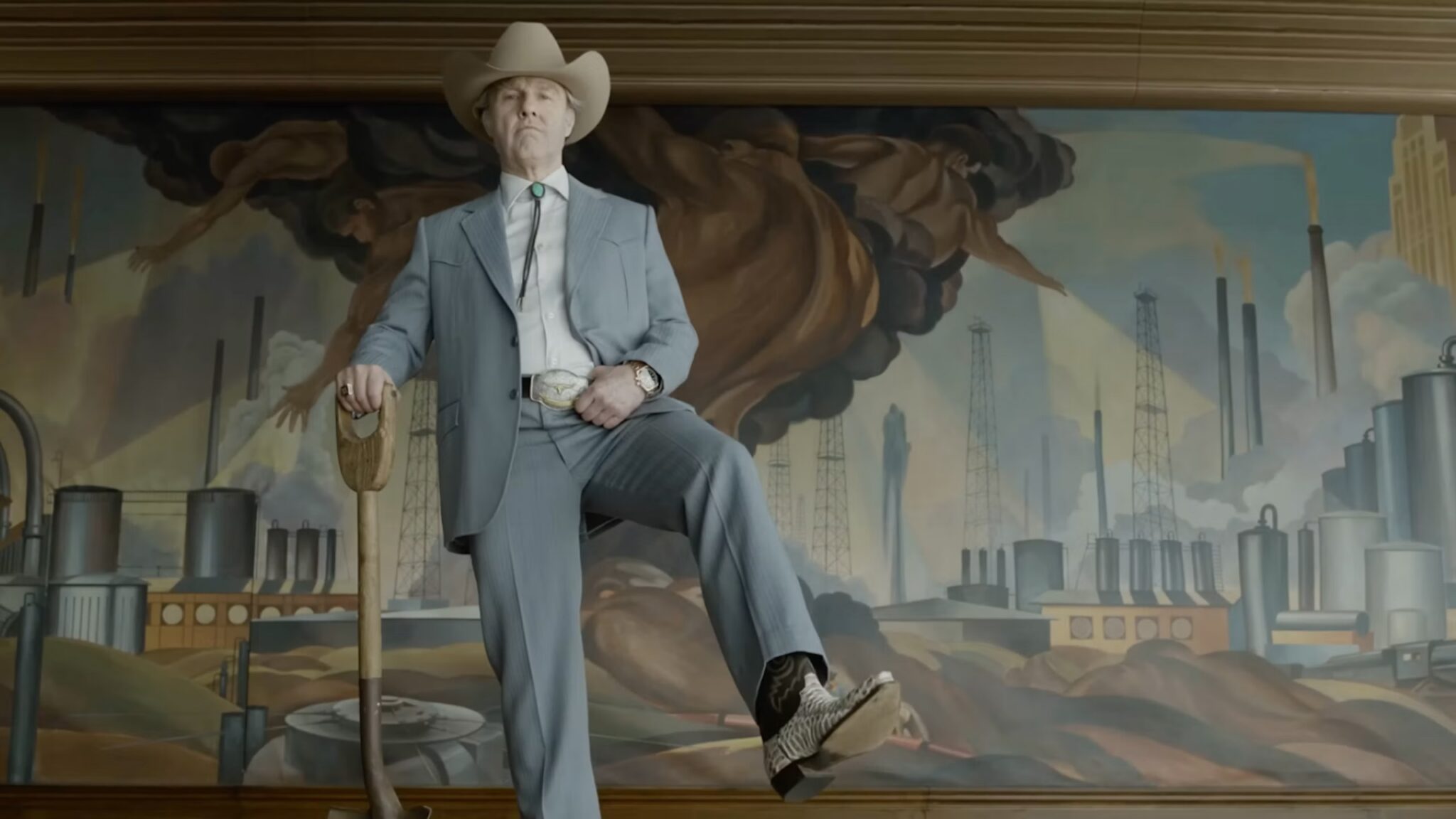
Digger ends with a “Level Four” warning interrupting the audience’s ovation for the preview of Fossil Fools. In response, everyone puts on their Lungz-brand breathing masks, then files out into post-flood, dystopian Manhattan. Melanie Safka’s “Look What They’ve Done to My Song, Ma” plays. Another “Level Four” announcement cuts off Safka’s singing. Then all we hear are the sounds of nature.
I’ll explain what’s going on in the world before getting into what’s going on thematically.
We already know that Fossil Fools is a dramatization of “real” events. In the film’s world, Judy really broke off and hit Europe. Then Kimberly, aka Kremlin Nova, collided with Alaska.
What the play doesn’t tell us is just how bad things are in the long term. Are there parts of Europe and America that are no longer accessible because they’re underwater? Has the weather changed? What is the state of the environment?
Given that people put on the masks when they hear Level Four, it seems we can assume there have been air-quality issues. Maybe related to the amount of methane released from Greenland? Or the nuclear waste from Kremlin Nova. Or both. Regardless of what happened, the result is that the air isn’t always safe to breathe. And that’s a common enough issue that the city installed a warning system.
We know that people still travel by plane. Curtis’s daughter was trying to fly from Jamaica to New York.
The shots of the audience applauding the end of the preview tell us that people still wear clothes that are similar to what people wear in real life. Neither the fashion nor the personal style screams that people don’t have access to consumer goods. And Kenny talks about his wealth and security company. So it seems there’s still some form of functioning economy and workforce.
When the camera follows the crowd out of the theater, we see people without masks walking around and trudging through the water-filled streets. This implies some sort of classism still exists.
And there is a strong military presence. We see a soldier on the corner of the sidewalk. A large vehicle in the background. Then the camera pans over to an armored vehicle with another soldier standing watch. I would assume this is because the world is still shattered, so the military presence is to keep things from descending into survival of the fittest in order to maintain some semblance of civilization. But someone does throw a rock at one of the soldiers, so maybe there’s more of an us-versus-them dynamic than it seems.
Even though it’s the 25th anniversary of Fossil Fools, the street outside the theater is full of ruined vehicles and debris that I’d guess were the result of some aftershock from Judy’s collision with Europe or a secondary event from the Greenland disaster. So while civilization has continued, reminders of what happened abound. That would explain why the audience was so happy to cheer for Digger’s demise. It hasn’t been that long since everything happened, and the consequences are still part of everyone’s daily existence.
The key to understanding the thematic intent of Digger’s ending is in Kenny’s speech where he talks about why he’s funding the play.
Kenny describes how he saw the original run of Fossil Fools and how even with terrible production value, it still caused the entire audience to stand up and cheer “ferociously”. He wasn’t embarrassed, humiliated, or angry about strangers reacting this way to his family. He “stood up and cheered right along with them, sharing their anger, part of the mob screaming for my family’s head. Satisfied. Absolutely satisfied.”
And that’s why he’s brought Fossil Fools back to life. He wants it to “convince people to brave those streets out there and witness this human-made theater play, to come to this abandoned space that we rescued and restored for people to get together again.” He wants to “remind people that it happened, because we were all oblivious when it did. Amused to death, absorbed in our pointless arguments, enthralled by our own opinions.”
The filmmaker, Alejandro Iñárritu, is using Kenny to make a statement about our real world, right now. In the fictional world, the tragedy has already happened. And Kenny makes it clear it wasn’t just Digger and the other elites in charge who failed. The public let incompetent leaders go unchecked because people were too busy arguing over inconsequential things. The audience watching Fossil Fools will leave the theater and return to their bleak, devastated world.
But the audience watching Digger will leave the theater to a world that’s yet to suffer such a catastrophe. It’s nice to think something like that will never happen, but there’s no guarantee. Digger is a reminder that our lack of concern is what makes catastrophe possible.
Iñárritu told an interviewer, who is younger than him, “This film is about your generation. You’re dealing with people taking the narrative and telling you that everything is fine, when you guys know that everything is not fine. You are being bombarded with narratives all day. Powerful people are controlling the narratives for their own interests. You have to decide which story you want to tell yourself.”
The Level Four announcement at the end of Digger is more of a warning to you and me than it is to the audience in the theater. That’s also why we hear Melanie Safka’s “Look What They’ve Done to My Song, Ma”.
Look what they done to my song, ma
Look what they done to my song
Well it’s the only thing
That I could do half right
And it’s turning out all wrong, ma
Look what they done to my songLook what they done to my brain, ma
Look what they done to my brain
Well they picked it like a chicken bone
And I think I’m half insane, ma
Look what they done to my song
In the context of the film, as we see the audience leave the theater and walk the streets of this ruined world, the line “look what they’ve done to my song” feels like a request by the film to gaze upon the aftermath of Digger’s actions. Look what these guys did.
Iñárritu’s mourning the abuse of power that leads to something like this, warning against it. And he positions Kenny and everyone involved in the play as attempting to repair the song through art.
Then the Level Four announcement blares again and cuts off Safka’s singing. The music doesn’t resume. Notice how the same thing happened with the crowd. They were having this hugely cathartic moment, celebrating the show, then the announcement ended all of that. Whatever they were in the midst of feeling and sharing yields to the reminder of the disaster.
This mirrors the Judy event. The world was humming along before the ice shelf detached and slammed into Europe, interrupting everything. Eventually, some disaster will be the ultimate interruption, an extinction-level event.
I think that’s why Digger ends with the sounds of nature instead of Safka’s singing. We’re really hearing the absence of humans. That makes the line “Look what they done to my song” a haunting statement, as it’s no longer about the song but about us. We’re the song.
Iñárritu’s also making a statement about the importance of art. He does that through Kenny’s declaration about the role art plays in society. It transforms spaces, brings people together, and allows us to find catharsis for events that happen in our lives. Whether it’s a global catastrophe that touched the lives of everyone in the theater or something that speaks more to the overall human condition and experience.
Digger positions art as crucial rather than mere entertainment or a distraction. It’s through art that we connect with others and our own emotions. It keeps history in the present rather than lost to time so we don’t forget what’s happened and end up doomed to repeat it. Art plays a role in a healthy society.
In that way, Kenny’s revival of Fossil Fools is a means of healing. Because even though the people leave that theater and return to the terrible world they now live in, it’s more bearable, at least for a little while, after experiencing the play.
We have another Iñárritu quote, from the same interview, that reinforces what I’m saying. “The film’s about storytelling. It’s about the stories we tell ourselves, the futility of art, and the importance of art as a way to explain ourselves when we’re dealing with so much reality. Theatre is a way to represent reality, and that representation is sometimes more real than reality because it allows us to see ourselves—and laugh about ourselves.”
When he says the “futility of art,” I take that as referring to the limitations of art to have a real political impact. Art probably won’t galvanize someone like Digger to act responsibly. Leonardo da Vinci’s Mona Lisa won’t prevent a war. But it’s important for other reasons.


Film Colossus Supporters get access to the Frameshift and Active Viewing courses, an ad-free site, the Watch More Films newsletter, and the ability to request movies for analysis. Your support also directly keeps Film Colossus alive while I try to scale it into something sustainable, as it's just me, Chris, who does everything here.
Or create a free account. You gain access to the Active Viewing course and Watch More Films.
Join the Film Colossus community, get the newsletter, and unlock member features as they're added.