Newsletter Subscribe
Enter your email address below and subscribe to our newsletter
If you have plot questions about The End of Oak Street, this is the article for you. I’m going to address as many of them as I can. If you still have a question, leave a comment at the bottom of the page. I’ll answer.
For the thematic analysis and deep dive into Oak Street‘s deeper meaning and ending, click here.
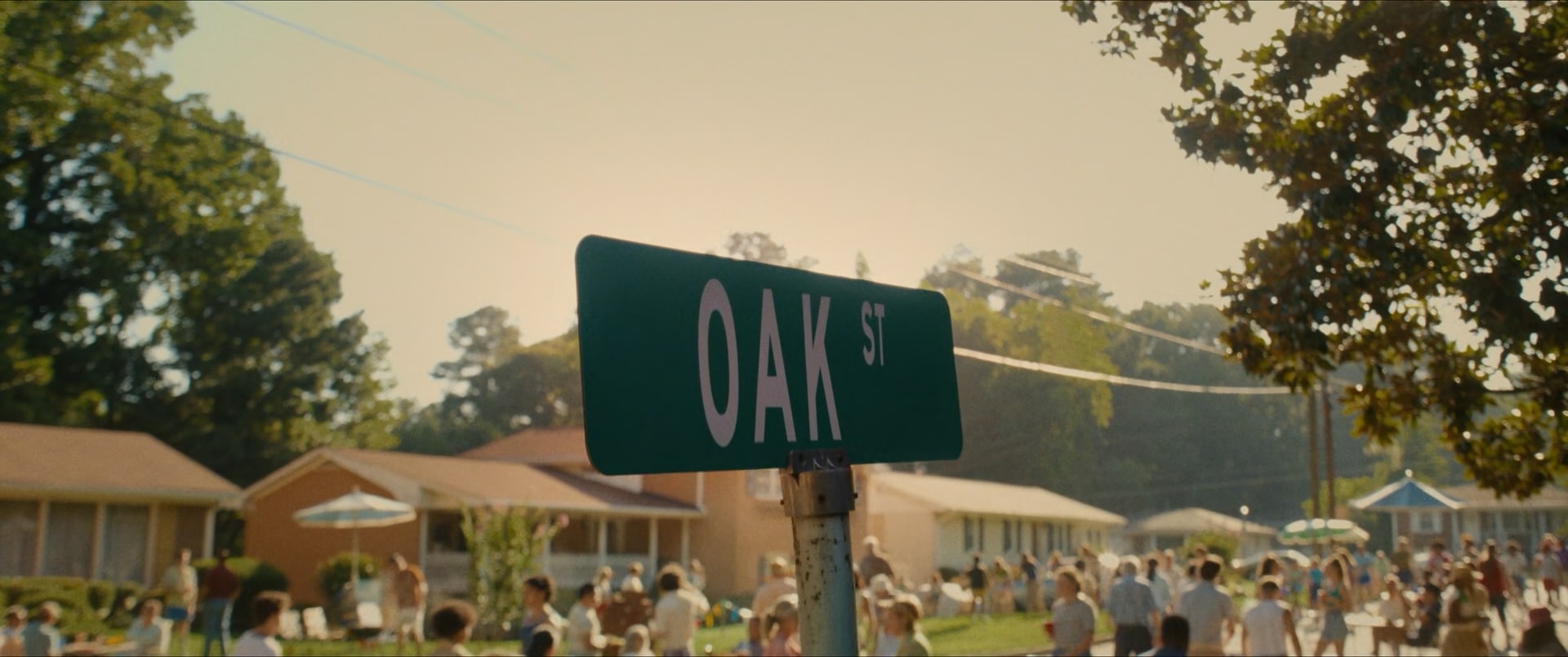
Oak Street takes place in 1982, in Flowervale, Michigan.
In the early scenes like this, movies often use dialogue to establish core concepts and ideas. So the neighbor tells Greg, “You got a great family. You’re a lucky man,” so the film can anchor the audience to the idea that Oak Street is focused on Greg’s family. Superficially, it does seem like Greg has a great family, right? Except in the very next scene we see there’s more going on, that everything isn’t as idyllic as it seems.
Carl Sagan really did teach at Cornell. He passed away in 1996, at the age of 62. He was a science rockstar who walked the walk and talked the talk. He was an important advisor to NASA for over 30 years, was a pop culture figure, and his TV documentary, Cosmos: A Personal Voyage, set viewing records.
In modern times, Neil deGrasse Tyson is the closest comparison, but there’s a huge gap between them. Carl Sagan contributed seminal research to understanding the atmospheres of Venus, Mars, and Titan (Saturn’s moon). Tyson is an astrophysicist with some research under his belt, but nothing like what Sagan did. Tyson’s achievements are more to do with the work he’s done to keep astronomy and science in the mainstream zeitgeist.
We see Audrey talking to her friend about what they’ll do after high school. Then the friend’s boyfriend walks up. Audrey has this look on her face that makes it seem like she either likes the guy or is just really forlorn about being single.
Again, this is another moment where the film’s setting up a larger idea. Audrey’s character arc deals with her orientation, the loneliness of being LGBTQIA+ in the 80s, and the build up to her relationship with Jeannette.
Oak Street isn’t as interested in Brian as a character, but notice that right before this scene with Audrey we see Brian tell his mom that “You can’t leave Starbuck at home.” Later, during the whole dinosaur debacle, Brian’s once again committed to not leaving Starbuck behind. All of these moments are there to set-up what happens deeper into the film.
Greg hasn’t told anyone that he lost his job. So he’s working as much as he can so Denise and the kids won’t feel the loss of income. What he’s not realizing, though, is that they feel his loss of presence. That’s exactly what Denise brings up when she says, “We agreed we needed a family day.”
This is the twist on the earlier scene where the neighbor tells Greg he’s a lucky man. As happy as the family looked to the neighbor, we now see that’s not how they always are. Denise and Greg are actually on the brink of divorce. They think they’ve hidden that fact from the kids but the kids see it plain as day. So as much as everyone tries to keep up the appearance that everything is okay, it’s really not. That’s actually one of the main themes of The End of Oak Street.
We hear someone on the radio say NASA is tracking unusual ripples in space that came from a solar flare. When these ripples reach Earth, they create wormholes that start sending things to and from different points in time.
Denise tells her editor-neighbor that the story she’s written isn’t really about her. Except we know that it is. She’s unhappy with Greg and just brought up divorce to him in the previous scene. So when we hear she’s writing this novel about a wife-and-mother who keeps her suitcase packed in case she wants to leave one day, we know it’s more autobiographical than it might seem to the editor. To the editor, Denise is this happy housewife with a great husband and kids, so the story really must just be fiction. But Denise knows better. For her, it’s a daydream, a way to escape the marriage before she’s actually escaped the marriage. That’s why she hasn’t shown Greg or the kids, because she knows how true it is.
So earthquakes have smaller foreshocks, the big mainshock, and then the smaller aftershocks. That’s kind of what happens in The End of Oak Street. There are the initial unusual ripples that cause some smaller things from the past to appear in Oak Street’s present. We see a few of these leading up to the big event that sends Oak Street into the past. The little portals that appear later in the film, the ones they use to get home, are the aftershocks.
It’s real but doesn’t exist today. It actually gained prominence after what’s known as the Permian–Triassic extinction event. While most plant life suffered in the harsh conditions created by an absurd amount of volcanic eruptions that essentially poisoned air, land, and sea, the Pleuromeia was pretty happy. Once the volcanoes calmed down and the climate became hospitable again, Pleuromeia couldn’t survive the new temperatures and increased competition from new and returning plants.
The first recorded fossil was found in 1830, in Germany.
There is a distant relative that’s around today: quillworts. But the quillwort is incredibly bland and looks nothing like Pleuromeia. It’s like when you find out that wolves and hamsters have a common ancestor. Imagine if wolves and all canines were extinct and all we had left were hamsters. That’s Pleuromeia vs. quillworts.
But, really, the plant showing up is less about the story and more about the audience. The film wants to start teasing what’s to come and build anticipation. So they’re having these things show up to keep people hooked while they establish the family drama.
Brian is acting out because of the stuff going on between his parents. So when this other kid was riding by on his bike, Brian put a stick between the spokes and the kid flipped and broke his arm. Then Brian talks with such bravado by saying he’ll put an arrow in the kid’s big brother if the brother tries to get revenge. But throughout the film, Brian fails to use the bow and arrow a single time. So his character arc involves a lot of humbling.
I mentioned how a big theme of Oak Street is the appearance of things vs. the reality of things. The reality is that Greg delivers pizzas. But Denise doesn’t like the appearance of that. Typically, pizza delivery is thought of as something high school kids do. Not something a middle aged guy who has a career does. Denise cares so much about the perception of her husband and family that she asks him to take the pizza sign off the car, even though that creates more work for Greg.
We learn later that whatever phenomenon is occurring creates wormholes. The creation of those wormholes involves that bright light and other reactions (like the wind). Brian witnesses another foreshock. And the next day, we see what travelled through the wormhole and landed in the neighbor’s yard: a giant pile of dung.
I just wanted to point out that this is a standard trope from 70s and 80s movies. The younger teenage boy runs away from an older teenage boy who wants to beat him up. The typical use of the trope is that the younger kid is a protagonist the audience is supposed to root for. But Oak Street puts a twist on it because we know that the older kid is actually trying to get back at Brian for being a bully himself.
So the audience will probably initially root for Brian here since films have conditioned us to root for the main character. But, when you think about it, you remember that Brian’s actually the one who started this and hasn’t apologized and doesn’t seem remorseful. He’s more of the bad guy in the scenario than the kid chasing him.
After the mainshock occurs and the family’s trying to figure out what happened, Brian asks Denise why she was downstairs. She lies and says she was doing laundry. We know she was actually working on her secret novel where she leaves her family.
Again, another instance of appearance vs. reality. How things seem, how people present themselves, doesn’t always represent how things really are, who they really are. I’ll keep coming back to this again and again.
This may surprise some younger people, but prior to the 2000s, a lot of people kept their dogs outside. Dog houses were really common and people felt comfortable just leaving their dogs outside, either fenced in or tied up. Today, you don’t really see that as much. Oak Street has Starbuck outside like that because it’s accurate to the time period.
Mrs. Huddleston’s in an unfortunate situation. I mean, everyone in the neighborhood is. But the Platts’ house is interior, which is why they didn’t realize something had gone wrong. Mrs. Huddleston’s house was on the exterior of the transported portion of the neighborhood. So her backyard was up against the prehistoric jungle. Her house would have been one of the first ones discovered by the dinosaurs.
When Denise goes into the backyard, you can see claw marks on Mrs. Huddleston’s screen door and the upper corner’s damaged. So it seems like the dinosaurs just forced its way in, attacked, then left. I would guess the dinosaur was one of the raptors we see chase Greg in the next scene.
Denise seems like your average housewife. But we see how comfortable she is with a rifle. Instead of leaving the audience to debate whether that’s legitimate or not, and instead of forcing some exposition about her having a hunting background, Oak Street briefly shows a photo of Denise out hunting, holding a rifle. Now we have some background information that establishes why she’s so comfortable using a firearm. It’s a little detail but it adds to the worldbuilding.
Every 2026 movie I’ve seen, ranked. Became a dad, so catching up. Updated: October 17
We don’t get a concrete explanation. But I have to assume it’s water from their own pipes? With the whole neighborhood phasing as it did, you have to imagine that would wreak havoc on the utility infrastructure.
There is a caveat, though. Oak Street has an aerial wide shot that shows the entirety of the neighborhood and how this disc of land from 1982 has plopped into the middle of the Mesozoic. We can actually see that it wasn’t just the surface that made the trip but 100 feet of earth. Water pipes are buried only a few feet. So all the infrastructure would probably be intact?
When Denise and Greg first leave the house, they see a geyser shooting boiling water into the air. That would mean something had already broken through all that earth and reached the surface. So it’s possible the water in the basement is from the dinosaur world rather than 1982. But if that were the case, you’d imagine it would keep flooding but that doesn’t happen.
Honestly, I don’t think we’re supposed to think about it as hard as I’m thinking about it.
“Valerie” by Steve Winwood. It’s a love song where Winwood yearns for a woman named Valerie. Remember, during Audrey’s first scene, we saw that she was upset when she saw her friend and the friend’s boyfriend. So this moment brings us back to the fact that Audrey’s pining for some kind of romance.
We don’t see the full dinosaur. Just that it has a lot of hair. I’m guessing it’s one of the long necks that we see mating later. If it was a carnivore, like a spinosaurus or allosaurus, I think it would turn its attention to Mel on the roof. Instead, it carries on and it’s the pteranodons that tear Mel apart like that one scene in Neon Genesis Evangelion.
Kind of. She’s clearly living out the fantasy in her novel. But that doesn’t mean she would actually pull the trigger in real life. So I get why people wouldn’t hold that against her. Except she’s the one who brought up divorce during the block party. Is the novel just a bit of escapism for her or a way to build up her courage? If nothing had changed, I imagine she would have left.
Yup. It’s supposed to be a Titanoboa. The first fossil evidence didn’t appear until 2002, so it’s a relatively new discovery. Estimates put its size somewhere between 40 and 50 feet. I saw some dinosaur people on Twitter upset that the titanoboa in the film wasn’t visually accurate and so it shouldn’t be called a Titanoboa. But official marketing materials from the film refer to the snake as a titanoboa. So we’ll go with that.
It’s the largest snake ever discovered.
That, my friends, is a Spinosaurus. You may recognize it as the main carnivore villain from Jurassic Park III and also appeared in Jurassic Park Rebirth.
It seems coincidental. The brothers are looking for their mom. The older one probably heard Brian calling for Starbuck and took the opportunity to attack. But then he feels terrible about it so stops and leaves. The reality of getting revenge was way more terrible than he probably thought. Especially given the situation.
I appreciated how Oak Street handled this. Brian’s had his stupid bow since the beginning of the film. And he was the first one to see Jeannette and seemed interested in her. So when she yells for help and the siblings come across her struggling for her life against a raptor, the expectation is that Brian will finally use his bow and arrow and save the day, win the girl over, etc. Except he misses.
It’s Audrey who jumps the fence and runs over and drives the raptor away. She’s the hero who saves Jeannette. When Jeannette breaks down crying, it’s Audrey who walks up and comforts her. We get two shots of Brian standing at an awkward distance, observing.
This is another way Oak Street subverts the tropes and concepts from 80s-era Amblin-style films. Mainstream cinema from the 1980s presented life a certain way. That included heteronormative romance plots and mostly heteronormative characters. It was as if queer people and their stories didn’t exist. But they did. So Oak Street shows that as part of this deconstruction of that time period and the nostalgia people have for it. It wasn’t this simplistic, idyllic, homogenous time.
A stampede of dinosaurs causes Greg and Denise to hide in a car. While they huddle together, something wordless passes between them. It’s as if they suddenly remembered how much they love each other. It’s after this moment of genuine connection that the light appears.
In real life, that would be a coincidence. But in narrative art, especially narrative art inspired by 80s cinema, the light is a reward for the characters overcoming some internal hurdle. That’s part of why everything in the film is representative rather than literal. In reality, the family was on the brink of falling apart through divorce. The dinosaurs become the external representation of the internal problems. In reality, Greg and Denise would go to counseling or something and talk through their issues. But it makes for a more entertaining movie if dealing with the dinosaurs represents them working through their issues.
In reality, the hope is that everything could go back to how it was before Greg and Denise started fighting so much. In the film, that’s what the wormhole represents: a return to how things were. That’s why it follows this moment where the couple seemingly mends whatever had broken. Emotionally, they’re ready to return to being a happy family. So the movie now gives them a way to return to being a happy family.
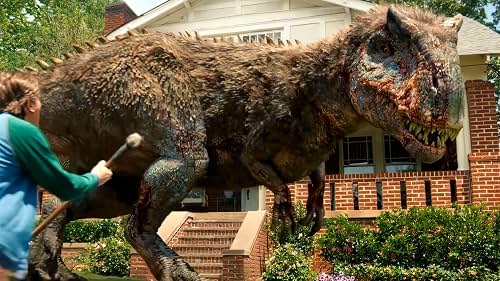
Nope. It’s the underrepresented Allosaurus. What’s crazy is that while the Allosaurus looks similar to a Tyrannosaurus, they aren’t really related. During the Triassic period, a family of two-legged carnivores emerged. They started growing larger. By the Jurassic period, you had a split between two-legged carnivore A and two-legged carnivore B. Allosauroidea and Coelurosauria. Millions of more years passed. The Allosaurus dominates the end of the Jurassic period. Dies out. Like 100 million years go by and we’re in the Cretaceous period and Tyrannosaurs come about.
It makes sense when you think about it, but dinosaurs got bigger between each period. So the Triassic dinosaurs were the smallest. Jurassic ones were medium-sized. And Cretaceous dinos were large. So Allosaurs would get about 15-feet tall. Tyrannosaurs 21-feet.
Probably not? But if you watch boxing matches, sometimes a hit to the bottom jaw turns the lights out. It creates a whiplash effect that causes the brain to crash into the skull. So Greg wouldn’t have to hit the Allosaurus around the forehead to knock it out. But, clearly, it wasn’t down for long.
Remember how we talked about appearance vs. reality? In Denise’s novel, she was able to fantasize about what it would be like to leave Greg. It was her idealized version of events. After Allosaurus eats him, Denise experiences the reality of what life is like without Greg. And it’s not at all like what she had imagined. It rocks her, shocks her, knocks her off balance.
Notice the shot we get of her once she’s back home. She sits at the top of the steps to the basement, holding a photo from their wedding day. The basement is where she was writing the novel, where she imagined what it would be like to be on her own, without him. It’s a nice way to acknowledge the thematic tension through a visual.
When Greg and Denise first encounter the Spinosaurus, it knocks their car into a house. The car catches fire and explodes. That’s probably where the blaze originated.
Denise did a lot of damage to it. Leaving was a matter of self-preservation.
They are Ornithosuchus. The name means “bird crocodile”. They were discovered late in the 1800s, in Scotland. Speculation is that they spent most of their time on all-fours but could and did walk on their hind legs as well.
It’s a plot contrivance. Starbuck reappears right when Brian needs him the most and to get the biggest reaction from the audience. If you want some logic, he was following their scent then heard Brian scream.
Plot convenience. You’d think, logically, that it would drop them off at the equivalent span of time from when they initially transported. So if it had been three days, they’d be three days in the future. But that’s thinking through things logically. The movie isn’t about the logic of the situation so much as what the situation represents: Denise making amends and showing gratitude.
Because the remaining Platts went back to the future, they now exist at a time when their past selves also exist. So the Greg who shows up with the pizza is Greg before they went back in time. That makes him Greg 2. He has no idea what happened to Greg 1 and that the Denise, Audrey, and Brian hugging him aren’t his Denise, Audrey, and Brian. I mean, they are but they aren’t. So Greg 2 ends up continuing his life with Denise 1, Audrey 1, and Brian 1.
They go back in time, without Greg, and have to face the dinosaurs. I’d assume they don’t survive.
But let me tell you why this doesn’t matter. Remember, the film represents a couple on the brink of divorce and how they work through it. So it’s not important if it’s Greg 1 or Greg 2. What matters is that Denise no longer cares about appearances and accepts Greg. Remember, she hadn’t liked him delivering pizzas. She didn’t like the appearance of it and didn’t like him leaving the family to go do that. But it’s because he delivers pizzas that she’s able to save him and reunite the family.
During their reunion, he says, “I thought you’d be mad at me for doing deliveries.” And she says, “Whatever you needed to do. It doesn’t matter.” That’s what I mean by acceptance. She realizes all the petty things that had been dividing them aren’t important when reduced to the binary of having Greg or not having Greg.
There’s a grounded version of this story where instead of an Allosaurus eating Greg, something realistic happens. Like, they clear the air but then Greg’s in a car crash and in the hospital and finally wakes up. Films like Sweet Home Alabama and Crazy, Stupid, Love have plots where a married couple separate, are forced to interact, start to fall back in love, then something happens that drives them apart again, only for the film to end with renewed love.
That’s what happens in Oak Street, it just exaggerates the story with dinosaurs.
So, yes, in the literal story, Denise lets Denise 2, Audrey 2, and Brian 2 all go to hell, essentially. But fixating on that misses the emotional vibe of what’s going on.
We hear a reporter on the TV say two years have passed since Flowervale disappeared.
Remember that it’s 1982 and she has 20 minutes before the neighborhood disappears. Maybe she had some phone numbers memorized, but we know she called some people Collect. That means calling the operator, probably having them look up the number, reaching the person, then convincing them to leave their home in the middle of the night.
Also, she had to call and order the pizza right away and hope Greg got there fast enough. You figure it might take three minutes for each phone call, at least. That would give her time for about six calls. She reached Greg, Mrs. Huddleston, Doris the librarian who sacrificed herself to save Denise from the crocodiles, and Mel. If any of those calls took four or five minutes, that’s all her time.
And if she had called the police or something, what would they have done? Could she have convinced someone at a news station to tell everyone to evacuate? Maybe. But would the people she cared about have seen the message? Probably not.
But, again, that’s thinking of this literally. Representatively, it’s more about Denise showing gratitude to Mrs. Huddleston and Doris, and mending the relationship with Mel. The point isn’t to think about everyone she didn’t save but the relevance of the people she did save and how they relate to her character arc.
Imagine, too, if Denise had called her house and tried to convince herself or Greg to take the whole family and leave. Maybe it would have worked. Jeannette certainly convinced her family. But maybe not. So she did a little game theory and manipulated the situation so Greg would come to them without having to explain that a wormhole was about to open.
At the start of the film, Denise is writing a fictional version of her life that allows her to escape. At the end of the film, she writes “the incredible true story” about what happened.
What’s the theme I’ve constantly harped on throughout this article? Appearance vs. reality. Appearances are often a kind of fiction. Think about social media and how someone presents their life. I’m pretty sure most of us know people who are in unhappy relationships but they post happy photos with loving captions that say “Love you forever, babe.” Or the person who uses filters in all of their photos because it makes them feel better about how they look.
The fiction is what almost ruined Denise’s marriage. Not just her fiction but no one in the family was being honest with one another. Brian was lying about the things he was doing. Audrey wasn’t open about her sexuality. Greg was hiding losing his job. And Denise was writing her secret novel. But the events of the film bring all of that out into the open. So Denise writing non-fiction represents that lifestyle of honesty.
We see Audrey in her Cornell sweater. But on the wall there’s a photo of her as part of the Cornell Astronomical Society, with Carl Sagan standing next to Audrey. Brian has a girlfriend, too.
Yes, 100%.
Yes, there are two Jeannettes at the end. Jeannette 1 successfully made it to her house in time to convince Jeannette 2 and her parents to leave with her. We see out the window that Jeannette 1 and Audrey are together while Jeannette 2 and her parents arrive.
Yes, that does imply that Denise could have saved Denise 2 and the kids. And maybe all of them could have coexisted.
Also, this feels like a nod to all the time travel movies that always warn that people from different time periods shouldn’t interact. There’s always that concern that it would destroy the space-time continuum by creating some paradox. It’s one of the main rules of the Back to the Future franchise. To me, the two Jeannette thing is a direct nod to that trope and another example of subverting social and cinematic norms of the 80s.


Film Colossus Supporters get access to the Frameshift and Active Viewing courses, an ad-free site, the Watch More Films newsletter, and the ability to request movies for analysis. Your support also directly keeps Film Colossus alive while I try to scale it into something sustainable, as it's just me, Chris, who does everything here.
Or create a free account. You gain access to the Active Viewing course and Watch More Films.
Join the Film Colossus community, get the newsletter, and unlock member features as they're added.