Newsletter Subscribe
Enter your email address below and subscribe to our newsletter

Nickel Boys is a tragic story that’s ultimately about perseverance and inspiration. If you want to understand the movie on a deeper level, you’ve come to the right place.
Think of what happens at the Nickel Academy as a microcosm of America. It’s a classic storytelling technique: you shrink the scope of the story down to something far more intimate but use it as a metaphor for the larger whole.
That’s why the time outside of Nickel Academy is important, because it establishes the state of the nation. It also shows us Elwood’s early protest efforts and his love of Martin Luther King Jr., two key concepts that carry over to Elwood’s time at Nickel.
Check out how the novel, by Colson Whitehead, opens.
So the novel, with the very first sentence, connects Elwood to Martin Luther King. Elwood, like King, tries to do the right thing and bring reform to Nickel. For speaking truth to power, both end up dead.
All of that is the set-up for the main theme of how Elwood’s actions inspire Turner.
The structure of Nickel Boys is such that we initially believe Elwood lives. We see a handful of scenes of Elwood over the decades, seemingly happy and healthy. That can bring a sense of relief to the viewer. You’re confident about Elwood, but fear for Turner. Then you get hit with the revelation—Elwood didn’t make it, Turner’s the one who survived and took the other’s name.
It’s a powerful choice that works as a plot twist and device to crush the audience. But what makes it brilliant is how Elwood’s death plays into the overall theme.
Turner had been in and out of Nickel once already. You would hope that would be enough to get his life together. But, instead, he lives in such a way that he’s sent back. And his attitude, while there, is almost defeatist rather than motivated.
The two boys have different ideologies. Elwood is socially motivated and infuriated enough to put his life on the line to do the right thing. Turner is self-motivated and has no interest in the greater good.
Elwood’s death is a turning point for Turner. Again, him becoming Elwood works as a plot twist and story device, but it’s thematic in that it shows Turner literally trying to live like Elwood. And it seems to work. Turner has a moving company. He employs people. He ends up married. His life is, overall, good.
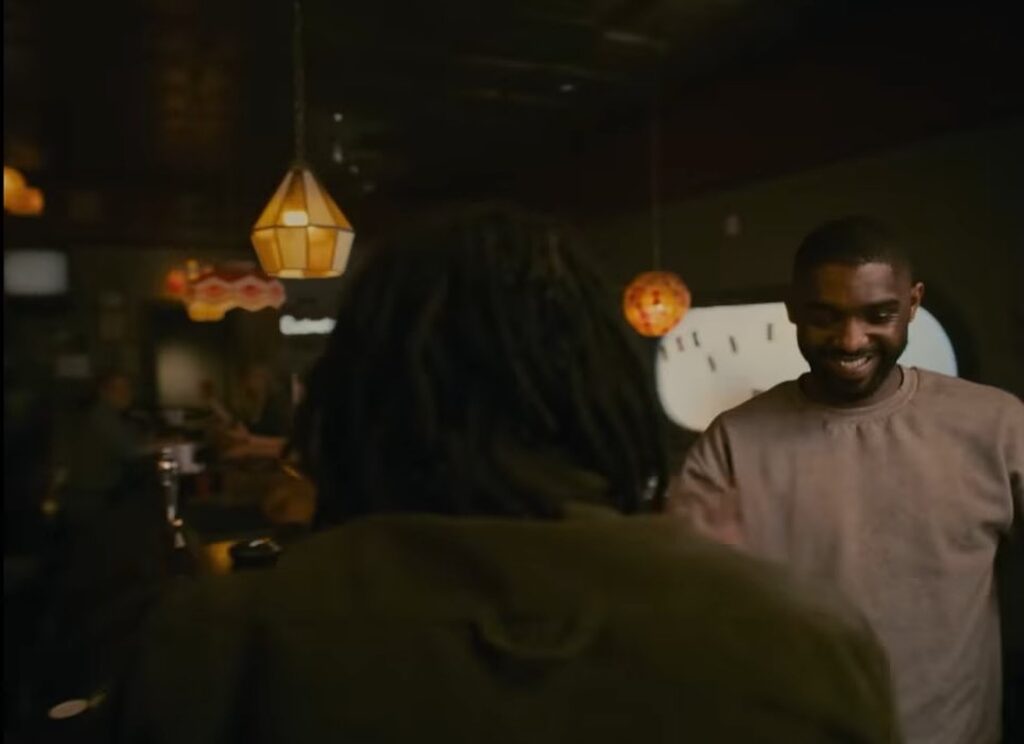
That gets at the purpose of the scene with Chickie Pete, at the bar. Pete serves as an example of the road Turner could have gone down: haunted by the demons of Nickel, coping with alcohol, struggling to stay employed and progress in life.
Nickel Boys has this motif of the duality between progress and stupidity. On the one hand, America in the 1960s had all these scientific achievements and breakthroughs, arguably some of the greatest in human history (like the Apollo 8 mission that’s featured so often). And at the same time, it was (and is, to this day) a hotbed of horrendous racism and idiocy. That same tension exists in the souls of every individual. We all have the capacity for growth and destruction. It’s a question of which path we choose to walk.
Which is the question Turner has at the end of the film. Authorities have discovered all the bodies at Nickel Academy and want people to come forward. Turner can go down there and make a difference. Not only in the investigation but in terms of the story becoming mainstream. But that could have a personal cost—he’s lived as Elwood Curtis for decades. If he reveals himself to be Jack Turner…will there be consequences? Maybe they won’t throw him in jail for leaving Nickel, but what about identity theft? Tax fraud? Could he lose his company? What about his friends and family members, how would they react?
As easy as it might initially seem to do the right thing, it’s actually quite the risk. And that’s why the film ends how it does. First, it asks viewers to decide what they would do. Would you do the right thing, even at a personal cost? Second, it shows the influence Elwood has had on Turner. We can assume he’ll choose to go. Because he knows Elwood would have.
And that’s the main thrust of both the novel (which won the Pulitzer Prize) and the film. People who do the right thing change the world. It may cost them their lives. But they set an example that inspires others for many years to come. And that’s why it’s important to stand up for what you believe.
It’s not just that, though, because that makes it seem like Elwood is the only hero here. It takes courage to do what Turner did—to care enough that you feel guilt so self-reflect then change for the better.
Every 2026 movie I’ve seen, ranked. Became a dad, so catching up. Updated: October 17
Many people are so afraid of feeling bad that they avoid introspection. Turner, despite his flaws, had the bravery to judge himself and grow.
Which is why I think the film handles the cinematography the way it does. The perspective shift from Elwood to Turner isn’t just a functional choice. It’s a mechanism to show that Turner is someone who helps Elwood see himself. And Elwood does the same for Turner. The back and forth between the two isn’t a gimmick for the sake of being interesting—it highlights how the boys are each a mirror for the other and grow individually because of their time together.
Notice that early in the film, Elwood only sees himself in reflections. It shows the budding sense of self in the young man. The first instance of that is his reflection in the iron (or some other item) in his grandmother’s house. The second is in the store window. Behind the glass are a bunch of TV screens that show Martin Luther King Jr. So Elwood sees himself overtop of this image of MLK. And what’s the next shot? Elwood glances down at his arm, at the color of his skin. It’s a subtle, small moment that has the power of a thunderbolt and is the pay-off for the film’s entire opening stretch, as we see Elwood go from innocent to cognizant.
That brings us to why the camera is different for older Elwood (who is actually Turner). It’s like Elwood’s behind Turner, watching him. And Turner’s aware of that. I assume you, reader, are probably an adult (rather than a teenager or kid). Think about the difference in your level of self-awareness between now and when you were younger. As you age, you’re less inside yourself and more capable of viewing yourself in context of the world around you (for better and for worse).
But Turner, specifically, is viewing himself through the “eyes of Elwood”. While that’s hinted at in the movie, it’s very clear in the novel.
In the novel, Turner doesn’t hesitate about whether or not he’ll help in the Nickel investigation. He goes to Florida and accepts whatever consequences may come. Why? Because it’s what Elwood would do.
So ask yourself—who inspires you? Have you ever let yourself be inspired? Have you ever let yourself care enough about a cause? About anything? What would you fight for? Stand up for? Die for? Okay, so don’t have to be a martyr. But have you found the courage to live for something, or someone, other than yourself? And that doesn’t mean throwing away your entire identity. It just means being self-aware and self-critical.
Do you watch an hour of YouTube videos? Or do you volunteer somewhere? Or call a friend? Or work on that novel you’ve wanted to write?
Do you go to the bar, again, just because? Or do you read a book? Go to the gym? Learn a language?
That’s not to say you can never indulge or be carefree. Just that there’s a difference when you lack motivation compared to making choices because you want to honor the past, better the present, or plant seeds of hope for the future. Having some sense of standard for yourself, for your life, can make all the difference. Maybe you won’t go to outer space, but you’ll be further ahead than you otherwise would have been. While others, without those standards, end up in an existential swamp, waiting for the alligator to bite.
I think it goes without saying that Nickel Boys is very much about the Black experience. I can’t personally speak to that, so forgive me for not highlighting it with more nuance. To me, the powerful thing about storytelling is that it’s all the human condition. So even when a story is very specific, it’s still universal. I’m far more equipped to speak to the universals. If you have recommendations for additional reading, from other voices, please, leave them in the comments below!
Nickel Academy wasn’t a real place. But Dozier School was. It closed in 2011, after 111 years in operation. Unfortunately, while the movie is fictional, it’s based on real events that transpired at Dozier School (and places like it).
After I write my analysis, I like to research filmmaker interviews and see how close I was (or wasn’t). Here’s what I found from RaMell Ross. Pretty close, overall.
RaMell Ross went onto the Script Apart podcast and dished on a lot of the ideas and concepts in Nickel Boys.


Film Colossus Supporters get access to the Frameshift and Active Viewing courses, an ad-free site, the Watch More Films newsletter, and the ability to request movies for analysis. Your support also directly keeps Film Colossus alive while I try to scale it into something sustainable, as it's just me, Chris, who does everything here.
Or create a free account. You gain access to the Active Viewing course and Watch More Films.
Join the Film Colossus community, get the newsletter, and unlock member features as they're added.