

Newsletter Subscribe
Enter your email address below and subscribe to our newsletter

Everyone wants to know what happens in Primer. I’ll tell you. But let’s start with a quote from Shane Carruth himself. The Village Voice asked, “Does everything add up, or did you deliberately leave a few loose ends?” And he said:
It’s never tidily summed up, but I’ve made sure the information is there. Almost every detail, from who the narrator is to how many Aarons there are in the end. But there’s one piece of information that isn’t, and that has to do with Granger coming back and how he was able to. That’s purposefully vague…. This man found out about the machine and he’s used it to come back, but they don’t know from what point in the future or who told him about it…. That’s the one big question that comes up, and I’m satisfied by that—that’s supposed to be the big question.
In storytelling (that’s well-done), information does one of several things: (1) further develops a character or situation, (2) directly advances the plot or theme, or (3) serves as a breadcrumb that’s part of a longer series of set-ups and payoffs related to plot or theme. The more complicated the movie, the more reliant it is on breadcrumbs. Primer is a breadcrumb-heavy movie.
Below is my theory on Primer. I’ve read every major attempt I could find. Some examples: one, two, three, four, five. All were helpful but flawed. They got a date wrong or didn’t account for certain dialogue or gave up on a key detail. I’m not saying mine won’t do any of those things, just that there’s a reason for it to exist. While Primer purposefully leaves some gaps, I believe we can fill most of them by following the breadcrumbs.
Now that we’ve untangled the timelines, let’s turn our attention to what it represents.
Every 2026 movie I’ve seen, ranked. Became a dad, so catching up. Updated: October 17
I feel like I say this in every thematic explanation, but it bears repeating: you can easily understand the gist of almost every movie by contrasting where the protagonist(s) begin(s) versus where they end. Even a movie that’s as ridiculous as Primer. What do we see?
Beginning: Aaron, Abe, Robert, and Phillip are part of an entrepreneurial cohort that, while once united, has grown divisive. Robert and Phillip aren’t on the same page as Aaron and Abe. The quad softly fractures, leaving Aaron and Abe united. They’re true friends who will carry on together.
Ending: Third Aaron and Second Abe don’t like each other. The final conversation starts with Aaron acknowledging they’re upset with one another and in a disagreement. Despite that, Aaron still thinks they can salvage their friendship by leaving town together. Abe says no because he feels responsible for looking after everyone. While Aaron wants to embrace his freedom. The two go their separate ways.
Everything with the boxes and time travel and the party and all the insane plot mechanics are nothing more than a method of showing the dissolution of this friendship. They embark on a project that demands tremendous trust. Then continuously break that trust. And it ruins the relationship. It’s as simple as that. The middle portion could have been anything. A business deal. A road trip. A recreational softball league. Discovering aliens. Battling gremlins. Stuck in a cabin during a blizzard. Carruth went with time travel.
There is a bit more nuance. For example, forget for a second that Third Aaron has no claim to his wife and daughter because he has invaded a timeline that has its own Original Aaron. They don’t need him because they already have him. That’s story-level thinking. On the theme-level, there’s only one Aaron. Through that lens, the ending represents Aaron having other priorities than his family. Which is what we saw at the beginning of the film. He had already turned their garage into this workshop and spent much of his homelife still focused on work. He had purchased a new fridge because he probably had already used the previous one for parts, just like we see him try to use Abe’s fridge for parts. We never see him spend quality time with Kara or Lauren. He’s visible but not present. At least not for them. Like when the cat goes missing. He goes and looks for it, not because he actually cares, but because “it’s what you do.”
The cat conversation is actually another great example of the difference between story and theme. Story-level, Second Aaron doesn’t care about the cat because this isn’t his timeline. It’s also why he so willingly risked his life to stop Rachel’s ex-boyfriend at the party. Abe doesn’t know this, so, while looking for the cat, chastises Aaron. “If it was just you you had to worry about, I’d still think you’re stupid. But you have a family now.”
On the theme-level, there is only one Aaron. Second Aaron represents this developing selfishness that grows more intense as the story progresses. Aaron isn’t putting his family first, anymore. He searches for the cat because Kara and Lauren worry about the cat. But he isn’t trying, he doesn’t care. He’s merely going through the motions, as needed. It’s the first sign of his disconnect.
And Abe is the foil for that. Think back to when the two first feel they’re onto something with the box. Aaron immediately puts a lock on the garage and moves to omit Robert and Phillip. It’s not like Abe wants to include them, but he has a sense of it being unfair. “I mean, they have their work in there, too.” Abe’s the one trying to follow rules and do things the right way. While Aaron is the wildcard. Abe feels a sense of responsibility and obligation that Aaron, at the end, does not. Which is why the two part. They no longer share the same values—Aaron chooses ambition, while Abe chooses responsibility.
Think Don Draper in Mad Men. His life is divided. He presents himself as the prototypical 1960s husband and father. But it’s a facade. Most of his time is spent at work, on affairs, and/or avoiding unprocessed trauma. Metaphorically, there are two Don Drapers. The tension of the show comes from his struggle to exist as both and the consequences of that conflict. That’s the realistic version of what the three Aarons represent in Primer. Original Aaron, who will remain oblivious to time travel and be around for his wife and daughter, is Don keeping up appearances. While the other Aarons are where his heart and mind truly lie—on work, money, achievement, etc. It’s what we call “defamiliarization”. You take something grounded and realistic but present it in a way that feels unfamiliar and is often unrealistic. Defamiliarization is the heart of genres like sci-fi, horror, and fantasy, as it allows them to explore universal themes through extraordinary circumstances.
To recap. Thematically, Primer is very simple. Two friends grow apart due to a loss of trust and differing morals because one becomes a workaholic and a jerk.
If you have issues with my theory leave a comment and we can discuss! I actually have one of my own: Second Aaron’s narration. Specifically: I can tell you with certainty what I did that night, when it was my turn. But I think it would do little good, because what the world remembers, the actuality, the last revision, is what counts, apparently.
The Aaron at the end of the movie, in the airport, who I, and others, identify as Third Aaron, is actually the true original Aaron. He’s the only one who experiences everything that we see in the movie. When he uses the failsafe the first time, we call him Second Aaron because he’s “added” to the new timeline. But he is still Aaron Prime. And when he uses the failsafe a second time, after the Thomas Granger Incident, we call him Third Aaron because he’s, once again, an addition. The one we call Original Aaron refers to who would be considered natural to that timeline. That’s who gets put in the attic. Likewise, even though Third Aaron was Second Aaron, the final Second Aaron, Narrator Aaron, refers to that version of him that never experienced the third timeline. And that’s the problem.
Third Aaron shows up right after Second Aaron drugs Original Aaron. Which is why Second Aaron, during his narration says, “And that’s where I would have entered the story. Or exited, depending on your reference.” What he means is that he didn’t get to play a role because Third Aaron, Second Aaron from the future, appears and asks Second Aaron to leave. So he does.
How, then, if Second Aaron left Monday morning, did he ever have a turn at confronting Rachel’s ex-boyfriend at the party? “I can tell you with certainty what I did that night, when it was my turn.” That implies he experienced the party, had an interaction with the ex-boyfriend, etc. But, how, if he already exited the story?
The only way he could tell us “with certainty what I did that night” is if Third Aaron told him. But the dialogue doesn’t convey that. Quote: “For reasons that are only evident to me now, I understood that he simply wanted it more. That he just had more invested. So I left.” That’s very different from saying something like, “He told me about what happened next and what he needed to do. I understood. So I left.” Second Aaron is quite clear when he says the reasons “are only evident to me now.” Meaning at the time he didn’t know what Third Aaron’s motivation was, just that “he simply wanted it more” and was “more invested”.
At best, this is a logic gap. In which case, someone might have a better theory as to how Narrator Second Aaron experienced something that is logistically impossible for him to have experienced. At worst, it’s a plot hole. Which, in the grand scheme of plot holes, is pretty minor. But at least worth noting. Maybe it’s more of a flaw with my theory than the movie? I wanted to bring it up for the sake of discussion.


Film Colossus Supporters get access to the Frameshift and Active Viewing courses, an ad-free site, the Watch More Films newsletter, and the ability to request movies for analysis. Your support also directly keeps Film Colossus alive while I try to scale it into something sustainable, as it's just me, Chris, who does everything here.
Or create a free account. You gain access to the Active Viewing course and Watch More Films.
Join the Film Colossus community, get the newsletter, and unlock member features as they're added.


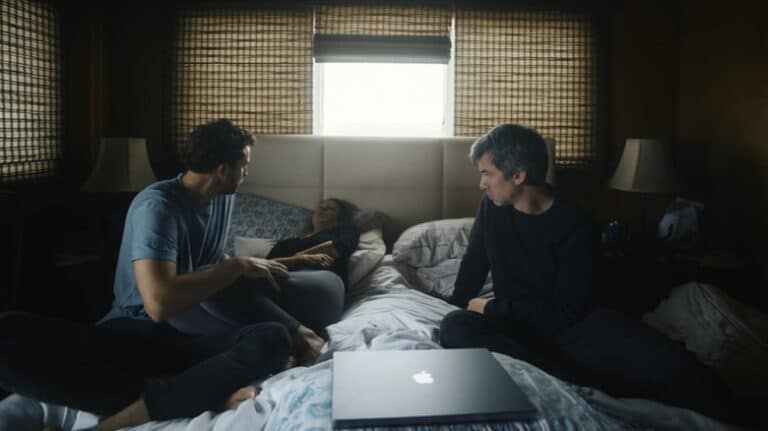
“How, then, if Second Aaron left Monday morning, did he ever have a turn at confronting Rachel’s ex-boyfriend at the party? “I can tell you with certainty what I did that night, when it was my turn.” That implies he experienced the party, had an interaction with the ex-boyfriend, etc. But, how, if he already exited the story?”
My assumption is that second Aaron had for whatever reason completed multiple trips back by that point. I understand he exits the story Monday morning, but that’s only from our perspective. He has already found the failsafe at that point and knew you could bring it back with you this making it reusable. There’s nothing stopping him at that point from going back several times to replay the party however he sees fit, right? Why he would do that is another question though.
Thank you Chris for giving us your take on this one. Really enjoyed it. It’s one of those movies worth watching over and over.