Newsletter Subscribe
Enter your email address below and subscribe to our newsletter
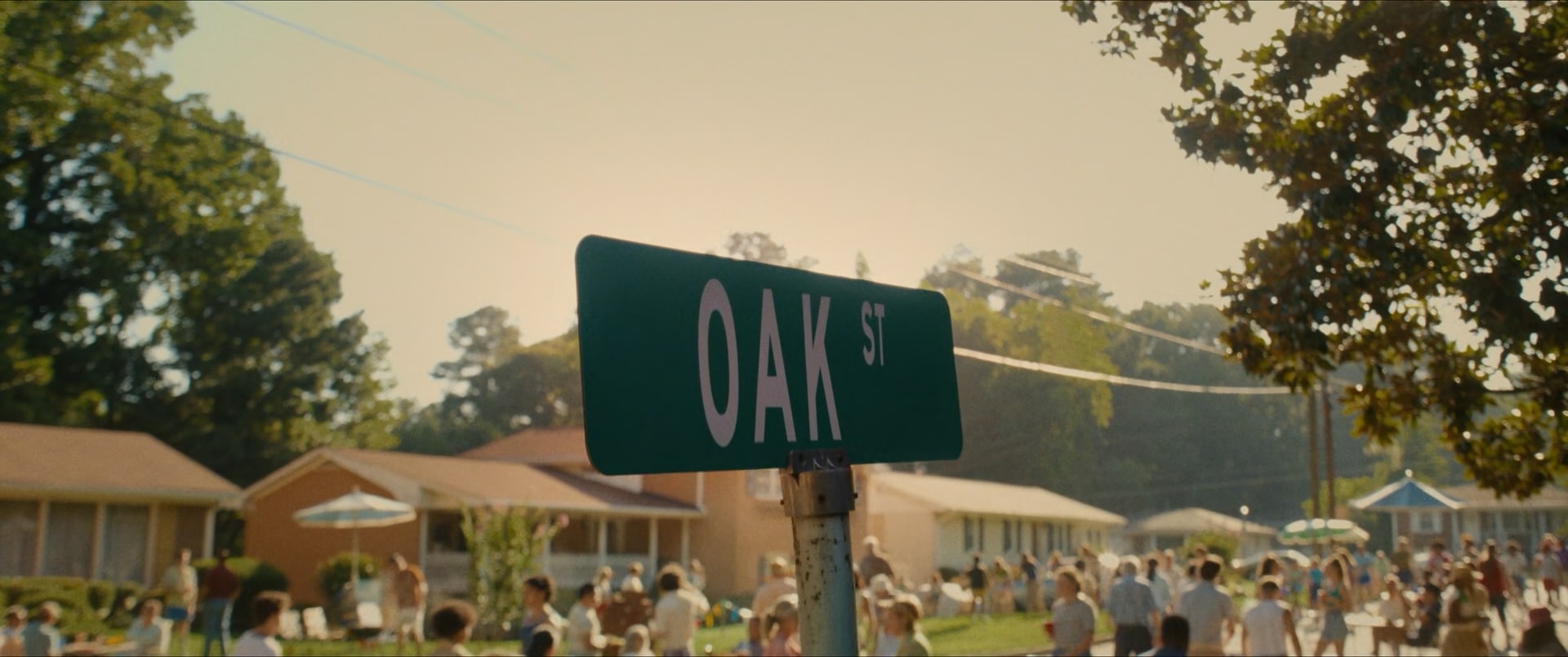
If you have plot questions about The End of Oak Street, this is the article for you. I’m going to address as many of them as I can. If you still have a question, leave a comment at the bottom of the page. I’ll answer.
For the thematic analysis and deep dive into Oak Street‘s deeper meaning and ending, click here.
Oak Street takes place in 1982, in Flowerville, Michigan.
In the early scenes like this, movies often use dialogue to establish core concepts and ideas. So the neighbor tells Greg, “You got a great family. You’re a lucky man,” so the film can anchor the audience to the idea that Oak Street is focused on Greg’s family. Superficially, it does seem like Greg has a great family, right? Except in the very next scene we see there’s more going on, that everything isn’t as idyllic as it seems.
Carl Sagan really did teach at Cornell. He passed away in 1996, at the age of 62. He was a science rockstar who walked the walk and talked the talk. He was an important advisor to NASA for over 30 years, was a pop culture figure, and his TV documentary, Cosmos: A Personal Voyage, set viewing records.
In modern times, Neil DeGrasse Tyson is the closest comparison, but there’s a huge gap between them. Carl Sagan contributed seminal research to understanding the atmospheres of Venus, Mars, and Titan (Saturn’s moon). Tyson is an astrophysicist with some research under his belt, but nothing like what Sagan did. Tyson’s achievements are more to do with the work he’s done to keep astronomy and science in the mainstream zeitgeist.
We see Audrey talking to her friend about what they’ll do after high school. Then the friend’s boyfriend walks up. Audrey has this look on her face that makes it seem like she either likes the guy or is just really forlorn about being single.
Again, this is another moment where the film’s setting up a larger idea. Audrey’s character arc deals with her orientation, the loneliness of being LGTBQIA+ in the 80s, and the build up to her relationship with Jeannette.
Oak Street isn’t as interested in Brian as a character, but notice that right before this scene with Audrey we see Brian tell his mom that “You can’t leave Starbuck at home.” Later, during the whole dinosaur debacle, Brian’s once again committed to not leaving Starbuck behind. All of these moments are there to set-up what happens deeper into the film.
Greg hasn’t told anyone that he lost his job. So he’s working as much as he can so Denise and the kids won’t feel the loss of income. What he’s not realizing, though, is that they feel his loss of presence. That’s exactly what Denise brings up when she says, “We agreed we needed a family day.”
This is the twist on the earlier scene where the neighbor tells Greg he’s a lucky man. As happy as the family looked to the neighbor, we now see that’s not how they always are. Denise and Greg are actually on the brink of divorce. They think they’ve hidden that fact from the kids but the kids see it plain as day. So as much as everyone tries to keep up the appearance that everything is okay, it’s really not. That’s actually one of the main themes of The End of Oak Street.
Remind me to come back to this.
Every 2026 movie I’ve seen, ranked. Became a dad, so catching up. Updated: October 17
Denise tells her editor-neighbor that the story she’s written isn’t really about her. Except we know that it is. She’s unhappy with Greg and just brought up divorce to him in the previous scene. So when we hear she’s writing this novel about a wife-and-mother who keeps her suitcase packed in case she wants to leave one day, we know it’s more autobiographical than it might seem to the editor. To the editor, Denise is this happy housewife with a great husband and kids, so the story really must just be fiction. But Denise knows better. For her, it’s a daydream, a way to escape the marriage before she’s actually escaped the marriage. That’s why she hasn’t shown Greg or the kids, because she knows how true it is.
So earthquakes have smaller foreshocks, the big mainshock, and then the smaller aftershocks. That’s kind of what happens in The End of Oak Street. There are the initial usual ripples that cause some smaller things from the past to appear in Oak Street’s present. We see a few of these leading up to the big event that sends Oak Street into the past. The little portals that appear later in the film, the ones they use to get home, are the aftershocks.
It’s real but doesn’t exist today. It actually gained prominence after what’s known as the Permian–Triassic extinction event. While most plant life suffered in the harsh conditions created by an absurd amount of volcanic eruptions that essentially poisoned air, land, and sea, the Pleuromeia was pretty happy. Once the volcanos calmed down and the climate became hospitable again, Pleuromeia couldn’t survive the new temperatures and increased competition from new and returning plants.
The first recorded fossil was found in 1830, in Germany.
There is a distant relative that’s around today: quillworts. But the quillwort is incredibly bland and looks nothing like Pleuromeia. It’s like when you find out that wolves and hamsters have a common ancestor. Imagine if wolves and all canines were extinct and all we had left were hamsters. That’s Pleuromeia vs. quillworts.
But, really, the plant showing up is less about the story and more about the audience. The film wants to start teasing what’s to come and build anticipation. So they’re having these things show up to keep people hooked while they establish the family drama.
Brian is acting out because of the stuff going on between his parents. So when this other kid was riding by on his bike, Brian put a stick between the spokes and the kid flipped and broke his arm. Then Brian talks with such bravado by saying he’ll put an arrow in the kid’s big brother if the brother tries to get revenge. But throughout the film, Brian fails to use the bow and arrow a single time. So his character arc involves a lot of humbling.
I mentioned how a big theme of Oak Street is the appearance of things vs. the reality of things. The reality is that Greg delivers pizzas. But Denise doesn’t like the appearance of that. Typically, pizza delivery is thought of as something high school kids do. Not something a middle aged guy who has a career does. Denise cares so much about the perception of her husband and family that she asks him to take the pizza sign off the car, even though that creates more work for Greg.
We learn later that whatever phenomenon is occurring creates wormholes. The creation of those wormholes involves that bright light and other reactions (like the wind). Brian witnesses another foreshock. And the next day, we see what travelled through the wormhole and landed in the neighbor’s yard: a giant pile of dung.
I just wanted to point out that this is a standard trope from 70s and 80s movies. The younger teenage boy runs away from an older teenage boy who wants to beat him up. The typical use of the trope is that the younger kid is a protagonist the audience is supposed to root for. But Oak Street puts a twist on it because we know that the older kid is actually trying to get back at Brian for being a bully himself.
So the audience will probably initially root for Brian here since films have conditioned us to root for the main character. But, when you think about it, you remember that Brian’s actually the one who started this and hasn’t apologized and doesn’t seem remorseful. He’s more of the bad guy in the scenario than the kid chasing him.
After the mainshock occurs and the family’s trying to figure out what happened, Brian asks Denise why she was downstairs. She lies and says she was doing laundry. We know she was actually working on her secret novel where she leaves her family.
Again, another instance of appearance vs. reality. How things seem, how people present themselves, doesn’t always represent how things really are, who they really are. I’ll keep coming back to this again and again.
This may surprise some younger people, but prior to the 2000s, a lot of people kept their dogs outside. Dog houses were really common and people felt comfortable just leaving their dogs outside, either fenced in or tied up. Today, you don’t really see that as much. Oak Street has Starbuck outside like that because it’s accurate to the time period.


Film Colossus Supporters get access to the Frameshift and Active Viewing courses, an ad-free site, the Watch More Films newsletter, and the ability to request movies for analysis. Your support also directly keeps Film Colossus alive while I try to scale it into something sustainable, as it's just me, Chris, who does everything here.
Or create a free account. You gain access to the Active Viewing course and Watch More Films.
Join the Film Colossus community, get the newsletter, and unlock member features as they're added.