Newsletter Subscribe
Enter your email address below and subscribe to our newsletter
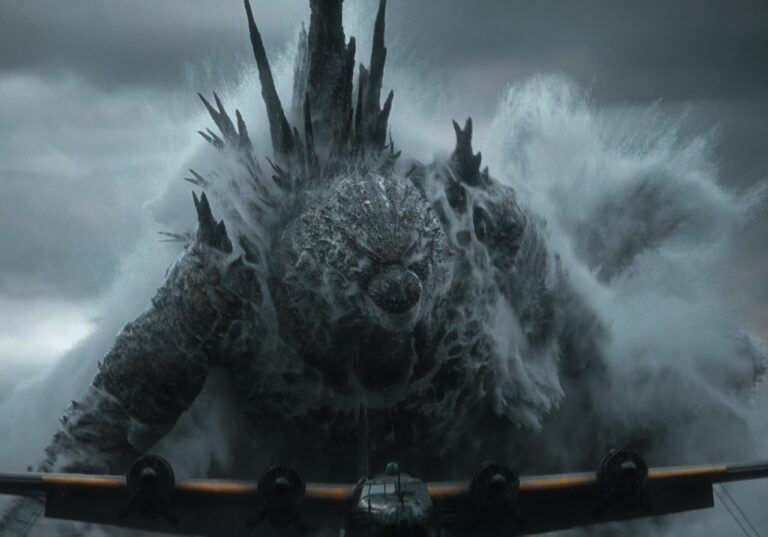
Godzilla Minus Zero is a long film. Some of that is because of the extended action sequences. But the runtime is mostly because writer-director Takahshi Yamazaki is concerned about more than just monsters. He’s added a lot of thematic nuance to Minus Zero.
It’s one thing to overcome your past, which is what happened in Minus One. It’s another to face the future.
We’re going to go almost chronologically through Minus Zero, laying the groundwork for the ending and what “Have a safe trip” is more meaningful than what you probably think. And, look, if the end of the article makes you cry, I’m sorry. So, let’s start at the start: Ghidorah’s arrival.
Godzilla Minus One used Godzilla as a representation of grief and remorse from the past that haunts people in the present. That’s why the film starts with Shikishima encountering a “small” Godzilla only to re-encounter the full-size monster all those years later. Shikishima’s shame and PTSD had festered and grown more powerful within him. Godzilla is the outward manifestation of those negative emotions.
This idea of Godzilla as a manifestation is the reason its obliteration of Ginza recalls the earlier bombing of Tokyo. So Minus One’s final confrontation with Godzilla is Shikishima and Japan confronting their trauma in physical form and defeating it in order to turn the page.
Ghidorah in Minus Zero is that next page. And remember how the film characterizes Ghidorah. It’s not a creature that transforms but one that evolves. If Godzilla in Minus One represented the emotional hurdle the characters had to overcome, it’s safe to assume Ghidorah does too. So what is that emotional hurdle?
Hydra and chimera are creatures of mythology. The hydra is a serpent with a bunch of heads that can regenerate. And the chimera is a single creature made up of features from other animals.
What could this possibly have to do with Japan? Well, think about the context. In the first film, Godzilla was tied to disasters associated with World War II. In this second film, we’re post-WWII. If you look at the history of Japan since that time, have any great disasters befallen the country?
These numbers don’t include the dozens of smaller natural disasters that claimed hundreds of lives each. Just two years ago, in 2024, the Noto earthquake claimed nearly 700 people.
Now, ask yourself, does Godzilla Minus Zero talk about nature or the weather at all? Godzilla was a byproduct of atomic testing, while Ghidorah is the aftermath of a meteor crashing into Japan. That’s a natural event. And then very quickly the film moves to associate Ghidorah with weather. There’s that whole plan to use lightning strikes to fry Ghidorah, except the monster becomes one with the lightning and harnesses its destructive power to rain ruin on Japan.
Yamazaki himself confirmed the connection: “The way in which [Ghidorah] interacts with or affects the weather is a metaphor for a natural disaster…. There were a lot of disastrous typhoons that we had to survive through in our postwar era, which is also a reason that our postwar recovery was a bit delayed as well. So it does symbolize the turmoil and catastrophe that we had to survive in that era in Japan.”
By Minus Zero’s midpoint, Ghidorah’s following storms around. During the final confrontation, it literally emerges from the dark clouds. Remember the transitive property from high school math? If A = B = C then A = C.
Hydras have many heads that regenerate. We see Ghidorah grow two additional heads and regenerate one that Godzilla severs. Chimera combine the aspects of multiple animals. Ghidorah’s protean form melded with various animals until it produced the initial one-headed dragon.
Do natural disasters have many heads and multiple aspects? Yeah. There’s flooding, lightning, tornadoes, earthquakes, landslides, mudslides, fires, volcanic eruptions, etc. Just this decade, from 2020 to 2026, Japan has had five earthquakes that had casualties. To reach the same number in the United States, you have to go back 25 years.
Noda was our lovable scientist from Godzilla Minus One. He’s a former weapons developer who then has to find a way to defeat Godzilla, the manifestation of weapon technology.
Aoyama has a similar role. She’s a weather forecaster who has to find a way to defeat Ghidorah, the manifestation of weather-related disasters.
That’s why the film sets up a bit of a mentor/mentee dynamic between the two before ultimately having Noda pass the torch to her. He was the solution for a problem that was no longer the primary problem facing the country (the legacy of World War II). It’s up to the next generation of leaders to emerge and face the new challenges.
For those who aren’t familiar with Japanese cinema, “fixing the weather” is actually a pretty prominent sub-genre. In 2016, an anime film called Kimi no Na wa, known internationally as Your Name, came out of nowhere to become the highest-grossing Japanese film ever, earning over $400 million dollars worldwide and maintaining its title for four years.
You know what Your Name is about? Preventing a natural disaster (in the form of a comet destroying a rural town).
Three years later, the writer-director, Makoto Shinkai, released another film. It was also a huge hit. It’s called Weathering with You. You know what it’s about? Stopping rainstorms.
And three years after that, Shinkai released his last film (as of 2026): Suzume. You know what it’s about? A worm that creates earthquakes.
Every 2026 movie I’ve seen, ranked. Became a dad, so catching up. Updated: October 17
Shinkai called these films the Disaster trilogy. They’re currently the 3rd, 5th, and 12th highest-grossing films in the history of Japanese cinema. A lot of that has to do with the hope Shinkai offers the younger generation, hope that they themselves can be the ones to discover a way through the seemingly endless disasters.
Godzilla Minus Zero is doing something similar and uses Aoyama in the same capacity. She’s a youthful protagonist who plays a critical role in turning weather from something to fear to a tool the people can harness against the monster.
Midway through Minus Zero, the film reveals that Professor Murakami lost his wife, daughter, and grandson in the Hiroshima bombing. Since then, he’s dreamed about getting revenge on the United States. His plan involves using Noriko to lure Godzilla to the United States so Godzilla can unleash disaster on the people of New York City.
Murakami is the oldest of Minus Zero’s main characters. Old age is often associated with traditional thinking, rigid thinking. And while Murakami is forward-thinking in terms of science, he’s hanging onto old traumas, onto his dream of vengeance.
He has everything he needs to carry out his plan: Noriko and her G-Cells, a resurrected Godzilla, and the resonance device. Except he never makes his move. We eventually find out that Noda had confronted Murakami and begged him to let go of his anger and hatred, to help preserve life rather than continuing the cycle of violence.
What Noda’s asking, really, is for Murakami to evolve. Can this man who is still so wounded by the past make choices for the benefit of those in the future? Murakami comes to the realization that Noda was right. That gives him the strength to abandon not only his dream of revenge but also his life’s work.
That’s now three instances of people evolving. Noda by embracing Aoyama and a new way of thinking. Aoyama by becoming a leader. And Murakami by not being the stereotype of the old man stuck in his ways.
I want to note that evolution isn’t the only motif. There’s also the idea of old vs. new. Godzilla is old, Ghidorah is new. Noda is old, Aoyama is new. Murakami has an old way of thinking that he replaces with a new way of thinking.
We see a similar thing play out with Shikishima. When Noda first recruits him to help with Ghidorah, Shikishima’s only supposed to consult the newer pilots on strategy against a monster. But Shikishima struggles to accept that role so opts to fly with the men instead. His old ways win out over the new. Then his old ways fail to solve the problem of Ghidorah.
It’s after that first failure to defeat Ghidorah that Shikishima runs off with Noriko and Akiko. The team wants to use Noriko’s G-Cells to draw Godzilla to Ghidorah, and Shikishima refuses to let that happen. The family tries to ignore the reality of Ghidorah and start a new chapter. Except Noriko can’t do that. She can’t run away knowing she’s the only person who can step up and be the pied piper that leads Godzilla to Ghidorah.
This gets at a very important thematic idea: giri versus ninjō
For hundreds of years, Japan’s various political systems reinforced duty over individuality. In fact, it reached a point where the official stance of the Japanese government was that their emperor was a living god and the subjects had a moral duty to obey the state. This was part of an ideology known as State Shinto. It lasted until the end of World War II. After Japan’s surrender, America had the emperor release a declaration rejecting his divinity.
In 1946, Japan created a new constitution. The first section is about the powers of the Emperor. The second is a total renunciation of war. And the third is a bill of rights. There you have Article 13: All of the people shall be respected as individuals. Their right to life, liberty, and the pursuit of happiness shall, to the extent that it does not interfere with the public welfare, be the supreme consideration in legislation and in other governmental affairs.
Individuality, which had been subordinated by the state for centuries, was literally codified into Japan’s current constitution.
Remember how Shikishima started Godzilla Minus One as a kamikaze pilot who failed to kamikaze? Remember how much shame he felt about that? That is a direct representation of the duty Japanese people felt under the empire. Shikishima chose his individuality over his duty to a “divine” emperor. Minus One is consistently critical of the state and uses the human cast to celebrate individuality and the power of people who choose to support one another (rather than being forced to sacrifice for those in power).
In Minus One, Shikishima learned to stop feeling bad about giri and embrace ninjō. In Minus Zero, we see a negative version of ninjō when he tries to abandon everyone to protect Noriko, even though he and Noriko are two of the only people who can actually make a difference.
Noriko, on the other hand, shows us a healthy version of giri. Noda isn’t asking her to kamikaze the way the emperor’s military ordered Shikishima and others. She doesn’t view her role as being forced into something she doesn’t want to do. She views it as an opportunity to perform a duty only she can perform.
So Noriko evolves and takes on this new responsibility. Likewise, Shikishima accepts a new role as a supporting act rather than the ace pilot leading the charge.
It’s because these two are willing to change that Godzilla is able to defeat Ghidorah. That ensures Japan’s future. The problem is what happens next.

After their heroics, Shikishima and Noriko are afraid the United States will capture Noriko in order to study her G-Cells. Their plan is to abandon Akiko at the orphanage and go on the run. They talk themselves into believing that Akiko will eventually understand their actions.
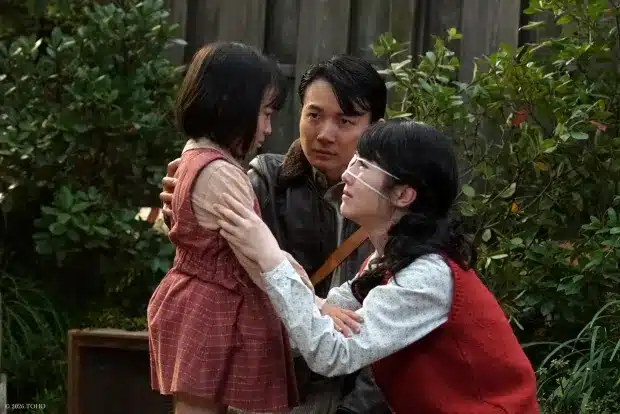
Except when they visit Akiko to say goodbye (and I’m crying just thinking about the scene), Akiko sobs and screams “Have a safe trip” over and over again because Noriko had told her it was a magic spell that means the person leaving will return.
Think about this in abstract terms. Shikishima and Noriko are essentially asking Akiko to accept a future without them. They’re asking that because they’re afraid that their future will be dangerous, too dangerous for a young child like Akiko.
Defeating Godzilla in Minus One was a metaphor for overcoming emotional baggage. It’s the same with Ghidorah in Minus Zero. The emotional hurdle, this time, is being able to face the future. Initially, it’s immense and terrifying to both the characters and post-WWII Japan. But, together, they overcome that fear and vanquish Ghidorah.
When Shikishima and Noriko came up with their plan to leave Akiko, it was before the fight with Ghidorah. Meaning fear of the future was still overwhelming for them. If they were really committed to that course of action, they would have just driven right by the orphanage. The reason they go back, the reason they say goodbye, is because they don’t want to leave Akiko.
The situation with Akiko parallels what happened earlier, when the family was going to leave before Noda could recruit Noriko. They feared the worst so ran away, only to realize that they made the decision for the wrong reasons. Likewise, will they really protect Akiko by leaving her?
Underlying both moments is the film’s main conflict: how do we deal with the future when it’s scary? What Shikishima and Noriko learned in the fight against Ghidorah is that you deal with it by sticking together.
I like to think “Have a safe trip” has an even deeper meaning after all of this. We’re all on a journey into the future. And none of us know what’s in store for us. What hydra and chimera lie in wait. We head out every morning to live and hopefully there’s someone out there wishing you a safe trip so you make it home each night.
So if no one has said it to you recently, I’m saying it to you now. Have a safe trip.


Film Colossus Supporters get access to the Frameshift and Active Viewing courses, an ad-free site, the Watch More Films newsletter, and the ability to request movies for analysis. Your support also directly keeps Film Colossus alive while I try to scale it into something sustainable, as it's just me, Chris, who does everything here.
Or create a free account. You gain access to the Active Viewing course and Watch More Films.
Join the Film Colossus community, get the newsletter, and unlock member features as they're added.