Newsletter Subscribe
Enter your email address below and subscribe to our newsletter

If you just want to know about the two Jeannettes at the end of the movie, here’s what’s going on.
Jeannette Prime ran back down the hill to save her parents and her past self. She then convinced them all to leave the house, the street, the neighborhood, before the flash happened. She just didn’t immediately make it back to Platt Primes and Greg Two. I imagine Jeannette Prime ends up living with them and is still dating Audrey. So when the Platts have that BBQ, Jeannette Prime, Jeannette Two, and their parents all show up.
Of course, there will be people who read into this quite deeply and think it’s a huge twist, but, honestly, I think it’s more David Robert Mitchell having fun and working through the time travel mechanics, even winking at that ‘80s trope from Back to the Future where the future self and past self can’t interact. As far as I’m concerned, it’s not a twist. It doesn’t change the thematic reading of the movie. Or even the plot.
The biggest thing it confirms is that Denise could have saved her entire past family but opted only to save Greg. The implication of that being she sacrificed those other versions of herself and her kids for her own happiness. Which is kind of crazy. But actually fits with the theme. Let me explain.
Alright, let’s dive into the theme of The End of Oak Street. And, yes, it has one. I know the film plays out like your standard survival movie that’s meant for fun and not thought. But David Robert Mitchell snuck some meaning into the film nonetheless. And everyone who loves Under the Silver Lake can appreciate hiding a message in plain sight. If you don’t get that reference, go watch Mitchell’s last film, Under the Silver Lake.
Oak Street has a pretty standard thematic setup, where the opening scene establishes the main idea and the ending confirms that idea through contrast. And we have the title as the supporting evidence. So let’s dive in.
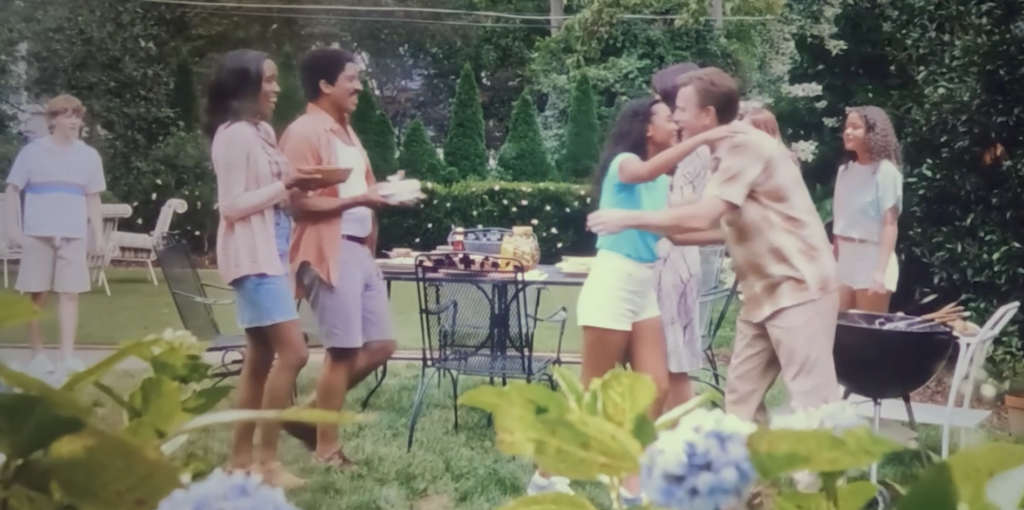
End of Oak Street opens with an establishing shot of the suburban town of Flowervale. Then cuts to the sign for Oak Street. Then to the Platt family, happily preparing for a sack race. After the race, we cut back to a wider shot of the block that reveals the party and all the neighbors having a great time. Mitchell steeps the scene in this idyllic romanticizing of 1980s America.
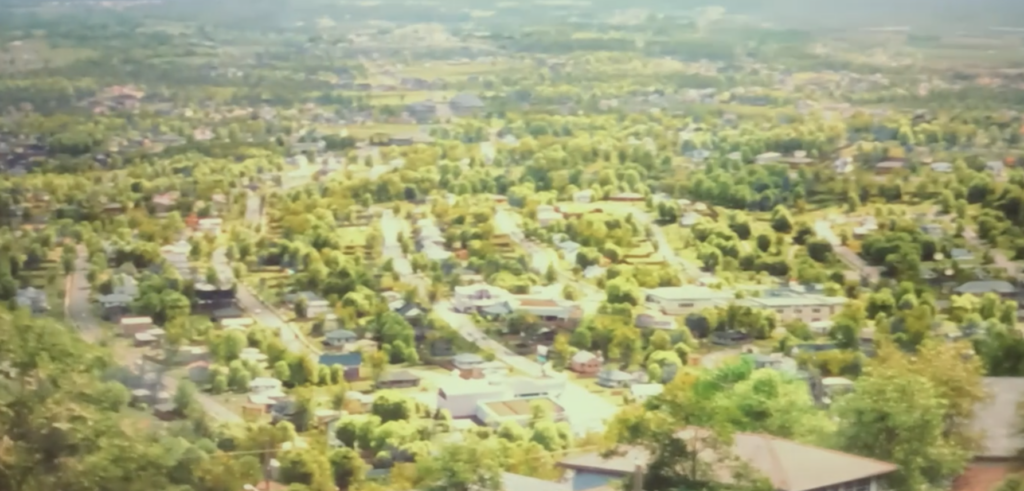

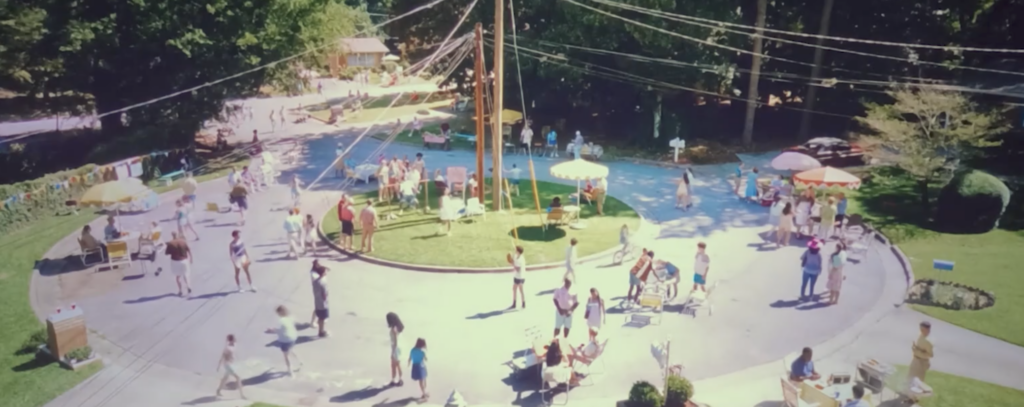
The film positions the Platts as part of this romanticizing. They aren’t special or oppositional. They’re representative. They appear just like everyone else. And there’s that dialogue early on where the neighbor says to Greg, “You got a great family. You’re a lucky man.” It all seems lovely, doesn’t it?
To the friends and neighbors, the Platts seem perfect. Except very quickly it emerges that things aren’t great. Greg and Denise have been fighting and are on the brink of divorce. Denise uses writing a novel as a form of escapism where she can imagine leaving her family and starting a new life. While the couple think they’re hiding the strain, the kids are very much aware of how bad things are, openly speculating about whether the relationship will survive.
Remember how the movie started by zooming in from the neighborhood to the street to the Platts? While that’s a basic maneuver to bring the audience into the world, it also establishes the movement from broad to narrow. And thus allows us to reverse that movement from narrow to broad.
So if the Platts represent the seemingly perfect family of the 1980s, we can zoom out and say they represent “oak street” and the “neighborhood”. Even America itself. In the 1980s, a lot of people, including Americans, still romanticized the American Way of Life. That picture-perfect, white-picket-fence existence. To this day, some people still think that’s how the country is.
But just like with the Platt family, appearances are just appearances. What’s going on behind closed doors is often not idyllic.
I’ve used Audible for more than a decade and listened to over 150 audiobooks. If you’ve been meaning to try it, you can start a free trial through Film Colossus. It’s an easy way to support my work without becoming a paid member.
#CommissionsEarned
The big difference between movies and novels isn’t that novels are written and movies are filmed, it’s that novels have interiority and movies don’t. Novels often directly tell or show us what a character is feeling, thinking, remembering, etc. So we’re not only told what they’re doing but we get to experience why they’re doing it.
Look at the opening of Virginia Woolf’s To the Lighthouse.
“Yes, of course, if it’s fine tomorrow,” said Mrs. Ramsay. “But you’ll have to be up with the lark,” she added.
To her son these words conveyed an extraordinary joy, as if it were settled, the expedition were bound to take place, and the wonder to which he had looked forward, for years and years it seemed, was, after a night’s darkness and a day’s sail, within touch. Since he belonged, even at the age of six, to that great clan which cannot keep this feeling separate from that, but must let future prospects, with their joys and sorrows, cloud what is actually at hand, since to such people even in earliest childhood any turn in the wheel of sensation has the power to crystallise and transfix the moment upon which its gloom or radiance rests, James Ramsay, sitting on the floor cutting out pictures from the illustrated catalogue of the Army and Navy stores, endowed the picture of a refrigerator, as his mother spoke, with heavenly bliss. It was fringed with joy.
A movie would either have to resort to voiceover, which is often a lackluster choice, or have to rely on the actor conveying the appropriate amount of joy and hope about potentially going to the lighthouse. The movie may even need to add dialogue to get the point across.
Because film lacks this interiority, what often happens is that the events of the plot become an externalization of whatever the character is dealing with internally. This is most obvious in horror films when the monster is an externalization of the character’s grief or depression or loneliness. The process of engaging with the monster represents engaging with the real emotion. And conquering the monster often coincides with emotional breakthrough or catharsis.
Even realistic movies can use this technique. In Good Will Hunting, Will keeps sabotaging himself because of trauma. He acts confident but is actually terrified that people will leave him, hurt him. The film uses his relationship with Skylar as an externalization by which we can measure his progress. When he blows up the relationship, it’s a byproduct of his inner conflict. When the movie ends with him finally leaving Boston to be with her in California, it reflects he’s no longer operating out of a place of fear and has finally embraced vulnerability. Fight Club is the same character journey but told fantastically.
So, in End of Oak Street Denise and Greg have these marital issues. And even though it seems they’re all friendly with their entire neighborhood, we see the bad relationship they have with their next-door neighbor, Mel. Things aren’t idyllic, are they? And if that’s true for the Platts, it’s probably true for everyone else, right?
Oak Street could explore this revelation, of the ugliness underneath the perfect appearance, in a realistic way, like Mad Men does with Don Draper, or Revolutionary Road with Frank and April, or, you know, American Beauty. Or it could defamiliarize like The Stepford Wives. In that film the men in a seemingly perfect suburban neighborhood actually replace their wives with obedient androids. Some people might think Stepford Wives is just a fun thriller about androids. But it’s actually commentary on the female experience in a patriarchal society that puts superficial appearance and male ego on a pedestal.
The dinosaurs become a metaphor for all the shit that people try to hide in order to keep up appearances. You can’t keep it hidden. Denise tried to hide her novel from Greg but he finds it and is crushed. Greg tried to hide that he lost his job and the dishonesty was ruining his marriage. If he had been honest, maybe it would have actually made their marriage stronger. Greg has to hide his pizza delivery roof-topper because it embarrasses Denise for the neighbors to see it. The result of all of this hiding: dinosaurs.
In a grounded movie, the dinosaurs would be something like Greg and Denise having a huge fight and separating. Their appearance as a perfect family crumbles. At the same time, scandal rocks the neighborhood as these other dramas reveal themselves. A year would pass and the Annual Oak Street BBQ doesn’t happen. Neighbors snub each other on the sidewalk. The neighborhood is far more guarded, closed off. The pleasant Oak Street from the movie’s opening is gone.
Every 2026 movie I’ve seen, ranked. Became a dad, so catching up. Updated: October 5th
That’s what’s happening in End of Oak Street, except by way of dinosaurs. That idyllic 1980s living was never real. All the hidden ugliness has finally come to light.
Edit: I’ve had a few days to think about this and the dinosaur metaphor is even better than I originally realized. In modern culture, dinosaurs are toys, cartoons, and museum attractions for kids. They’re this cool relic from the past that people are able to safely cherish. We romanticize them. End of Oak Street takes that romanticism and shows us how terrible dinosaurs would be if they were still around. And it’s the same thing if people suddenly went back to 1980s America. Or 1950s America. Reality is very different. And that extends, then, to Denise. She had the fantasy of leaving her family, leaving her husband. Then the dinosaurs show up and threaten her family, take her husband, and she experiences the reality of what it would be like without them. And it wasn’t nearly as fun as the fiction she was writing.
At the end of Oak Street, we’re two years in the future. And we don’t end with another block party where everyone is neighborly and happy. It’s a BBQ at the Platt house. Just their family and Jeannette and a second Jeannette and her parents. Maybe others will show up.
Let’s take inventory real fast and establish what’s different at the end.
Denise no longer has to hide her novel writing. It seems her book about the whole dinosaur experience was a success. Greg’s barbecuing, which may seem minor, but, remember, at the start of the film he tells Denise he can’t grill because he has to make some deliveries. That causes the first fight we see between the couple. So him grilling in this closing scene brings closure to that. Audrey’s with Jeannette, at a time when many LGBTQ+ people had to sequester their sexuality.
What we see are multiple characters no longer having to hide or appear a certain way. That fakeness is over. So if the movie starts by emphasizing people hiding things from one another and ends with them being open…that contrast tells us something.
The Platt household, in the final shot, is quite progressive. It’s reflective of a modern America that isn’t all white, all straight, and all Christian. I wonder if Mitchell was making a point by having the movie conclude at the Platt home and not with another Oak Street block party? It strikes me as commentary about the end of a homogenous America. And how that’s not a bad thing. If each family is living their truth in their own home and not causing problems for others, isn’t that fine?
I mean, look at the title. The End of Oak Street. Oak Street was the setting for the false romanticism that opened the film. And if the dinosaurs are a metaphor for the ugly truth that destroys that romanticism…then you can say that the end of The End of Oak Street tells us that the movie is actually about people embracing honesty and truth in order to progress. Not only in their own lives, but in the world around them.
If I were to sum up the theme, I’d say it’s something like, “Stop idealizing the past and move on.” Like…dinosaurs are quite literally Earth’s past. So the “past” is the film’s antagonist. Which seems like an evolution of ideas Mitchell explored in Under the Silver Lake, where his main character struggled to escape the influences of the past.
I’ll finish this section with a quote Mitchell gave to Mubi, about Silver Lake, in 2018.
Edit: Another edit from having watched the movie again. One thing I wanted to point out is that at the start of the movie, Denise writes fiction, the story of a “woman who isn’t Denise” leaving her “husband who isn’t Greg”. Then she actually experiences what it would be like to lose Greg. At the end of the movie, we see she published a non-fiction book about the “Incredible True Story” of The End of Oak Street. That change from Denise writing fiction to non-fiction captures what the entire movie is about.
Remember, movies are representative. So you shouldn’t think about it literally as Denise not saving her past self and past kids. Think about it metaphorically. Denise and her kids have grown through this experience. Who they were before the dinosaurs isn’t who they are after the dinosaurs. So the past versions of them are already “gone”. They were part of the Oak Street way of life. And we’re past that now.
And Denise didn’t appreciate Greg before the dinosaurs. So her reunion with Past Greg, embracing him, proclaiming her love for him, is her acceptance of who he was, especially his pizza delivery driving.
If you brought in past Denise and the kids, it muddies the thematic lines. So instead they end up in Dino Hell.
One last thought.
By taking on the iconography and tropes of Spielberg and Amblin movies that defined pop culture in the 80s and 90s, I’d argue that Oak Street extends its commentary beyond America to cinema itself. Just like the country has had to reckon with “dinosaurs” so too has the film industry. That innocence that people had about movies and Hollywood is gone. Today’s movie heroes aren’t in the vein of Indiana Jones. They’re John Wick.
Hollywood’s no longer seen as a dream machine but a business focused on money, money, money. Through this lens, you could argue Denise represents filmmakers who are less concerned with pleasing Oak Street and more focused on telling truth through art.
Oak Street‘s original ending was a downer. Denise, Audrey, and Brian still jump through the wormhole. Except they end up “in the prairies during the settlers’ times,” according to Ewan McGregor. That’s roughly sometime between 1600 and 1900. That would mean the family escapes one terrible past just to end up in another. They can’t return to their lives. They can’t save anyone. Greg doesn’t come back.
I get why they changed it. It’s just…not very interesting. To have the family go through all of that and make it out only for them to not really make it out and just have to survive in another past…meh. That’s such a bitter statement about not being able to escape the past, even when you really try and people make sacrifices to help you. As cheesy as the new ending is, I think the contrast to the opening gives it a lot of depth and will make the film relevant for a long time. Because it’s a statement about the importance of letting go of the past and these fictions we create. That will always be relevant and something people need to hear.
With the negative ending, who really needs reminded that life can suck, no matter how hard you try to fix what’s wrong? Those tragic endings can work. But I think in movies that are fundamentally different than what Oak Street‘s doing. A tragic ending works in like…Atonement. But in an Amblin-style film where the family dog is named Starbuck? Nah.
I mean, yeah, you saw a T-Rex (actually, an Allosaurus) eat him. That wasn’t fake. And in this world, the wormhole is real. It wasn’t a dream. The Greg at the end isn’t Greg Prime who we spend most of the movie with. It’s Greg Two. If Denise hadn’t called him, he would have gone back in time with the rest of the family and a Allosaurus would have devoured him. But she called him and thus created this new future.
They probably didn’t make it. We saw how futile bunkering down was for the family. At some point, some dinosaur or giant snake or alligator was going to enter the home. Or they would run out of supplies and have to forage or hunt. The chances of survival are pretty much nil. And since it’s been two years, it’s unlikely that any of the other three found the mini-wormhole and returned.
But, like I said in the thematic analysis, if you go down this rabbit hole, you’re reading the movie too literally. The Denise, Audrey, and Brian who survive the dinosaurs escaped Oak Street and their past selves represent the versions of them who were part of Oak Street. So it’s an expression of the movie’s themes rather than some moral failing on Denise’s part.
If you take the movie literally, then Denise not saving her entire family, only Greg, was a really selfish act. And I get why people would be mad at that. But the ending has a happy tone that doesn’t reflect any judgment on Denise. That’s because her not saving the other version of herself and her kids is representative instead of literal.
And then it’s the 1980s and Denise only had like 23 minutes or something before the wormhole opened. How many people could she realistically convince to leave? But the film uses her saving Mel as an example of Denise being a good person. He was her nemesis. There was no reason for her to call him. But she did so anyway. And he listened to her, despite their differences.
So I think the film really wants you to feel positively about Denise at the end rather than think there’s this final twist where she’s actually awful.
That snake is what’s called a Titanoboa. They really did exist. The cool thing about them is the first fossils were discovered in 2002! And categorized in 2009. And in 2011, an expedition discovered skull fossils. Estimates put it at 40+ feet long, making it the largest snake ever discovered.
The movie made it really simple: a wormhole. They reference Carl Sagan and the lights being portals that were smoothing things between different points in time. The plant in Mrs. Huddleston’s yard and the pile of poop in Mel’s backyard were like the foreshocks that precede an earthquake or volcanic eruption.
According to J.J. Abrams, no. “The only connection to our Cloverfield movies is that Ewan’s partner is Mary Elizabeth Winstead, who was the star of 10 Cloverfield Lane, who we were very lucky to get to work with and who I adore. So there was that, but other than that, people are just making connections that they happen to see.”
Even if it did, that doesn’t guarantee a sequel. And vice-versa. They could have made it as a standalone film and if the studio decides they want another one, they’ll find a way to make another one.
But, no. End of Oak Street tried to tie up as many loose ends as it needed to. And doesn’t hint at any further story.
I see The End of Oak Street, It Follows, and Under the Silver Lake as spiritually connected. It Follows introduces this idea of an act from your past haunting you and confronting it is awful and getting away from it is awful. Then Under the Silver Lake also explores something haunting you, just less directly and more existentially. Silver Lake‘s protagonist has more agency and more catharsis. But Silver Lake is a pretty bitter film where the character struggles to reconcile the past’s influence on the present. And then End of Oak Street is kind of freeing in that Mitchell has the characters confront the past, defeat it, then move on into a more promising future. It’s a simpler film than Under the Silver Lake, but also less bogged down in Mitchell’s own fretting. It feels like he’s turned some kind of corner which allows Oak Street to be, in some ways, more profound than something as ambitious as Silver Lake.


Film Colossus Supporters get access to the Frameshift and Active Viewing courses, an ad-free site, the Watch More Films newsletter, and the ability to request movies for analysis. Your support also directly keeps Film Colossus alive while I try to scale it into something sustainable, as it's just me, Chris, who does everything here.
Or create a free account. You gain access to the Active Viewing course and Watch More Films.
Join the Film Colossus community, get the newsletter, and unlock member features as they're added.