Newsletter Subscribe
Enter your email address below and subscribe to our newsletter

If you want to understand the spider scenes in Enemy, I have you covered. It’s actually much simpler than it seems while watching the movie. I know a lot of these explainer articles are just plot summaries with little interpretative insight. I promise that’s not what’s going on here. There’s actual analysis, but sometimes that necessitates a bit of summary/recap.
We have four spider scenes in Enemy: the one at the secret club, the spider-headed woman in the dream, the kaiju spider walking across Toronto, and, lastly Helen becoming a spider.
What do you notice in the opening scenes? At the very beginning, Adam receives a call from his mom. She mentions his new apartment and how she’s worried about him. Then we cut to Adam/Anthony arriving at the secret club. There, a bunch of men watch a woman. They don’t just watch, they’re transfixed. She leaves and another woman brings out the tray with the spider. The woman returns, unclothed, attractive, and puts a high heel to the spider. Then we cut to the next scene.
There’s no explanation. No exposition. Which can make the scene feel mysterious. So it may seem like that scene isn’t really telling us anything. But that’s not true. Narrative art of this type explains itself through the elements in the scene and the juxtaposition of those elements. We don’t need to know what’s literally happening, because the point of the scene is to show us this dynamic between men and women, and to establish an association between women and spiders. So we don’t need an explanation or exposition. The meaning of the scene is exactly what you’re seeing.
And then think about the club scene in contrast to the opening dialogue. In the opening, the mother makes observations about her son. The visual underneath that dialogue is the Toronto skyline. Then we get the reverse of that dynamic, men observing women, except it’s in this dark, enclosed room.
So in those first few minutes, Enemy establishes a theme around the power dynamics between men and women. With the spider becoming a visual motif for women.

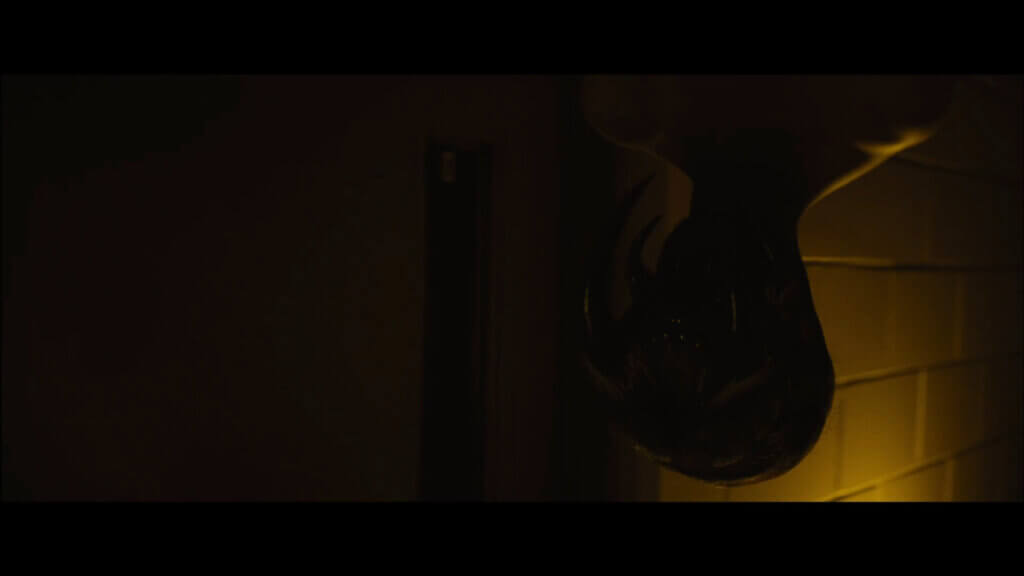
The second spider visual is a surreal sequence where Adam and Anthony both dream of a woman walking down a dark hallway. She has the head of a spider. It’s terrifying. Do note: she’s actually walking on the ground, but the camera is flipped, so the ground is up rather than down. Anthony’s the one who is actually on the ceiling.
This dream follows a fight between Anthony and Helen that occurs after Helen goes to see Adam. She’s clearly unsettled by the fact Adam looks exactly like Anthony. She’s at a loss to explain how someone who looks exactly like Anthony could exist. He says he doesn’t know what she’s talking about. She says, “I think you know.”
Keep in mind that Enemy is Denis Villeneuve’s Fight Club. Adam Bell and Anthony Claire are the same person. Adam’s just in the midst of an identity crisis and we’re seeing his subjective experience of compartmentalizing his life. It’s kind of like how Edward Norton’s character would watch Tyler Durden doing things, only for the film to eventually reveal it was just Edward Norton’s character doing those things.
Anthony’s married to Helen and cheating on her with Mary. He has a second apartment Helen doesn’t know about. He’s trying to become an actor but teaching on the side because acting wasn’t going well.
The problem with Anthony is that he’s self-centered. To be the husband Helen needs him to be, to be a father, means focusing less on himself and more on others. But he doesn’t want to do that. His ego won’t let him do that. His relationship with women means he can’t do that.
The dream represents this tension Anthony/Adam has with not just Helen but women in general. A positive version of this dream would show Anthony and a woman walking side by side, hand in hand, down the hallway, in the same direction. Instead, they’re heading in opposite directions, and one is on the ceiling while the other is on the ground, and the woman is alluring in her physical features but the spider head makes her scary and something to potentially stay away from.
Every 2026 movie I’ve seen, ranked. Became a dad, so catching up. Updated: October 17
All of that becomes representative of the tension and disconnect in Anthony’s relationship with Helen. They’re not aligned, not heading in the same direction.
But now we also have this idea of the alluring physicality of a woman compromised by the spider head. Which provides more context to the club scene, where a physically attractive woman is about to crush the spider. It’s like there’s the sex appeal of the woman at odds with the woman as spider.
The third spider is arguably the coolest. We have this extreme wide shot of the city of Toronto that shows Lake Ontario (which got renamed to Lake America?) and miles of the larger metropolitan area, as well as the downtown skyline. There’s a giant spider that’s taller than any of the skyscrapers.
Again, seemingly inexplicable. But the necessary context comes by looking at the scene right before it. Adam goes to see his mother. She dominates the conversation, criticizes Adam, overrides him. He tells her he doesn’t like blueberries, she says of course you do. He says he wanted her advice, she tells him he didn’t want her advice. Then she tells him to “quit the fantasy of being a third-rate movie actor.”
In that scene, the mother completely neuters Adam and critiques his entire life. It’s like watching a hungry tiger pounce on a sheep.
With that power dynamic in mind, does the giant spider walking across the city make more sense? The mom is the spider. Adam’s life is the city. She’s big. He’s small.
The citywalker spider is actually a direct nod to artist Louise Bourgeois’s 1999 sculpture of a giant spider, Maman. Bourgeois’s own words on the work: “The Spider is an ode to my mother. She was my best friend. Like a spider, my mother was a weaver. My family was in the business of tapestry restoration, and my mother was in charge of the workshop. Like spiders, my mother was very clever.”
Denis Villeneuve on the spider: “Yes, it’s inspired by Louise Bourgeois… We had to make it more dynamic at one point, but this idea of the spider and the mother was a link that was a bit more obvious in the screenplay [and] had to remove. Because I think it was too obvious. The way we approached this movie was very pretentious [laughs] because we were trying to do it on a concrete level and on the subconscious level at the same time. So it affects the audience on both levels.”
Now with that in mind, think back to the beginning of the film and the men watching the spider on the tray. If all those men have women in their lives that make them feel small, that make them feel like insects in a web, how much pleasure would it bring them to see someone step on that spider? In that place, Adam’s the giant. The spider is small. He’s powerful. It’s in danger.
Now we have a better idea of what the film was trying to say about women and spiders. Enemy introduces this binary where a woman is either a sexual object or a mother. And the spider represents the mother.

So a lot of Enemy positioned Adam as a nicer person than Anthony. Anthony gaslights Helen and is kind of rude to her. While Adam, pretending to be Anthony, is sweet to Helen. They share genuine intimacy with one another. You get the sense that maybe, just maybe, they’ll be happier together than Anthony and Helen were.
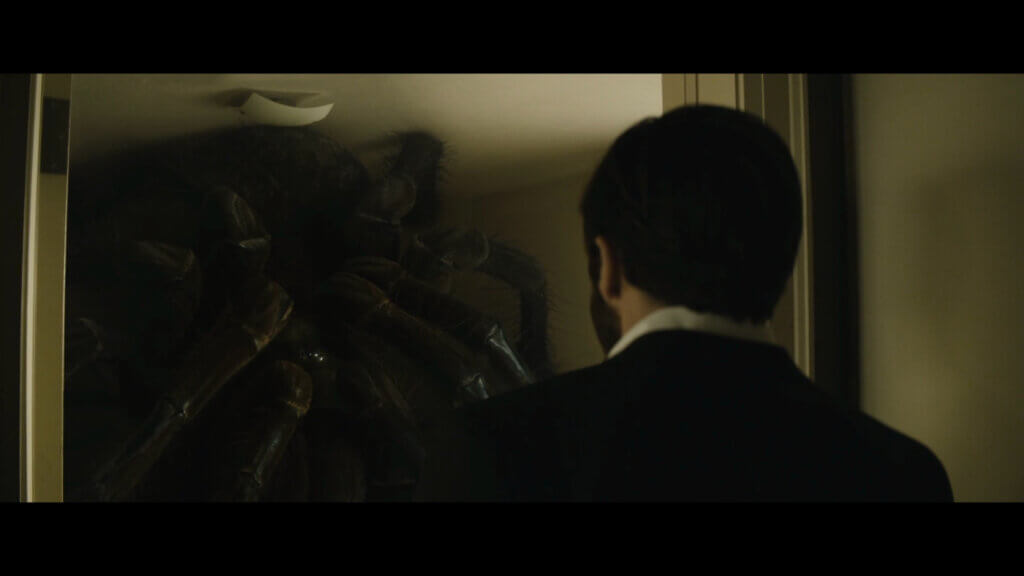
Except at the very end, Adam opens the invitation for the underground club. He makes the choice to go, so lies to Helen about his plans. It’s after he tells that lie that he walks to the room and sees Helen as the spider.
Villeneuve explained he used the spider because, “When I thought about the spider, there was something specific I was looking for, the feeling from this beast, and that main thing was intelligence. I wanted to see that the spider was a beast that has the characteristic of a strong intelligence, and elegance.”
If you rewatch the film, Helen’s pretty perceptive the entire time. When “Adam” first calls the apartment, she recognizes Anthony’s voice so is playing along, thinking it’s Anthony pretending to be a fan. Then there’s that scene Anthony says he doesn’t know what Helen’s talking about and she says “I think you know.” Then, at the end, she notices the man in her apartment is “Adam” and not Anthony. So over and over again, Helen sees through Anthony/Adam.
That’s what’s going on at the end. Some people think it’s Jake’s character who is in danger and Helen’s the monster. Nope. The transformation highlights that Helen sees through Adam’s bullshit. She’s afraid of him, because she knows he’s going to break her heart by cheating and ruining their marriage.
Helen spends the film trying to please Anthony, but her being on the brink of motherhood is something he resents, as he associates “mother” with the criticism and subjugation he experiences from his mom. That’s why Anthony/Adam cheats on Helen with Mary, because she’s just a warm body who comes over and pleases him. He can focus on himself more than her. While Helen demands more of him as a husband and soon-to-be father. He doesn’t want those responsibilities. He wants freedom.
In the interview with Film Comment, Denis said, “When somebody asked me recently to explain the movie, I said: ‘You know what, this movie is a very simple story. It’s a man who decides to leave his mistress and go back to his wife, and we see this story from his subconscious point of view.’ … It’s the simplest story but told in a very complex way.”
Except the man doesn’t go back to his wife, because he’ll keep repeating the same pattern of deceit and betrayal. It’s the wife who realizes something has to change, so changes, and Adam/Anthony recognizes that change, which is why he now sees her as a spider.
For the full breakdown of the film’s themes and meaning, read my giant explanation of Enemy.


Film Colossus Supporters get access to the Frameshift and Active Viewing courses, an ad-free site, the Watch More Films newsletter, and the ability to request movies for analysis. Your support also directly keeps Film Colossus alive while I try to scale it into something sustainable, as it's just me, Chris, who does everything here.
Or create a free account. You gain access to the Active Viewing course and Watch More Films.
Join the Film Colossus community, get the newsletter, and unlock member features as they're added.