Newsletter Subscribe
Enter your email address below and subscribe to our newsletter

So you want to understand Better Man a little better? You’ve come to the right place. While the title tells you most of what you need to know, there’s this whole visual motif through the movie that I absolutely adore and am excited to talk about.
Let’s start by breaking down the first scene and the last scene. As I say in every explanation, looking at those two is the quickest and easiest way to understand what’s going on in a movie.
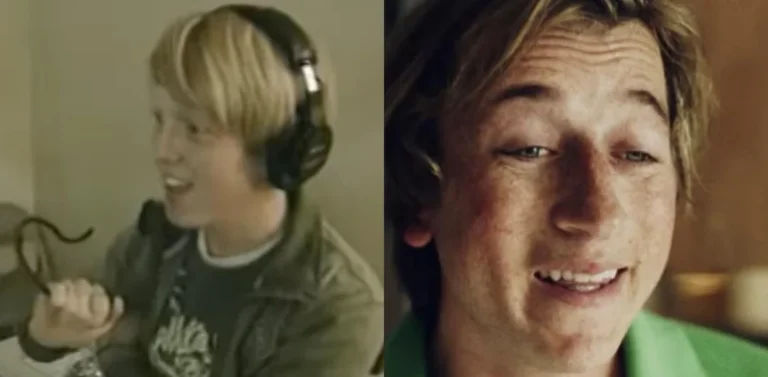
So the movie opened with 12-year-old Robbie not feeling safe. And it ends with him finally at a point where he’s experienced enough, survived enough, and grown enough to provide that safety. But the fight at Knebworth is his biggest failure. Which is ironic because it was the peak of his success. That ties back to what Grandma Betty had said about the dynamic between the spotlight and the heart. When Robbie’s spotlight was at its greatest, his heart was at its lowest.
That’s why the battle culminates with Robbie stabbing his little pirate-self from the school play. It’s a meaningful part of him because that’s when he first experienced a sense of the spotlight. That was the first crowd he ever won over. The first time he ever “lit them up”. There were no negative voices that night. It was a performance of pure innocence and joy. Until he saw his dad wasn’t there. Then Robbie heard the negative voices for the first time.
Notice where Pirate Robbie went as soon as he was done on stage? To a mirror. And he said to himself, “They fucking hate you,” even though everyone had applauded him. The mirror is a huge motif. Even when Grandma Betty made her point about the spotlight versus the heart, she used a mirror to reflect light onto Robbie. Later, Robbie tells his dad he can’t keep track of who he is. And his dad says, “Go and ask that lot out there. They know exactly who you are.” That makes the negative versions of Robbie all the more powerful. Because if those versions of him say he sucks and is horrible, then it must be true, right?
When Robbie finally gets his heart to a better place, the spotlight doesn’t go away. In fact, it finally became something positive and fulfilling. The lesson there is that it’s never too early to do the work to love yourself. And, more importantly, it’s never too late. Just give yourself the opportunity.
If you’ve ever done therapy, chances are your therapist has mentioned some version of inner child theory. It’s the idea that different versions of ourselves never go away. So if you were a scrawny kid, it doesn’t matter if you’re now athletic and powerful, that scrawny, scared kid is still part of you and sometimes influences how you react.
Maybe you grew up poor and you spent your twenties living paycheck to paycheck, often overdrafting your account and seeing those fees pile up. You could have a million dollars in your bank account and still feel a sense of fear when you go to log into your bank account, or when buying new furniture or going out to eat. The logical part of you knows you’re financially okay, but that past version of you might still feel insecure.
So your therapist might ask you to speak directly to that five-year-old version of you who was scared of the dark. Or the 10-year-old who farted in front of the whole class. Or the 15-year-old who didn’t make the team. Or the 20-year-old heartbroken by their first love. Or the 25-year-old who became a corporate drone.
There’s power in acknowledging these versions of you. Because then you can “recognize” them as the source of your reactions and hopefully have the space to choose whether you want to accept or let go of that reaction. And when you can do that, you gain a sense of control that allows you to provide safety and comfort to those parts of you that still hurt.
I first had a therapist do the whole inner child thing with me back in 2023. I feel like, ever since, I see two or three movies every year where I’m like, “Oh this person went to therapy and did inner child work.” The Adam Project with Ryan Reynolds is 100000% an example of that.
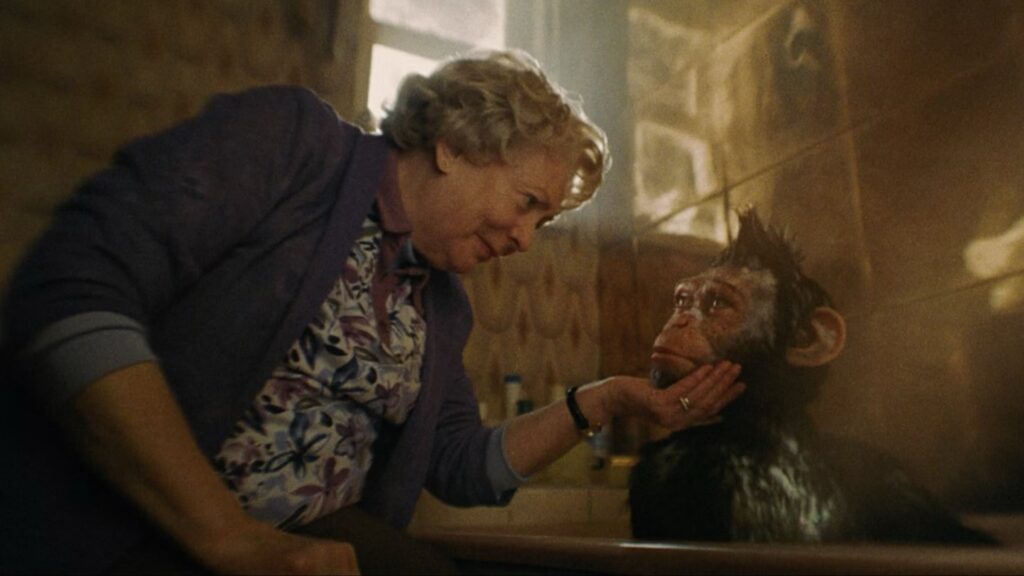
He mentions early on it’s how he sees himself. Later, when he’s at rehab, he admits to feeling “unevolved”. Williams told the Associated Press, “What’s more cheeky than a cheeky monkey? I’ve been a cheeky monkey all my life…. We care for animals more than we care for humans, most of us. I guess there is a removal, as well. It’s very much a human story but if you’re watching it and someone’s playing Robbie Williams, you’re thinking, Does he look like him? Does he act like him? Does he talk like him?”
Michael Gracey, the director, speaking to Deadline, mentioned how he “went back to [old] recordings, and when I was listening to them, I found Rob saying often that he was just dragged up to perform, like a monkey, or it didn’t really matter. He was just up the back performing like a monkey. And he said it enough times that I was like, ‘Oh, that’s how he sees himself. He literally sees himself as a performing monkey.’ And I thought, ‘That would be amazing. I would love to see that film.’ That’s where the idea came from.”

Film Colossus Supporters get access to the Frameshift and Active Viewing courses, an ad-free site, the Watch More Films newsletter, and the ability to request movies for analysis. Your support also directly keeps Film Colossus alive while I try to scale it into something sustainable, as it's just me, Chris, who does everything here.
Or create a free account. You gain access to the Active Viewing course and Watch More Films.
Join the Film Colossus community, get the newsletter, and unlock member features as they're added.