

Newsletter Subscribe
Enter your email address below and subscribe to our newsletter

There are filmmakers who would have tried to take ideas from the Resident Evil games and translate them directly into the film. And then there’s Zach Cregger. Cregger took monster concepts from the games and repackaged them so they feel both familiar and original. Which is pretty Umbrella Corporation of him.
I wanted to go through and provide details on all the monsters in Resident Evil (2026), including their in-game references and inspirations.
There are only two “traditional” infected in Cregger’s Resident Evil. The first is the woman Bryan hits on the road, who ends up being the wife from the farmhouse. The second is her husband, the man who charges at Bryan in the bedroom of the farmhouse.
While these are the basic T-Virus infected, they aren’t as decayed as the ones in the games, nor do they shamble. The woman sprints and shows flashes of intelligence that we don’t associate with the zombies from the games.
Many of the monsters in Resident Evil reflect Bryan’s fear around starting a family. The film starts in the middle of the conversation where he finds out his girlfriend is pregnant. He doesn’t do a great job of being there for her because he’s too focused on himself. It’s fitting, then, that the first infected he meets is this woman who surprises him. Then her husband.
The farmhouse dog that chases Bryan initially seems normal, rather than resembling the infected Dobermans from the first two games. But then its entire face opens and tentacles lash out and grab Bryan. So definitely infected, just a different take on the trope.
Both the original Resident Evil and Resident Evil 2 feature the Cerberus enemy. They’re pretty much zombie Dobermans. Resident Evil 4 introduced dogs infected by the original Plaga parasite. These are called Colmillos and have tentacles that erupt from their backs.
Resident Evil 5 added the Adjule, dogs with faces that split in half to reveal a much larger, more terrifying mouth. These are a byproduct of the Type-2 Plagas.
Cregger does not introduce the Plagas parasite in this film, so the traits of his mutant dog are simply a nod to the Plagas. I imagine it was supposed to be something fans of the games would recognize and appreciate. But the inclusion of Plagas traits has mostly sent fans spiraling into debate about Cregger’s use of the T-Virus.
Inside the farmhouse, we see a photo of the wife, husband, and their dog. They’re a seemingly happy unit. It’s this kind of grown-up life that Bryan’s afraid of.
The first version of the amalgamation monster forms before Bryan’s very eyes. He has just defeated both the farmhouse husband and wife, who seemed like your regular T-Virus zombies. Except tendrils come out of both, find one another, then bring the bodies together to start a merging process. The result is two bodies merged at the base of the neck, with four arms and four legs.
Fans have called this the Stalker because of how it trails Bryan. Cregger has called it the Human Tumbleweed because of how it rolls using the arms and legs of the bodies it collects. I call it the amalgamation monster because of how it keeps gathering bodies to grow larger.
The Amalgamation monster has three game parallels.
First is Nyx from Resident Evil Outbreak File #2. Nyx is a T-Virus monstrosity that uses tentacles to “incorporate” people into its body. It even has a large eye as part of its torso.
Second is Dhurlga/Durga from Resident Evil Revelations 2. This creature comes from the Uroboros Virus, which allows it to absorb parts from nearby bodies. The Dhurlga fuses together the bodies of several enemies known as Revenants, so it has a cluster-of-limbs appearance like Nyx.
Last is Nemesis from Resident Evil 3: Nemesis. The villain is known as the Pursuer because Nemesis stalks the player throughout the entire game The movie monster doesn’t physically resemble Nemesis in any way, but the function is similar.
Bryan’s whole deal is that he’s scared of starting a family. Psychologically, that’s rooted in the fear of losing your identity and individuality. When you aren’t married and don’t have kids, you don’t have to be responsible to or for anyone else. But both marriage and parenthood involve sacrifice. You can’t do what you want, when you want, because a good partner and parent compromises for their partner and child.
Instead of going home to talk to his girlfriend, Bryan takes another job, because it gives him an excuse to run away. Running from the monsters becomes an extended metaphor for his reluctance to give up some of his individuality and become part of a family unit.
The Human Tumbleweed/Stalker/Amalgamation monster perfectly embodies this fear of joining.
The little girl in the RV says her mom bit her. We’d expect the typical T-Virus infected from the original two games. Instead, the girl’s foot has become a mass of tentacles. To the surprise of both the girl and Bryan, the tentacles lunge at Bryan. She screams for him to help her, then her face, like a flower blooming, splits open. Inside is a single eye and lots of teeth. The folded back face gives the appearance of petals.
Personally, I think RV Girl is a nod to the Ivy enemy from Resident Evil 2. Umbrella scientists created a parasitic plant, then selectively bred it into this bipedal flower with a giant bulb for a head that opens to reveal teeth and a mouth.
The RE2 remake changes both the backstory and the design. Its Ivy are humans infected with Plant 43. Instead of the giant bulbheads, they’re far more humanoid. They also have mouths like a Venus flytrap.
I mean, come on. Bryan is freaking out about becoming a dad, and here he finds this little girl who is scared and wants a parent figure to help her. It’s the exact kind of responsibility he’s afraid of. And of course it’s this little girl who bites and infects him.
The bite is fascinating. Because in the world of the film, it’s clearly a bad thing since the bite infects him. But thematically, I think you can read it positively. It’s a trope where someone who doesn’t want kids is forced to interact with a kid and the experience changes their mind. It’s what’s known as the Lone Wolf and Cub dynamic. It’s in Jurassic Park, The Last of Us, Logan, and many more.
Every 2026 movie I’ve seen, ranked. Became a dad, so catching up. Updated: October 5th
While it’s common in fiction, it’s also a common occurrence in real life. Within a social group, one couple having a child often leads to others having children.
From Psychology Today: “When a social network member has a child, childless individuals and couples are able to learn about the joys and challenges of parenthood…. Contact with friends’ and siblings’ babies may trigger an emotional response among some childless adults, spurring a desire for their own children.”
So in a grounded movie, you’d show Bryan at the mall and this kid asks him for help because she can’t find her parents. Suddenly being in that caregiver role ignites a dad-ly fire within him. He’s bitten by the baby bug. But in a horror film serving as an extended metaphor for Bryan’s emotional journey, the “bite” becomes literal.
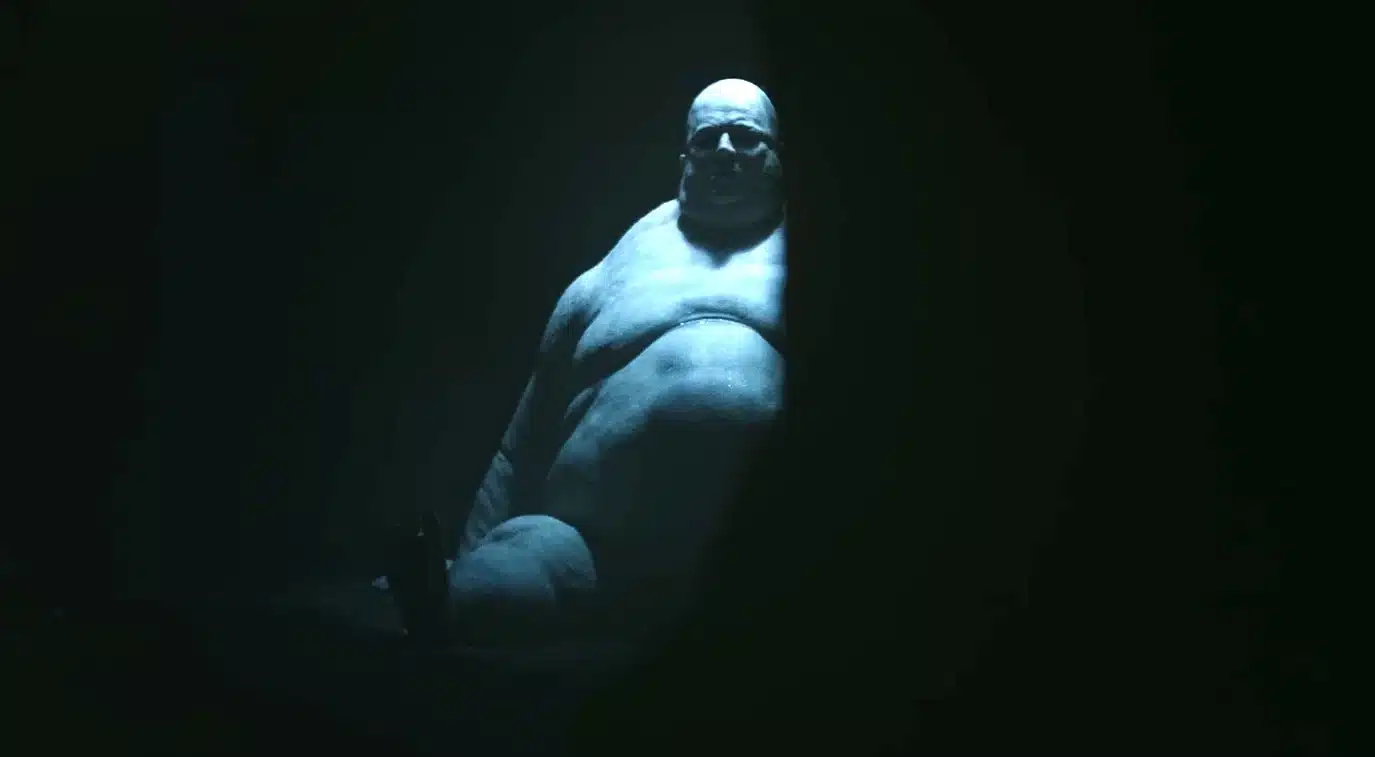
The obese guy in the sewer is one of the most shocking visuals in Resident Evil. How did he get there? How long has he been there? In one interview, Cregger mentioned that they had built a 2,000-pound puppet. That came out before the movie released, so we didn’t get details, but I imagine this guy was the puppet.
Cregger actually cited Cormac McCarthy’s novel Blood Meridian as inspiration, specifically the novel’s villain, Judge Holden. The most succinct description is: “Towering over them all is the judge and he is…dancing, his small feet lively and quick and now in doubletime and bowing to the ladies, huge and pale and hairless, line an enormous infant.”
After mentioning Blood Meridian, Cregger continued: “I don’t have a Nemesis in this movie. A gigantic, hulking terminator that’s following you. But this is also a little bit of a nod to the Nemesis.”
We mentioned Nemesis earlier. The titular villain from Resident Evil 3: Nemesis is a T-Virus variant known as a Tyrant. The Tyrants are larger than other monsters and are some of the most memorable of the entire franchise.
In terms of body type, the Sewer Man most closely resembles the Whopper from Resident Evil 6. The Whopper is a byproduct of the C-Virus. It’s very bulbous and pale. The sewer creature in the movie is far, far larger, but you can see how the Whopper would provide the foundation.
Cregger said Blood Meridian was one of his favorite books. Anyone who loves it is well aware of Judge Holden’s descriptions. They’re some of the novel’s most discussed passages, and the “enormous infant” like is arguably the most iconic. It’s one of several places where McCarthy describes Holden as childlike or a baby.
You can see how that connects to Bryan, right? In the sewers, he arrives at this physical manifestation of the exact thing that’s on his mind. Just like the married couple at the farm, just like the little girl in the RV.
For some reason, there are dozens of infected on the various rooftops of one street. And they all start throwing themselves at Bryan. To sneak a bit of opinion in here, this feels like the weakest concept in the film. It’s weird behavior for the infected, and it seems arbitrary that they don’t regenerate. Not to mention that it’s kind of strange that all of the infected on that street are on the rooftops and not, like…streaming out from the buildings.
I couldn’t find anything satisfactory here. If you have any suggestions, leave a comment.
In the theatrical version of the movie, I struggle to find a real connection here. Maybe something about Bryan not wanting to take the leap? But that feels like a reach.
However, a script from 2023 leaked and someone on Reddit noted that “The Zombies diving off the buildings in the script are all fused: Mother and daughter, Man and dog, three children, etc.”
That draft version ties into the established theme of Bryan’s fear of “fusing” with his girlfriend and baby.
As is, though, I don’t see an obvious thematic connection.
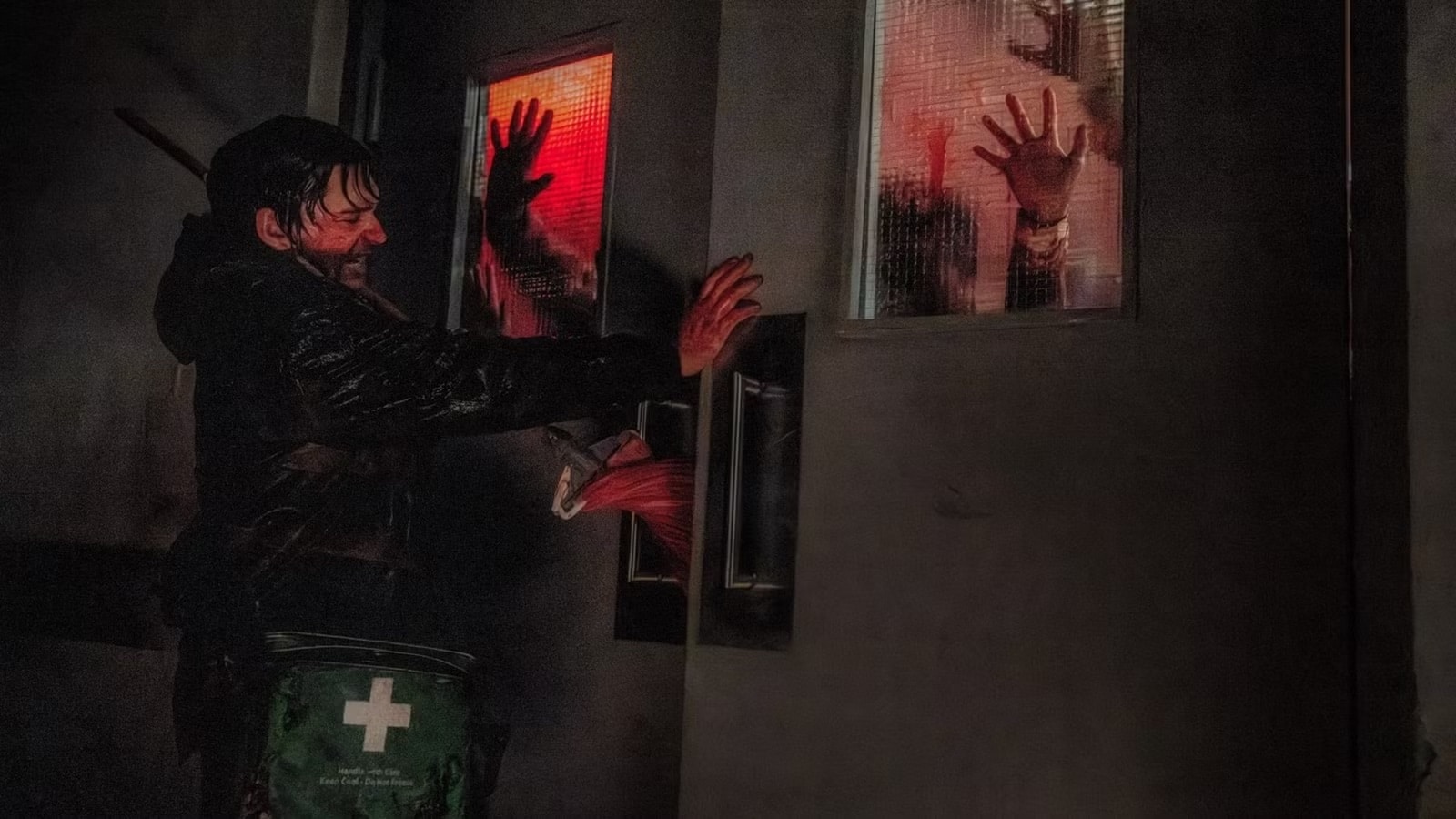
The Puker rains acid down on the elevator Bryan’s using to reach the hospital’s 24th floor. It’s not aimlessly upchucking but actively targeting Bryan.
Resident Evil 6 has C-Virus-infected zombies who spit stomach acid.
There’s also the Fat Molded from Resident Evil 7: Biohazard. These very ugly enemies also spit bile. And did I mention they’re super ugly, just like the Puker in the film?
Like the rooftop zombies, I don’t see an obvious thematic parallel. Some people on Twitter offered that it might tie in to morning sickness or how newborn babies spit up. I can see that, but it feels more like a reach to me than the farmer couple and RV Girl.
In the maternity ward, Bryan bumps a bassinet, and that triggers a sac to swell. Bryan, being the doofus that he is, stands there until the sac bursts, spewing gunk all over him. He watches from the floor as the long, spider-like arms appear. A head rises. There are a bunch of eyes. Before this abomination fully emerges, Bryan clubs it with a broom handle.
Cregger has mentioned Baby from Resident Evil 8 as his favorite scare in the game series. “It was the only time playing a video game I’ve ever actually just noped out and taken a break.”
While the Spider Baby in the film is not Baby, the arms are a prominent part of the RE8 design. So I could see it being part of the inspiration.
We’re in a maternity ward and Bryan comes face to face with a baby. The thematic connection smacks you in the face.
Once Bryan defeats the Spider Baby, the entire room descends into chaos. All these sacs burst to reveal the infected hospital staff. Why were they in cocoons when other infected weren’t? Who knows.
Capcom’s official Resident Evil site explains that “When [C-Virus] mutations exceed a certain threshold, the host is enveloped in a chrysalid, emerging shortly after as a complete mutation.” I would imagine that’s the reference here.
Bryan sees a baby in a maternity ward, then has a bunch of zombies chase him. If that’s not a metaphor for being stressed about having a kid, nothing is.
Bryan’s mutation is the most monstrous of all. Loads of tentacles emerge. A hungry, hungry mouth opens in his chest. Everyone he eats becomes part of the mass protruding from Bryan’s back. His left arm is gigantic. A new eyeball has taken over the left side of his head. By the time he roars at the approaching helicopters, Bryan’s features are barely recognizable as the mutation overwhelms his body.
Bryan’s final mutation has a dozen kicking legs on his back from the scientists he consumed. This recalls the Human Tumbleweed that pursues him over the course of the film. So Nyx is an obvious reference here.
But the human/monster duality recalls William Birkin from Resident Evil 2, also known as the G-Creature. Birkin infects himself with the G-Virus, which causes rapid, evolving mutations. Throughout the game, you fight five different versions of Birkin. In his first form, Birkin is still mostly recognizable and looks really similar to Bryan’s transformation in the film. Especially the big eyeballs.
This is my favorite part of the film. In his voice memo to his girlfriend, Bryan explains he was afraid of change, that he didn’t want to grow up, even though he knew it was inevitable. That’s what having a kid does: it changes you. That creates a throughline from RV Girl infecting Bryan to his transformation. Bryan’s resisting the existential change that comes with being a father, only to have a physical change occur because he tried to help a child.
There are a lot of different ways to take that. Here are two I like:
The first: Bryan posits that change is inevitable. If we accept that premise, then the film essentially makes the case that we can embrace healthy change or resist and find ourselves victims of negative change. If Bryan had gone home to speak with Michelle, that’s walking the path of healthy change. By not doing that, he heads down the darker path.
The second: If you view the movie as representational rather than literal, then Bryan finally changing at the end isn’t necessarily a bad thing. He was afraid of changing, afraid of the responsibility of being a father (and probably a husband) and the loss of individuality that comes with it. At the end, he changes into the kind of person who is okay with making room for others in his life. Cregger just shows that in an exaggerated way that fits the genre.
If that second idea sounds crazy, I give you a quote from a Zach Cregger interview: “[Bryan’s] life right now, without his choosing, has reached a really crucial fork in the road. It’s like, am I going to embrace change and take a leap into something that’s terrifying, but potentially going to improve my life? Or am I going to dig my heels in and try to freeze time and stay exactly where I am, which is comfortable, even though he realizes that’s not possible?”


Film Colossus Supporters get access to the Frameshift and Active Viewing courses, an ad-free site, the Watch More Films newsletter, and the ability to request movies for analysis. Your support also directly keeps Film Colossus alive while I try to scale it into something sustainable, as it's just me, Chris, who does everything here.
Or create a free account. You gain access to the Active Viewing course and Watch More Films.
Join the Film Colossus community, get the newsletter, and unlock member features as they're added.






I thought the throwing up monster kind of represented the fear of the visceral aspect of pregnancy, where pregnant women throw up. I saw the sewer guy in that lens too, like we see his belly inflated like a pregnant woman and this thing inside it trying to get out like how the baby kicks inside the womb.