Newsletter Subscribe
Enter your email address below and subscribe to our newsletter
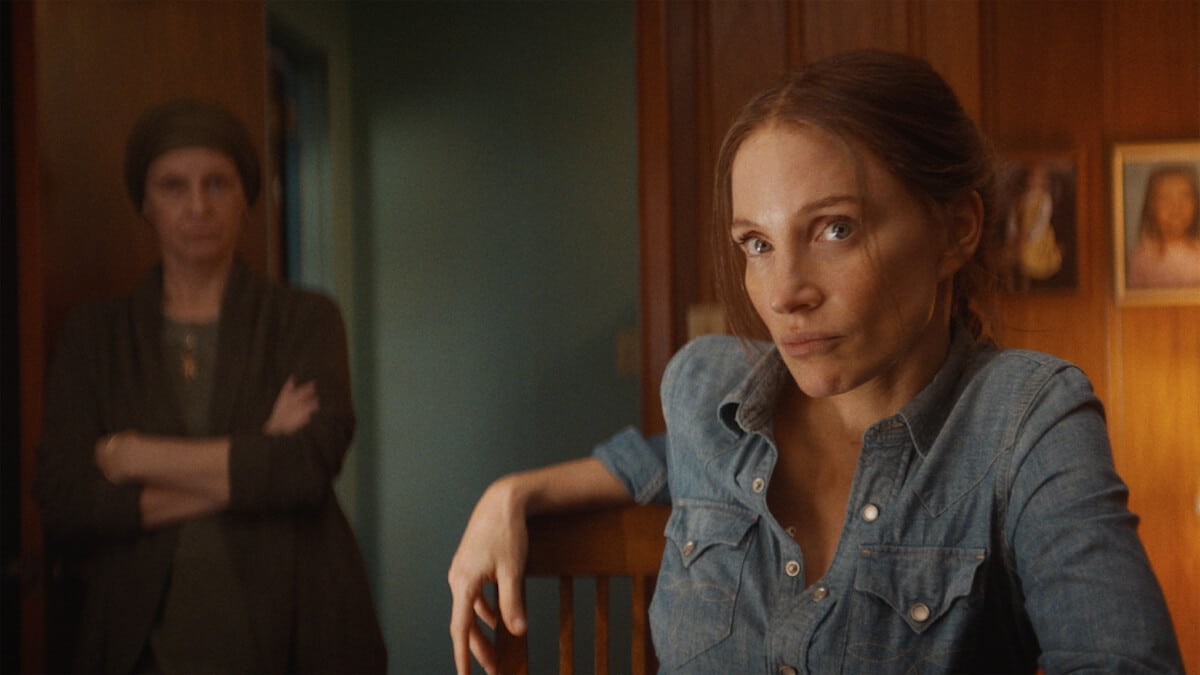
A lot of people are wondering what exactly happened in the Netflix movie Heartland, which has been the #1 movie on Netflix for two days running now. Starring Jessica Chastain as Misty Jones, the film produces the biggest questions in regards to Charlie Heart’s disappearance, which turns out to be a carefully staged deception.
The mechanics of this neo-noir plot are worth exploring and explaining. But an examination of those plot threads leads us toward something deeper—the vulnerable core of this movie, which features abused people who must learn to reintegrate into the very world that broke them. We’ll explore Heartland’s confusing plot, and in turn shine a lot of the movies themes of identity and public perception, of freedom and isolation, of justice and moral ambiguity.
Charlie Heart is alive. She fakes her murder to escape Roy Combs, who had exploited her and used compromising material to keep her under his control.
Once Misty Jones learns the truth, Roy tries to take out Misty. The only way to truly expose Roy is to find the laptop where compromising pictures and videos of Charlie are stored. Misty finds the laptop in Roy’s car after she forces him to crash it.
Roy survives and faces legal consequences after Charlie tells the world about what he did. Misty goes to prison because of all the violence she inflicted while trying to solve Charlie’s disappearance. The movie ends with Charlie independently pursuing her music career and Misty returning to watch her perform.
The deeper reading
The deeper reading here is that both women, Misty and Charlie, spent years trying to escape their pasts. Misty was plagued by her bad-girl image and her inability to care for Charlie, while Charlie was traumatized by what Roy had done to her. The ending thus offers them a way forward: Charlie is able to write her own lyrics and tell her story through music, while Misty is able to move forward knowing she and Clark Allen West did what was best for Charlie.
She staged her own murder because Roy was blackmailing her. He made threats against Charlie, making her believe she couldn’t escape.
Charlie had attempted to obtain a restraining order against Roy. But with so much pull in Nashville, Roy had done enough favors for officers like Detective White over the years that Charlie couldn’t seek legal protection.
In order to escape her hellish life under Roy’s control, Charlie fakes her own death.
To stage the murder, Charlie planted some blood at her home, as well as her bloody sweater in her stalker Jared Granger’s home.
The deeper reading
Charlie only returns to Misty so that she can escape Nashville and live quietly with her biological mother. Charlie’s proposed life comes to resemble Misty’s decades-long self-imposed isolation. This forces Misty to realize that hiding forever doesn’t make you free. Misty had tried that for years, but she was still plagued by her demons, resorting to drugs and alcohol in order to cope. She understood that disappearing would only allow Roy to destroy her career without needing to kill her. By helping Charlie to reclaim her life, Misty could start down the road towards reclaiming her own as well.

Misty’s investigation into Charlie’s disappearance points toward several different suspects, but eventually leads her to Roy as the culprit. Several different clues guide her down this path. While there is logical consistency between the clues, the clue that actually leads Misty to suspect Roy, the betting numbers, is a bit more flimsy. Let’s cover how it all plays out.
The pickup truck becomes Misty’s main device for figuring out who made Charlie disappear. Early in the movie when Misty first arrives in Nashville to investigate Charlie’s disappearance, the black Ford F-250 adorned with hunting lights runs Misty off the highway. Then, security footage outside Charlie’s home reveals that that exact truck showed up to pick her up the night she disappeared. She then knows that by finding the owner of the truck, she can zero in on who caused Charlie to go AWOL.
At first, she suspects Jace Jacobs, a popular country singer who had been Charlie’s boyfriend. Misty’s brother and Charlie’s stand-in father, Donny, didn’t trust Jace and considered him a suspect. When Misty discovers a black Ford F-250 outside Jace’s tour bus, she becomes sure of his guilt. But Jace reveals that the truck belongs to his manager, and that his relationship with Charlie was purely contractual.
Eventually, Misty suspects Roy. She visits his home and discovers he owns a black Ford F-250. Hidden in the truck’s bed are a set of hunting lights.
Jared was known by everyone in Charlie’s camp and the authorities as a stalker of Charlie. It’s never made clear why Jared has Charlie’s “bloody” sweater in his shed—perhaps he broke into her home and stole it after Charlie staged her murder, or perhaps Charlie involved him directly because she knew it would seemingly confirm her “death” to authorities. Regardless of why Jared has the sweater, his psychotic obsession with Charlie causes him to attack Misty after she retrieves it. Roy shows up just in time to shoot Jared, making himself look like a hero.
Jared then goes into critical condition at the hospital, where Roy claims he makes a full confession to Charlie’s murder. But remember: we never actually hear this confession ourselves. And since Charlie is alive, the claim is questionable at best. Jared is never officially declared dead in the movie.
Misty originally suspects Roy because of the gambling note she finds at Charlie’s house. The note reads “+42/-42”. She doesn’t know what it means at first, but after visiting a bar, she learns that it refers to a “point spread” in sports betting. This refers to the margin of victory in a game, rather than the amount of points a team scores. In the case of “+42/-42”, for instance, the underdog is assigned the positive number and can win the bet by either winning or losing by fewer points than the spread. It works vice versa for the favored team.
Knowing that Roy is plagued by gambling debts, the note causes Misty to suspect Roy was in Charlie’s house the night she staged her death. Later on when Misty confronts Charlie about planting the note at the crime scene, Charlie doesn’t confirm or deny planting the note, and just says, “I just wanted everyone to stop looking for me.”
The confusing part
The only confusing part of this plot point is that Charlie was seemingly trying to frame Jared, the stalker. But introducing the point spread note makes it seem like she was trying to frame Roy as well. While Charlie might not like Roy, framing him doesn’t make as much sense because A) he is blackmailing Charlie with the compromising photos and B) it makes Charlie’s fake murder less stable to involve two different parties.
Roy has two main motivations for wanting Charlie dead. First, he wants to prevent Charlie from exposing his exploitation of rising country music stars. Second, he stands to financially benefit from her death through a life insurance policy. This payment would cover his gambling debts.
Part of Roy’s cover for his abusive behavior is his public image as a generous music executive. He originally discovered Charlie after reaching out to her on social media when she was just a teenager. He then groomed her, giving her the Saturday night top slot at his club and making her a “Heart Sister,” leading to a career where they were selling out stadiums.
Every 2026 movie I’ve seen, ranked. Became a dad, so catching up. Updated: October 17
Because he considered himself responsible for Charlie’s success, he regarded her career as something she owed to him, which became his justification for controlling her. During Charlie’s ascension, Roy had taken sexual advantage of her when she was just 16 years old. Threatening to use the compromising pictures and videos stored on his laptop of her, he malevolently controlled her career. There’s a similar dynamic in Priscilla, where a young woman struggles to establish her own identity under the control of a powerful figure in the music industry.
Roy had taken out a life insurance policy on her as part of her record contract, so her actual death would have proved financially valuable to Roy, allowing him to cover his gambling debts. Charlie herself says, “I’m worth way more to Roy dead than alive.”
The deeper reading
Roy ultimately wanted Charlie dead so he could maintain his control and sway in the country music sector. Roy was emboldened by the people who enabled him, and his power depended largely on the willingness of others to protect the system in place that they benefitted from as well. Detective White protected Roy by discouraging Charlie from pursuing legal recourse. And Buck, who is indebted to Roy, tries to stop Misty from pursuing her vigilante investigation. This entire dynamic hovers like a phantom above Misty, who for years was plagued by the industry’s politics and never felt she could truly own her story.
Two of the movie’s biggest twists involve the public’s misunderstanding of Misty’s past. This is important thematically, as the public’s perception of Misty’s life doesn’t allow for grace when that is what Misty needs most. Let’s examine both reveals.
Misty and Clark are Charlie’s biological parents, but Donny and Janet raised her. As revealed during the conversation between Misty and Clark at the end of the movie, they saw themselves unfit to raise a child, especially given Misty’s alcoholism, volatile personal circumstances, and ambitions as a performer. Then her continual refusal to engage with Charlie over the years and tell her the truth about their relation intensified her guilt, and thus intensified her alcoholism and volatility. It also made it harder to pursue the career she kept in exchange for her daughter, leading to her eventual abandonment of the industry. In the end, however, we discover Charlie doesn’t judge Misty for her decision, as Charlie now knows how emotionally abusive and draining the music industry can be.
At the tribute concert for Winnie Jo Lean, we learn that Misty took public responsibility for an injury Winnie obtained when her abusive husband struck her in the mouth. This apparent “rivalry” was then played up by the press, painting Misty as a bad girl and Winnie as an angel, despite a longstanding friendship and selfless sacrifice. This changes the world’s perception of Winnie. While it doesn’t excuse Misty for her troubles over the years, the sacrifice does help color why her behavior got so out of control. She’s desperately in need of an empathetic shoulder, but has nobody to turn to—partly because she pushes people away, but also because the world turned its back on her.
No, Roy doesn’t die. While we don’t receive visual confirmation of his status, Misty explains to Charlie that she chose to keep him alive so he could serve out his prison sentence. Plus, we later see Roy walking out of a courthouse after Charlie reveals that Roy not only took sexual advantage of her but several other young women.
Violence is not consequence-free, so Misty goes to prison for her stint with vigilante justice. While she did uncover multiple wrongdoings that exonerated Charlie, she brutally injured at least two different parties: Misty knocked Buck unconscious on the way to Winnie’s tribute concert, and she cut off Roy’s finger so that she could access his laptop.
The conversation between Misty and Clark allows them to reckon with their decision to give Charlie up for adoption. Ultimately, they were not ready to be the parents Charlie would have needed. “I’d like to think we’d figured it out,” says Clark, “but that doesn’t seem to be our style. We made the best decision for her at the time.” Misty expresses the feeling that she’s had to “live with that,” live with “that feeling, it’s like a punishment every day.” But Clark tries to alleviate Misty’s regret, saying that Charlie came to visit Clark and said she had already forgiven both her biological parents.
Then Clark begins to question himself, blame himself for what happened to Charlie. So Misty gets into the bathtub with Clark and hugs him. There’s nothing romantic there. It’s purely a moment for them to reconnect, to help each other move past a painful, but necessary decision they made a long time ago, one that continues to haunt them, continues to shape them.

The final scene of the film features Charlie performing “Still the Sparrow Sings” at the Bluebird Cafe while Misty watches. Charlie has survived Roy’s exploitation and plans to release her music independently. There are three ways to think about this sequence.
Charlie has gone from being managed and manipulated by Roy, an empowered individual with sway in the industry, to performing independently. The significant change here isn’t that she became a successful singer—she was already successful. The real change here is that she can now pursue that success without submitting to the person who exploited her. Roy might have given her the chance to become a superstar, but it was always Charlie who had the talent to do so.
During Charlie’s visit to prison, she asks Misty to sing with her at the Bluebird Cafe. Misty declines. This matters because Misty had at one time built her entire personality and career around being an acclaimed performer. Now she’s content supporting Charlie rather than returning to the stage herself.
Then we must consider the lyrics of the song itself and why its placement at the end matters. Director Shana Feste confirmed that Carter Faith, the actress and real-life country music star who played Charlie, wrote the song “Still the Sparrow Sings” for the film and that she deliberately held the performance for the ending. “When I heard it,” Feste said, “I thought, ‘This is where a song does so much work for me, so much storytelling for me. This is all I needed to hear from her about her journey, these lyrics.’ I wanted to support the twist by showing her really just performing at the end of the film.”
The lyrics clearly speak to Misty’s self-imposed isolation, and how Charlie almost went down the same path. Lines like, “Kicked up gravel, dug up every bone/I ran everywhere except for home,” and “I got drunk on losing who I was/But I could never seem to drink enough” are more literal nods to Misty.
But the chorus provides more depth and insight:
The sky falls down and your heart breaks
You see the storm and fly away
And then you wake and feel the sun
After all that’s said and done
The willow, it may weep
But still the sparrow sings
This really speaks to Misty’s entire journey, one that forced her to come out of hibernation and step back into a world that had previously broken her. Fame had caused Misty to become a volatile presence, causing her to alienate everyone around her through drugs and anger. Even leaving the country music industry didn’t allow her to escape, as eventually her biological daughter stepped into the spotlight, keeping the industry’s troubles in her peripheral view. Running away can’t keep your demons away. They will always hover, and you’ll have to face them. Your heart can break, you can weep. But if you listen through the darkness, you’ll hear a sparrow singing. You’ll hear a beautiful voice, perhaps your daughter’s, and you’ll know there’s a path forward. Maybe then you’ll be ready to stop running.
After writing this entire article and thinking about the film’s ultimate deeper meaning, three major themes stand above the rest.
We see three different women who were forced to live with versions of themselves that were shaped or controlled by other people.
First, Charlie is controlled by Roy, who demands secrecy and an intense work schedule. Before she’s old enough to understand and navigate the complexities of the music industry, he has taken advantage of her, both physically and emotionally, and trapped her in emotional stasis, to the point where she wants to escape the world completely.
Then there’s Misty, who is forced to don the bad girl image. While Misty made plenty of bad decisions that led to this label, she was also unfairly backed into a corner after Winnie’s abusive husband struck Winnie. This reputation would follow Misty for the rest of her life, causing her to live with a chip on her shoulder, unwilling to trust others or form close connections.
And Winnie confronts public perception of her true self as well. She was labeled an “angel,” despite the fact that she feels she betrayed her best friend after letting Misty take the blame. She also couldn’t expose her abusive husband to the world, as they were supposed to maintain a loving relationship for public perception.
This struggle between public image and personal identity is also central to Perfect Blue, another psychological thriller about a young performer whose life is increasingly controlled by the people around her.
Charlie believes that by staging her own death, she will achieve freedom from an industry that has caused so much pain. But Misty displays the emotional costs of withdrawing from the world. Thus, Misty has crucial insight she can pass onto Charlie. In turn, Misty is forced to confront ugly truths about herself she had spent years trying to avoid. By doing so, she doesn’t just set Charlie free, but provides herself an opportunity to overcome those demons.
In true noir fashion, moral ambiguity is a meaningful part of Heartland’s discussion. One of the most fascinating aspects of the movie is its presentation of not just justice, but the idea of justified justice. Jared and Roy might have gotten what they had coming to them, but is it justified if it requires extreme violence? The movie doesn’t provide answers to these questions, but instead presents a thoroughly flawed central character, Misty, who does what she believes is necessary to protect her daughter.
The ultimate takeaway
Charlie and Misty begin in different circumstances, but both believe distancing themselves from the past is their only means of survival. Their eventual relationship provides another possibility.

Film Colossus Supporters get access to the Frameshift and Active Viewing courses, an ad-free site, the Watch More Films newsletter, and the ability to request movies for analysis. Your support also directly keeps Film Colossus alive while I try to scale it into something sustainable, as it's just me, Chris, who does everything here.
Or create a free account. You gain access to the Active Viewing course and Watch More Films.
Join the Film Colossus community, get the newsletter, and unlock member features as they're added.