Newsletter Subscribe
Enter your email address below and subscribe to our newsletter

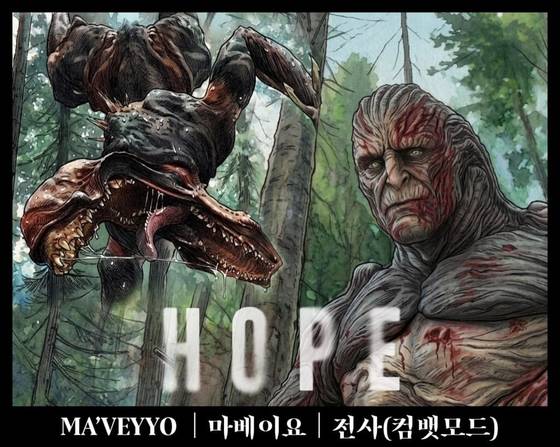
Hope ends with a conversation between J’aur and Ma’veyyo, a conversation that sets up a sequel Na said he already wrote. This happens after they watch a giant warship break through the clouds then crash into a distant mountain, exploding on impact.
- J’aur: Ma’veyyo
- Ma’veyyo: Majesty.
- J: Do you see what I see?
- M: The Emperor’s ship is falling.
- J: What is upon us?
- J: We must reach him immediately! Are you able to run?
- M: There is no time, your majesty. Only three molli remain.
- J: The Emperor’s ship has fallen!
- M: It is a tragedy, but it is done.
- M: Falter not, Your Majesty. In the name of Gh’ertu, I shall find the Prince. I shall change his destiny. This heart will revive His Highness. Should his destiny change, so too shall all of ours.
- J: In a recent dream, the Emperor came to me.
- Ma’veyyo: Majesty.
- J: He spoke to me. He said faith is evidence of what we do not see. What I am seeing now is not evidence. What I long for has not been realized yet. Ma’veyyo…
- M: Majesty.
- J: Bring forth true fate.
Before diving into the larger concepts, some context about the conversation.
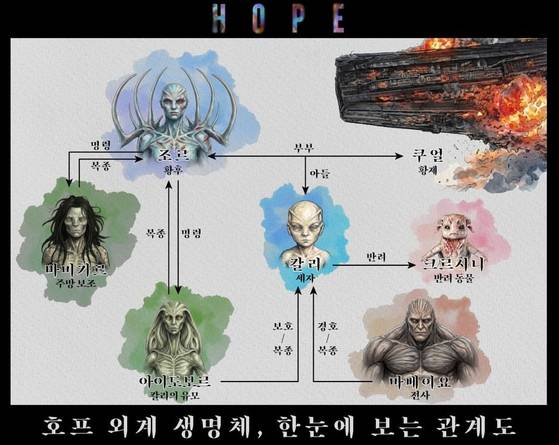
- The ship belongs to Ku’er, the emperor of wherever the aliens come from.
- J’aur is the empress, wife of Ku’er.
- Kali, the one Yang-bae had in the freezer, is the Crown Prince, son of J’aur and Ku’er.
- The heart Ma’veyyo pulls out is the same unknown organ the doctor found in the alien that attacked Hope Harbor. cha
- We don’t know what brought down Ku’er’s ship, but the director, Na Hong-jin, described it as a warship. That implies to me that there might be some larger conflict going on that we’ll find out about in the sequel.
- Also, “moli” refers to a unit of time. So Ma’veyyo is essentially saying they have a limited window to revive Kali.
I went much deeper into who J’aur, Kali, Ku’er, Ma’veyyo and the other aliens actually are in this breakdown.
The conversation is a kind of plot twist because up to this point in the film Hope had presented the aliens less as people and more as creatures. So to have this realization that these aren’t monsters or feral beings but civilized, intelligent beings displaying a broad range of emotions…yeah, that’s a whammy. It means that the perception people have had for nearly three hours has been wrong and they now have to ask themselves if they jumped to conclusions too quickly.
Na Hong-jin structured Hope to play with viewer expectations, all the way up to the very end of the film.
In a conversation with the Roger Ebert website, Na said:
These human characters talk about progress and how far they’ve come, but seeing the aliens arrive also makes them reflect inward and look back. They now feel strange about what they’ve done in the past and are unsure how to behave and live in light of the revelation…. They are the aggressors in the story…
But the aliens are the victims, and their conversation is inverted. They talk about how, no matter what has happened to us so far, we have to move forward, not lose hope, and keep believing in the future. The film concludes by intercutting between these conflicting powers, and I thought that was the most ideal ending.
Na’s description of “conflicting powers” means these groups have become symbolic for larger worldviews. The humans carry this negative weight, while the aliens have this positive purpose. Except that’s not how it initially seems.
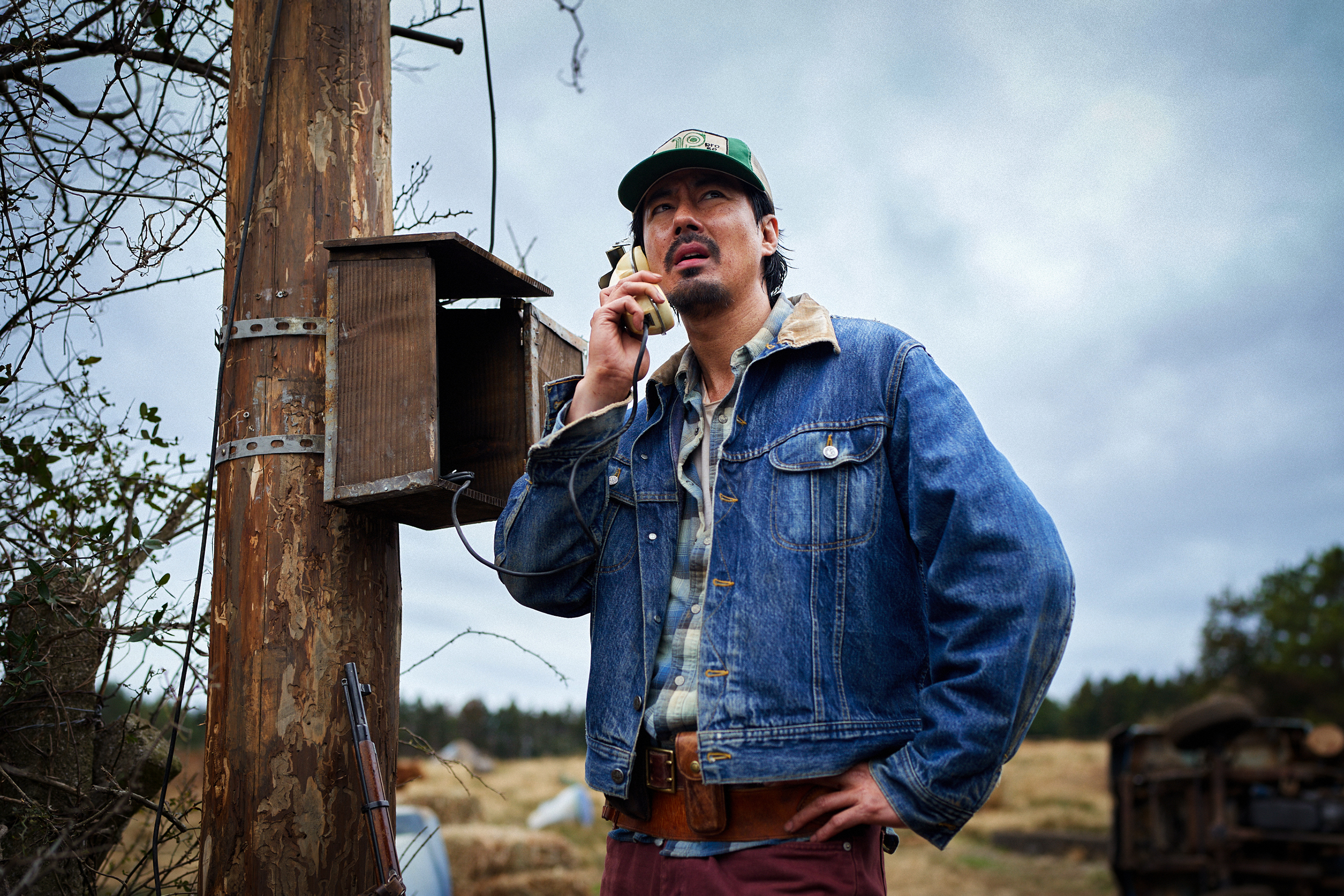
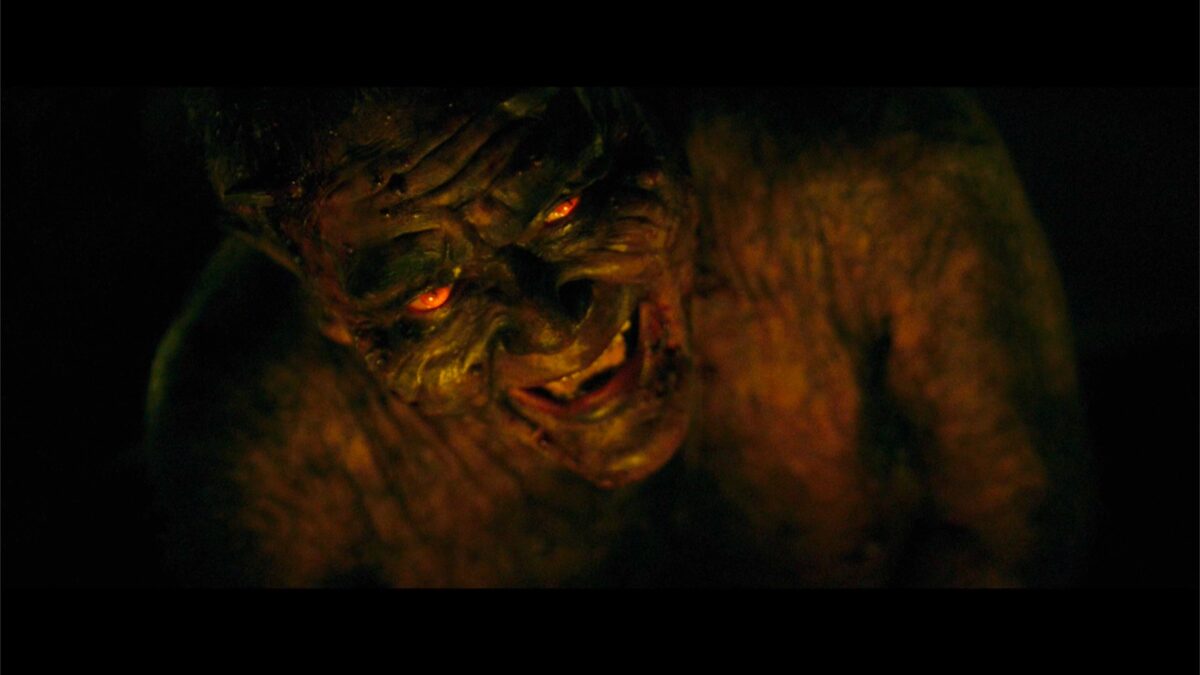
Initially, we’re anchored to the human characters, specifically Ko Bum-seok and Ko Sung-ki. And the first alien we meet, Va’migere, is this murderous monster we’re happy for our heroes to fight and destroy. But then Bum-seok has that moment of connection with Va’migere when he notices the tear in Va’s eye as it struggles to flee. That’s our first indication there may be more to the story. Especially since Bum-seok is our primary perspective character. His attitude directs the audience’s attitude. So if he’s starting to realize there’s humanity in the monster, that’s a sign that viewers should too.
The next twist comes when Yang-bae reveals the “monster” he sniped in the woods. And, again, our primary perspective character, Bum-seok, tells us how to respond when he puts two and two together and realizes the missing child is probably what caused the monster to terrorize Hope Harbor. Except Bum-seok’s now referring to Va’migere as a mother. That change in vocabulary is huge because it’s another instance of humanizing the aliens.
Every 2026 movie I’ve seen, ranked. Became a dad, so catching up. Updated: October 17
Then we get the spaceship sequence with Sung-ki and his crew. These aren’t just strange beasts in the woods but highly advanced beings. And in the ship’s holding bay the men don’t discover more monsters but a small, trembling creature with huge eyes. After that, we finally meet the rest of the aliens: J’aur, Ai’dovor, and Ma’veyyo. All look very different from Va’migere. Where Va’migere was beastly, the others have elegance, beauty, strength. We recognize human qualities in them.
For a moment, it seems like Sung-ki and J’aur will have a conversation. But then his friends open fire and the conflict between humans and aliens resumes. And that conflict extends all the way through the last chase sequence.
The whole final fight between Sung-ki and the other aliens has a different energy than the opening stretch with Bum-seok. During that first sequence, we’re completely on the side of humans. Va’migere does seem like nothing more than a monster. But once we have the context of the missing alien child, that dynamic changes. Are the remaining aliens actually the villains? Or are they the victims? Are humans too quick to use violence against what we don’t understand? And then as viewers: do we actually want Sung-ki to defeat Ma’veyyo? Isn’t their conflict actually a misunderstanding?
Which then brings us back to that conversation between J’aur and Ma’veyyo. Their goal isn’t to terrorize humanity but to save the life of a child that a human killed. And the crashed ship implies that there’s a much larger story going on.
But notice the thematic undertones of what J’aur and Ma’veyyo discuss. Ma’veyyo believes he can change fate. The implication is that they’re in the midst of something terrible but this one action could change the tide. That crashed ship and the giant mushroom cloud from its explosion visualizes that sense of doom that Ma’veyyo wants to change. Saving Kali will bring hope.
Juxtapose that with the conversation between Bum-seok and Sung-ae that follows Ma’veyyo’s declaration. Sung-ae thinks Bum-seok’s reeling from the apparent demise of Sung-ki. So she says to him:
“Sung-ki was just unlucky. And that crazy guy behind the wheel…that was just some freak twist of fate.”
Sung-ae wants to accept Sung-ki’s fate and tries to get Bum-seok to do the same. It’s a negative energy. That contrasts Ma’veyyo’s declaration of changing fate and J’aur’s closing words: bring forth true fate.
And that brings us to the larger thematic idea that the end of Hope expresses: perspective. The early limited perspective had the human characters thinking there was a tiger on the loose. Then the tiger is actually a monster. Then once Bum-seok knows about the alien child, he doesn’t think of the monster as a monster but a mother desperately looking for her offspring (even though that wasn’t Kali’s mother). By the end of the movie, the aliens are beings with depth and culture and a larger backstory we know nothing about but we can see they’re probably in desperate need of help.
This idea of seeing someone as “other” before getting to know them isn’t unique. It’s at the core of Blade Runner. Deckard initially sees replicants as non-human only to come to understand there’s no real difference between humans and replicants. But it took interacting with the replicants, learning about them, to really see them as more than his initial biases had made them seem.
Or there’s a famous short story by Liam O’Flaherty called “The Sniper” that takes place during the Irish Civil War. A sniper for the Republic ends up in a duel with a sniper from the Free State. He wins! And he feels good about it. Until, out of curiosity, he decides to see who he had dueled with. When he turns the body over, he recognizes the still face of his own brother.
If the characters had known who they were firing at, would they still have engaged? Probably not. Context would have changed how they handled the situation. But without that context, they defaulted to violence. And tragedy ensues.
That’s the larger idea that Hope’s ending is getting at and is the main theme of the entire film. Context matters and we are often too quick to fall into conflict and continue conflict without gaining more context. As much as J’aur’s wish to change fate is about saving Kali, it’s really Na hoping that humans can, one day, change too. Maybe instead of a pessimistic accepting things as they are, we’ll believe in our capacity to create a different future.
In May, at Cannes, Na said the sequel was written and ready to film. But following the U.S. premiere, Na told ScreenRant that:
“I think I would need one or two more movies to tell the full story, but in the process of making this movie, the thought did occur to me that maybe the story told within the movie Hope might be enough. As for the circumstances that would have to be met in order to make those sequels, I think the number one circumstance that needs to be met is me having more time to really think about it.”
The backpedaling does concern me a bit. He went from saying “And there’s a script that’s already been done that I’d like to shoot. So if I have the opportunity, I would indeed make a sequel if possible” to wanting to have “more time to really think about it.”
Does that mean he’s no longer satisfied with his sequel script? Or that he has to weigh whether or not he wants to actually continue this story? Or is he deftly playing the media game and hoping the potential for no sequel means people will demand the sequel?
If Hope doesn’t have a sequel, Na’s satisfaction with the ending might be why.
Because we got these clear, opposing sides of the story, I don’t think it’s ambiguous. In my opinion, it’s an adequate ending for the film.”
The clear opposing sides are what we talked about earlier. The humans, having been the transgressors, now with more context, feel a sense of repentance. While the aliens, despite being victims, feel that sense of hope.
The mid-credit scene shows Sung-ki survived falling out of the car on the highway. This dude made it through so much that he may be an actual superhuman. I do like how that plays into the idea of hope. The human characters think Sung-ki is gone. His return will be to them what Kali’s is to the aliens.
If you want the full, full, extended breakdown that doesn’t just recap what happened but actually explores the thematic reasons why it happened, I went much deeper into the meaning of Sunk-ki’s survival, what actually knocked him out of the car, and how his bizarre durability set ups the final reveal.


Film Colossus Supporters get access to the Frameshift and Active Viewing courses, an ad-free site, the Watch More Films newsletter, and the ability to request movies for analysis. Your support also directly keeps Film Colossus alive while I try to scale it into something sustainable, as it's just me, Chris, who does everything here.
Or create a free account. You gain access to the Active Viewing course and Watch More Films.
Join the Film Colossus community, get the newsletter, and unlock member features as they're added.