Newsletter Subscribe
Enter your email address below and subscribe to our newsletter
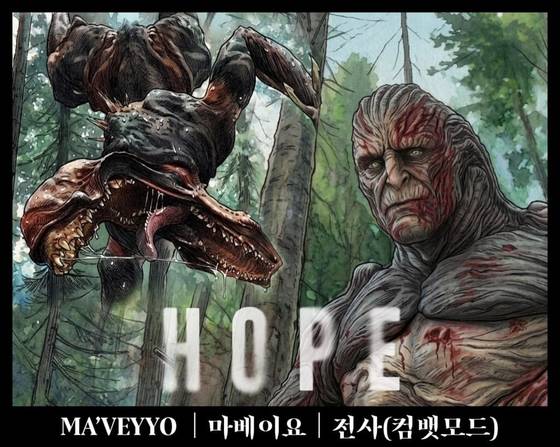
When I was first watching Hope, I thought Ma’veyyo was the father of the missing alien kid. The alien who tore up Hope Harbor was the mom, the others were the siblings, and then this giant alien dude, with Michael Fassbender’s face, was the dad. Obviously. Right?
Then the final conversation between J’aur and Ma’veyyo made me realize that was not the case. Assuming others are also confused about the big guy, I thought it might be nice to do a breakdown.
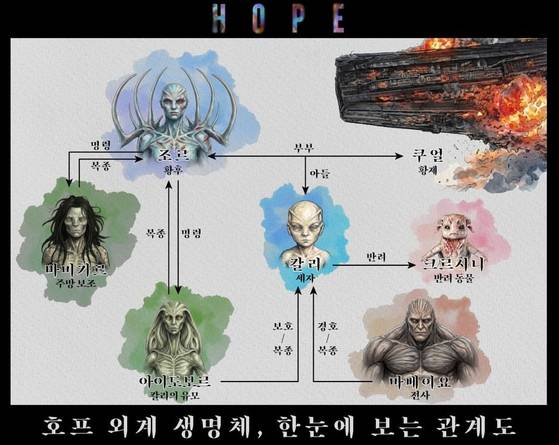
According to the official relationship chart released by Hope’s production company, Forged Films, Ma’veyyo protects Kali, the Crown Prince. So he’s in the service of Empress J’aur and Emperor Ku’er.
As Kali’s protector, it makes sense Ma’veyyo’s as big and strong as he is. Especially compared to the other aliens. J’aur isn’t necessarily a warrior, being the Empress. Ai’dovor’s a nanny. And Va’migere, who rampaged through Hope Harbor, was a kitchen assistant.
Their designs seem to reflect that hierarchy. Va’migere, a kitchen assistant, looks the wildest and least elegant of the four aliens. J’aur, the Empress, is the most ornate. And Ma’veyyo falls between them. More impressive than Va’migere but lacking J’aur’s elegance. He’s all function.

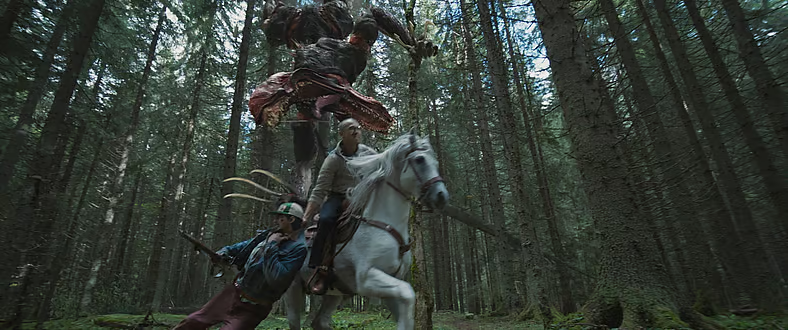
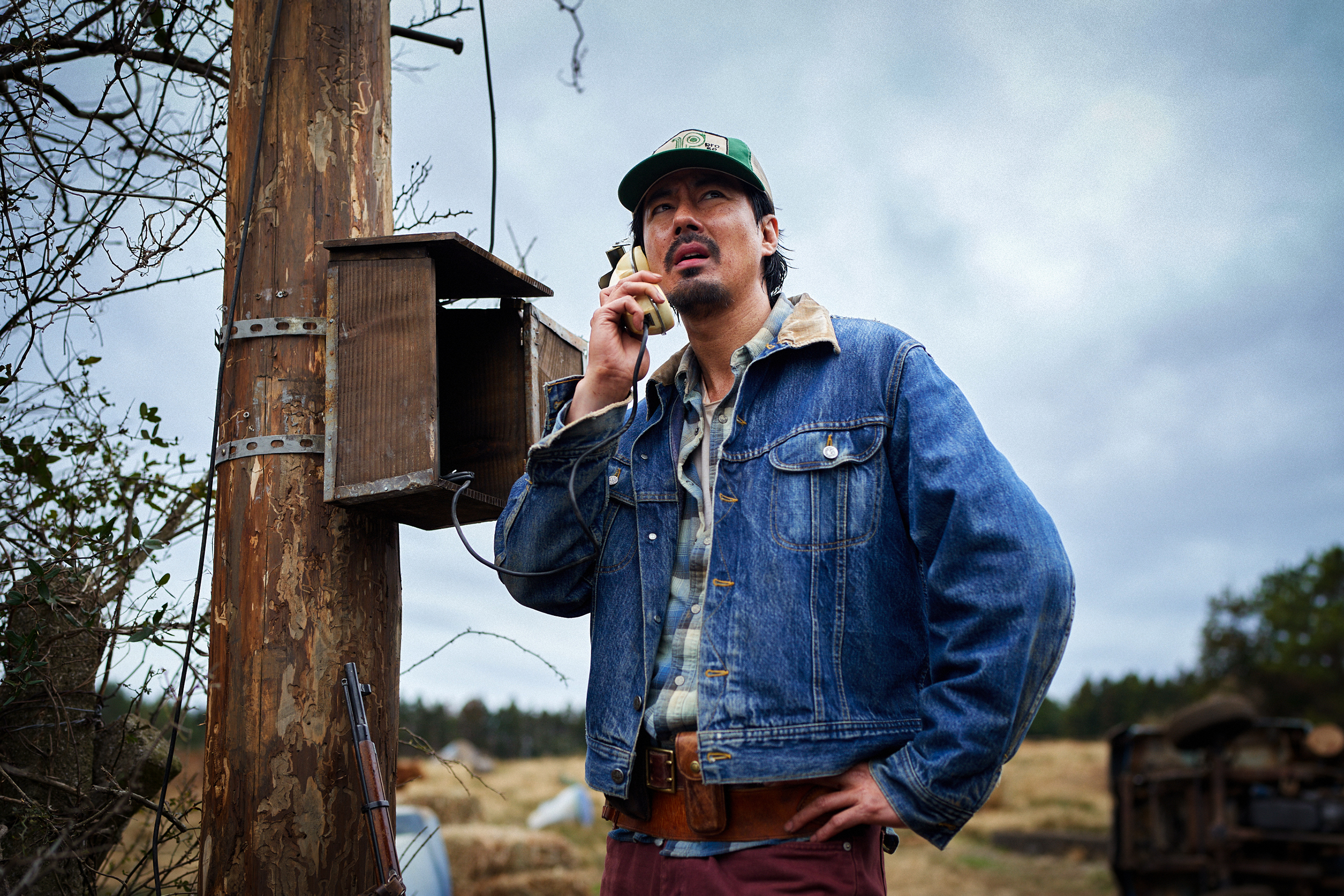
Initially, it seems like J’aur wants to talk to Sung-ki and his friends. And Sung-ki recognizes this and tells his crew not to fire. But their nerves get the better of them and they shoot at J’aur. Once that happens, Ma’veyyo, being the protector that he is, comes flying in to thwart the humans.
Because Hope has focused on Sung-ki and made him a key perspective character, we’re inclined to favor him. Aren’t these the monsters who destroyed Hope Harbor, after all? Ma’veyyo is clearly the aggressor and in the wrong. Obviously. Right?
Na Hong-jin purposefully plays with the audience’s perception of who is good and who is bad. Technically, Ma’veyyo is the one defending his people from the aggressive humans. As far as he’s concerned, Sung-ki is part of this group that showed up and opened fire on his Empress.
So it makes sense why Ma’veyyo attacks Sung-ki. But it does raise the question of why Ma’veyyo pursues Sung-ki for so long. If your goal is to find and revive Kali, why risk your life chasing Sung-ki for miles? Maybe Ma’veyyo can’t allow a witness who knows the location of their ship to escape?
I’ve used Audible for more than a decade and listened to over 150 audiobooks. If you’ve been meaning to try it, you can start a free trial through Film Colossus. It’s an easy way to support my work without becoming a paid member.
#CommissionsEarned
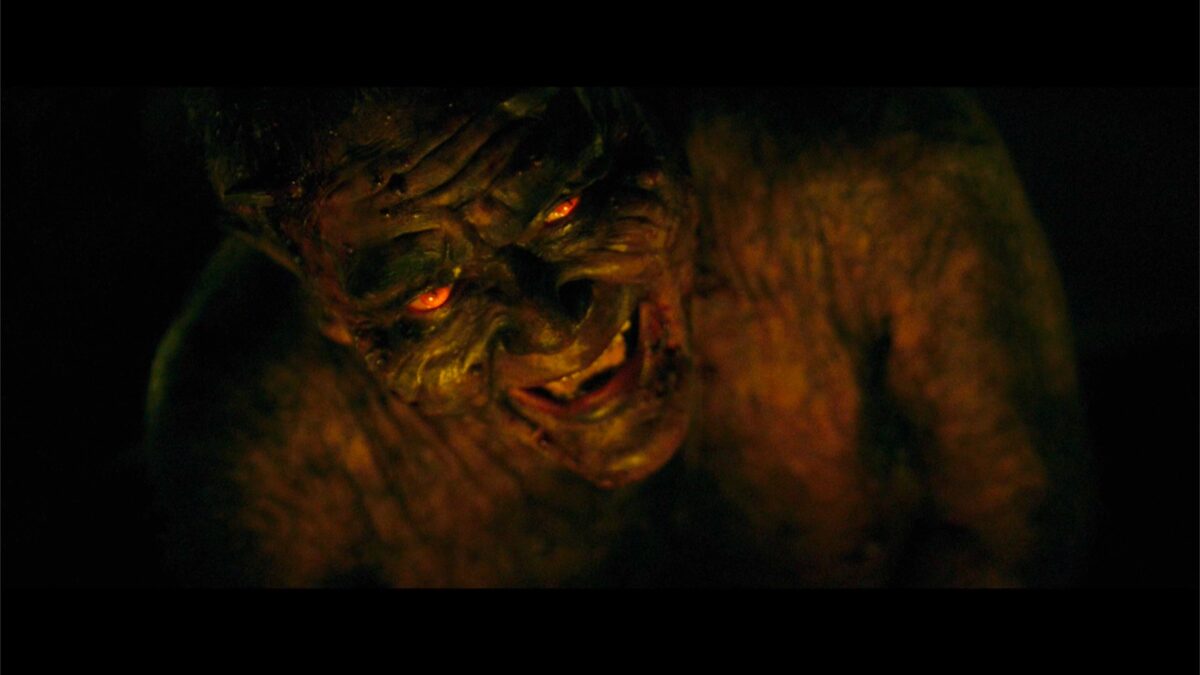
Ma’veyyo is the only alien we see transform from normal biped into a canine-like beast mode. According to Director Na, the aliens are “all from different planets and they are united in this one front when we meet them in the film.” So Ma’veyyo might just be from a world where everyone transforms but J’aur and the others aren’t.
Every 2026 movie I’ve seen, ranked. Became a dad, so catching up. Updated: October 17
Na commented on the design, specifically citing Ridley Scott’s Alien, and how the transformation is biological rather than mechanical. But he didn’t elaborate on the backstory in a meaningful way.
The one thing that confuses me about Na saying the aliens are from different planets is that we see Va’migere have the same extra heart that Ma’veyyo has. And Va’migere has the same ankle anatomy as Kali. I would assume if they’re from different planets that they’re different species? If that’s the case, why do three of them share key anatomical features?
The film teases the importance of the alien heart when the doctor autopsies Va’migere and pulls out an unknown organ. The movie seemingly isn’t going to answer that question until, at the very end, Ma’veyyo reaches into his chest and removes the same organ. Except where Va’migere’s is dull, Ma’veyyo’s looks magical. Probably because he’s alive and Va’migere is not.
Since Ma’veyyo can remove it and still function, it seems like it’s not necessarily his actual heart but maybe some extra engine? It could also explain his transformation and unreal durability.
The goal is to put that heart into Kali and spark the little guy back to life.
There’s a lot to unpack here. Simply put, Ma’veyyo is Kali’s guardian. Taking that role seriously, it makes sense he would do whatever is necessary to return Kali to life. But there’s more to it than simple duty.
Ma’veyyo: Falter not, Your Majesty. In the name of Gh’ertu, I shall find the Prince. I shall change his destiny. This heart will revive His Highness. Should his destiny change, so too shall all of ours.
Ma’veyyo sees in Kali the hope of his people. Without him, there’s an implied doom. But with Kali, Ma’veyyo believes that changes the destiny of the entire empire. That’s why J’aur shifts the conversation to a more direct discussion of faith:
“Faith is evidence of what we do not see” is a paraphrase of a line in the Bible, specifically Hebrews 11. “Now faith is the substance of things hoped for, the evidence of things not seen.” The entirety of Hebrews 11 is about faith and what you achieve by having faith, maintaining faith, even when you face hardships.
J’aur recognizes the hardship in front of her: her husband’s ship has exploded. The Emperor is gone. Kali is gone. All seems lost.
Ma’veyyo’s declaration that he’ll save Kali becomes a declaration of faith. He rejects the evidence in front of him, believing, instead, in a future that he cannot yet see. He maintains hope.
That’s what makes Ma’veyyo’s character so interesting. The film’s last 45 minutes frame him as this terrifying monster who relentlessly chases a fan-favorite character. By the end, though, Na challenges that perception. He isn’t a mindless, ravenous beast. He’s a guardian willing to sacrifice himself for the sake of his people.
The monster suddenly displays a quality we think of as decidedly human.


Film Colossus Supporters get access to the Frameshift and Active Viewing courses, an ad-free site, the Watch More Films newsletter, and the ability to request movies for analysis. Your support also directly keeps Film Colossus alive while I try to scale it into something sustainable, as it's just me, Chris, who does everything here.
Or create a free account. You gain access to the Active Viewing course and Watch More Films.
Join the Film Colossus community, get the newsletter, and unlock member features as they're added.