Newsletter Subscribe
Enter your email address below and subscribe to our newsletter
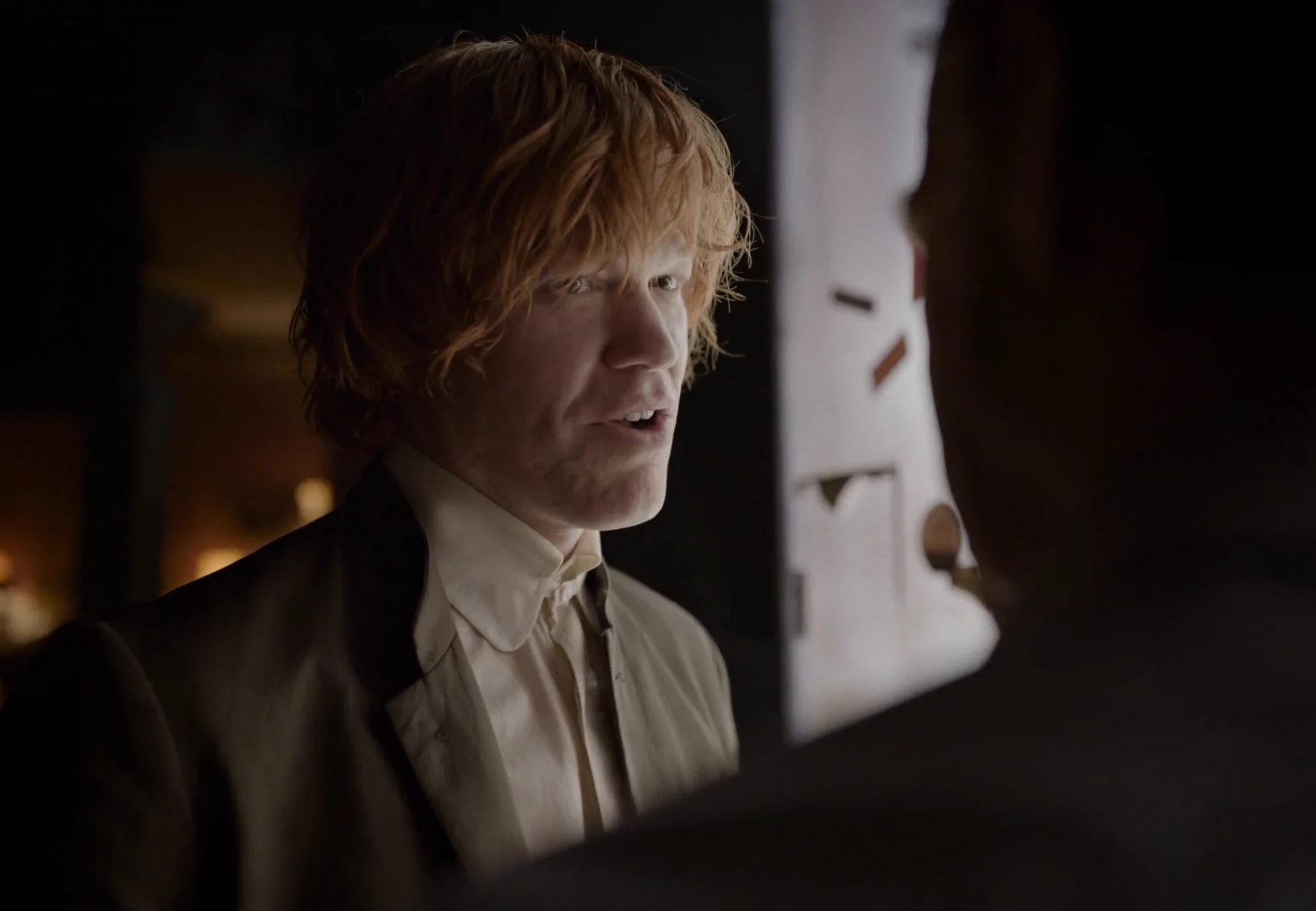
There’s been a lot of debate about how to interpret Kenny Rockwell in Digger. Is he sincere or isn’t he? What’s his true motive?
I’ll just tell you up front rather than making you read through a bunch of buildup: I disagree with the cynical interpretations; all the evidence in the film points to Kenny as well-intentioned.
Now, if you want to stick around for the elaboration. We’ll start by breaking down Kenny’s character.
We know Kenny is the nephew of Digger Rockwell. He was only a child during the events of Fossil Fools. Meaning, age-wise, he’s somewhere in his late twenties or early thirties.
We know from the play that young Kenny spent time living on a ship with his mom, uncle, and others. And that Kenny may have been one of the last people to talk to Digger before Digger leapt into the ocean.
At some point, he inherited his family’s fortune. He also runs a security company that’s powerful enough that he could find Curtis’s missing daughter by just having her phone number.
He saw Fossil Fools 15 years ago and it inspired him.
This is Kenny’s speech:
It really doesn’t matter. Satire, farce, drama, tragedy, it doesn’t matter. I first saw Fossil Fools 15 years ago in a shitty little theater in London, just three actors doing a bunch of monologues, President Compson, Ganesh, the Reverend… My Uncle Digger. Sitting in that theater, hearing a bunch of strangers laugh at my family, my mom, me—the same actress that played Ganesh, played me. She was very funny.
At the end of the play, when Uncle Digger, you know… They clapped. They stood up and cheered ferociously. I don’t know. What was it? Revenge? Justice? Pound of flesh? You’d think I’d be embarrassed, or humiliated, angry. I wasn’t any of that. I stood up and cheered right along with them, sharing their anger, part of the mob screaming for my family’s head. Satisfied. Absolutely satisfied, for that moment.
So I decided, I tracked down the playwright, bought the rights, I got Hannah here to adapt it. I hired you, Hannah, because… I don’t even remember. Someone said I should hire you. You were hip or something. Curtis, sir, I’ve seen everything you’ve done. And you always reminded me of him. I don’t even know how to… The constant dissatisfaction in your eyes. I knew you were him.
I hired all of you, and this space, and these screens, and you guys, were like the extras. Hannah told me that extras don’t even exist in plays. But it didn’t matter. We had to get it right. It had to be bigger than life, big as Uncle Digger, big enough to convince people to brave those streets out there and witness this human-made theater play, to come to this abandoned space that we rescued and restored for people to get together again. Is it ridiculous? Is my family ridiculous? Yes. We are. Was my uncle composed? Yes. Was he frightening? Yes. Was he ignorant? Tacky, narcissistic? Yes. You all have it right. It’s funny, and it’s stupid, and it’s scary, and it makes no goddamn sense. But it happened.
I put a gazillion dollars into this production to remind people that it happened, because we were all oblivious when it did. Amused to death, absorbed in our pointless arguments, enthralled by our own opinions, just like you two right now. You’re both right. You’re all right. Now what?
The cynical interpretation is that Kenny is Digger for another generation. Digger controlled the world through oil and politics. Kenny is doing the same but through technology. The argument would be that Kenny’s using Fossil Fools as another means of control.
If Fossil Fools reignites the hatred people have for Digger, Kenny could position himself as the heroic nephew who condemns his uncle. Or maybe he wants to operate in anonymity. Giving people a pop culture villain would distract them from whatever Kenny’s doing.
Digger may have lost power, but the Rockwell legacy lives on. After all, isn’t Kenny wealthy because he inherited his family’s blood money? With the world in such a state, shouldn’t he have donated it? Has he actually done anything altruistic?
And a security company doesn’t scream “good guy”. Is it just security or surveillance as well? How much control does that give Kenny? You have to wonder if those are his soldiers outside the theater, his drones in the sky.
There’s also the morality of Kenny owning the rights to Fossil Fools. This ultra-wealthy person now owns the rights to this story about his family. Isn’t that the definition of controlling the narrative?
All of this adds up to the play being less cathartic than it seems, with Digger, as a film, condemning pretty much everyone: the wealthy, the system, and you and me.
A lot of that cynical reading comes from applying ideas to the film rather than looking at what’s actually happening in the film.
At no point in Digger does Alejandro Iñárritu have someone push back on what Kenny said. At no point is it revealed that Kenny was lying or had ulterior motives. For the film to earn that negative interpretation from critics, the story would need some mechanism that counters Kenny. But it doesn’t have that.
Imagine if in Aladdin, Aladdin pretended to be Prince Ali, got everything he wanted, and never told Jasmine the truth about who he really is. In that version of the story, Aladdin benefits from not being himself. It would be incorrect to claim that version’s main theme is “be yourself”. All evidence points to the contrary.
In the actual Aladdin, Aladdin pretends to be Prince Ali, seems to get everything he wants, only for the lies to catch up with him. He almost loses his friends, Jasmine, and his life. He succeeds when he resumes being true to himself. The film actively undercuts being someone you’re not.
It’s the same thing with Anton Chigurh in No Country for Old Men. Most of No Country’s story builds up Anton as a terrifying, unstoppable force. Until near the end of the movie when out of nowhere he’s in a car crash. The monster suddenly becomes very mortal. Without the crash, there’s no contradiction. Without contradiction, the film reinforces Anton’s initial positioning as a force rather than a man.
But the crash happens and the monster is suddenly very fragile. Who helps him? Two teenage kids. Their youth contrasts Anton’s age and sudden vulnerability. That juxtaposition reminds us of the film’s title: No Country for Old Men. Even though Anton survived the crash, he’ll keep losing his edge, losing a step. His luck will run out. He will age and time will catch up to him.
If Iñárritu wanted to show Kenny’s words as hollow or manipulative, he would include some mechanism by which to do that. Notice how no one reacts to finding out Kenny’s a Rockwell? That tells us he doesn’t have an established reputation. He isn’t some villainous pop culture figure like Elon Musk.
There’s no subplot where Curtis realizes Kenny’s company is responsible for some terrible thing and he has to decide if he’s okay accepting help from someone like this. The only time we see him wield the power of his security company is to find Hope, Curtis’s missing daughter.
Without any narrative pushback or in-world context, the intention seems quite clear: we’re supposed to believe Kenny is sincere.
It’s completely valid to read Digger through a lens that billionaires having control of the arts is problematic. But it’s one thing to discuss the film through that frame versus arguing that the film is actively taking that stance. Digger does not take that stance. Iñárritu has positioned Kenny not as a warning of the cycle repeating in a new form but as an ideal.
Instead of presenting Kenny as the next evolution of Digger, the film uses him as a counterpoint. Digger is loud. Kenny is soft-spoken. Digger is self-centered. Kenny worries about others. Digger never used his wealth to help anyone. The only things we see Kenny do are compliment Curtis, fund the play, quell the fight between Curtis and Hannah, find Hope, and make the entire audience happy.
You know who Iñárritu actively undercuts? Digger. The speeches by Hannah and Kenny counter Digger’s worldview. When Hannah yells at Curtis, she’s essentially yelling at Digger and what he represented.
Hannah: You can’t see what we’re laughing at. We’re laughing at you. And your entire generation, who stood by feigning righteous indignation, while never lifting a single finger to put an end to the insanity that led us here, that led us to the world outside those doors…
So, yes, Iñárritu’s being earnest through Kenny and positions him as part of the next generation who isn’t making the same mistakes as the older generation. He’s a patron of the arts, not a villain in disguise.
Before Ganesh speaks at the European Parliament, he tells Digger, “I won’t say what you want me to say.” And Digger responds: “How do you know? You might say exactly what I want you to say.” Later in the conversation, Digger adds: “And I don’t want you to lie. I want you to tell, in detail, the terrible truth. Do I make myself clear that I’m giving you permission to tell the truth?”
During his speech, Ganesh tears Digger apart. Then Digger goes in and leans into everything Ganesh said, using it to build his argument that people are hypocrites because, even as they condemn him, they want him, need him to dig, dig, dig. Their entire lives depend on oil.
Ganesh: So, you weren’t kidding? I did say what you wanted me to say?
Digger: Oh, pretty much.
Right before Kenny’s big speech, Hannah and Curtis fight about the truth: Curtis wants truth in the play; Hannah tells him the truth about his behavior. That’s when Kenny steps in. And essentially says everyone is correct. Hannah’s right about what’s true, as is Curtis.
It’s possible to read this as a parallel to Ganesh. That Kenny’s giving them permission to tell, in detail, their version of the terrible truth. And they will end up saying exactly what Kenny wants them to say.
But is that bad? If Kenny is just the next iteration of Digger, sure. But if he’s a counter to Digger, which so much of the film reinforces, then the parallel is just another example of Kenny as an oppositional figure.
Kenny tells us what he hopes for: to get people to come together again. And that’s exactly what happens. If there were an ulterior motive, a Digger-like motive, the film doesn’t reveal it in some final twist. Instead, it shows us the world outside the theater and how much it sucks. Only then can we understand what that theater experience would have meant to everyone there, why the crowd cried and cheered. It reinforces everything Kenny had said.
I just don’t agree with the cynical interpretation. And I don’t think does, either.
Iñárritu: The representation of reality is framed in a way in the film that we can totally separate ourselves and see ourselves and laugh at ourselves to find a common ground about a very complicated thing. It has to do with how we tell the story of ourselves and have to approach something like that without fighting each other


Film Colossus Supporters get access to the Frameshift and Active Viewing courses, an ad-free site, the Watch More Films newsletter, and the ability to request movies for analysis. Your support also directly keeps Film Colossus alive while I try to scale it into something sustainable, as it's just me, Chris, who does everything here.
Or create a free account. You gain access to the Active Viewing course and Watch More Films.
Join the Film Colossus community, get the newsletter, and unlock member features as they're added.