Newsletter Subscribe
Enter your email address below and subscribe to our newsletter

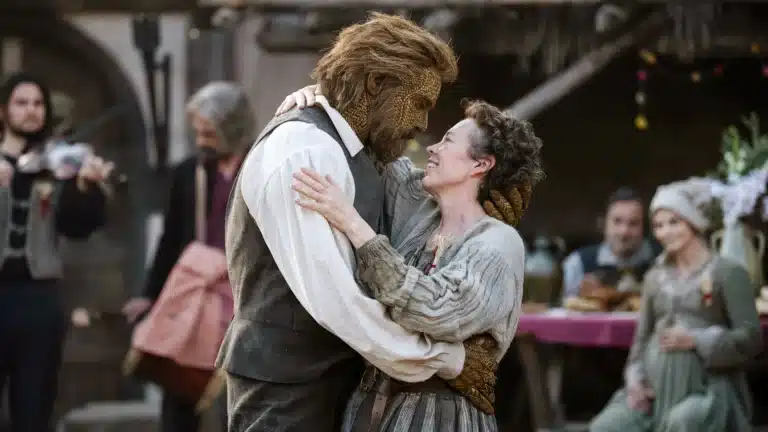
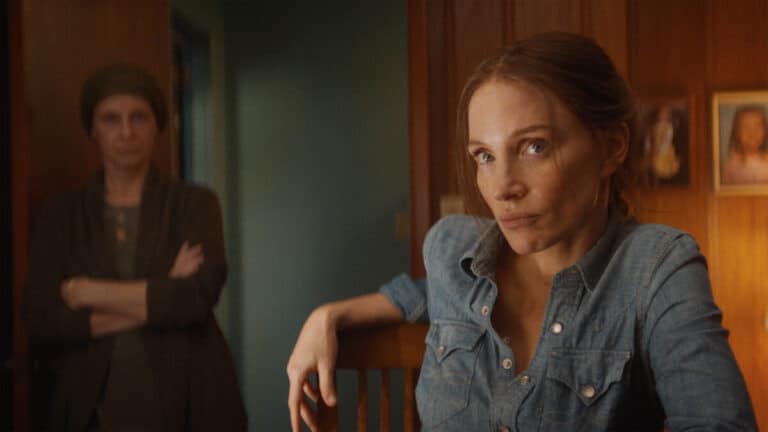
Martin McDonagh‘s Wild Horse Nine takes a dying CIA agent and uses him to explore the moral consequences of American foreign intervention. Chris Carlisle spent decades destabilizing governments. The result is him feeling more compassion for Chilean moths than Chilean citizens. But his experiences on Easter Island force him to confront that contradiction. This turns his personal crisis into a larger allegory about the United States, guilt, redemption, and getting old.
Wild Horse Nine is an allegory for the United States of America. Martin McDonagh just did this with his last movie, The Banshees of Inisherin. Banshees uses the pointless, escalating conflict between two former friends to represent and critique the Irish Civil War. McDonagh simplifies the conflict in order to show how ridiculous and harmful it was.
That same simplification happens with Wild Horse Nine. Chris Carlisle represents not just the CIA but America meddling in foreign affairs for the last 100 years. Wild Horse Nine earns that association in little ways.
First, by starting the film with Chris listing off the destabilization operations he’s led: Guatemala in 1954, the Congo in 1960, the Bay of Pigs in 1961, Dallas in 1963, and now Chile in 1973. Then, when Chris and Lee are in the airport and at Easter Island, Chris acts like a stereotypical American traveler. He’s ignorant, loud, entitled. When he identifies himself as CIA he’s identifying himself as part of the US government. Later in the film, MJ refers to Chris as embodying the history of the CIA. He says, “I liked Chris. He’s the entire history of the CIA, man.”
The first two examples I gave create context and subtext around what Chris represents. MJ’s declaration turns the idea into text for anyone who hadn’t made the connection.
So if Chris represents what’s essentially American foreign policy, what’s it mean that he’s feeling regret, grief and remorse?
Chris starts Wild Horse Nine by proudly listing off his operations and how each was a success. What goes unspoken is the human toll of his missions. When he says that Dallas in ‘63 was a success, what he’s really saying is that he was responsible for the assassination of John F. Kennedy. Imagine bragging about that? In terms of scale and scope, Dallas had much smaller stakes than what he “achieved” in Guatemala, the Congo, Cuba, and Chile. We’re talking casualties, economic collapse, and seismic culture shifts that caused decades of unrest. That’s the stuff Chris is bragging about.
There’s that scene in the airport where he happily mocks the Chilean girls, telling them to enjoy their left-wing president while he’s around. He acts all cute and goofy about it, but he’s talking about a military coup that will shatter the lives of these girls. The leader of the coup, Pinochet, became a brutal dictator. He was in power for 17 years. Historians attribute more than 3,000 casualties/disappearances to Pinochet’s corrupt government.
In writing his memoirs, Chris has to reflect on his life and who he is and what he’s done. That process ultimately causes him to change.
There’s that scene in the church in Chile where Chris smiles at the growing conflict between pro-communists and anti-communists. Afterwards, Chris talks about how he escorts moths out of his room rather than killing them. Here’s this man stoking a military coup but he feels bad about putting a moth outside when it’s raining because he feels like moths struggle in the rain. Then he hits us with the big line: “Sometimes I feel like I care more about the moths of Chile than I do the people of Chile.”
To me, this captures the dissociation one has to have to do the job Chris does. He’s actually an incredibly empathetic and caring person, but he can’t be that and be good at his job. So he’s stopped thinking about people. But his guilt and repression manifest in the concern he shows for everything else: moths, dinosaurs, his own cancer, horses, etc.
But this is Chris’s character arc and why Monica is a continued presence in the film. Initially he doesn’t care about what’s going to happen to her and her future. But over the course of several encounters, he rediscovers his humanity and starts caring about her and what happens to her.
Chris goes out to the Moai statues alone. There, death is clearly on his mind, as he drinks and brandishes a gun. Then a wild horse appears. The music stops. Chris says, “Wow.” The horse sniffs Chris and they share a moment. He gets emotional and says, “I know it’s sad, I know, but I’m still here. I’m still here. I’m still here.”
It’s after this encounter that Chris turns from self-pitying to proactive. McDonagh said in an interview: I’m always trying to put something from the animal or insect world in my stories. But horses specifically, there’s something sort of spiritual about them and kind. It seems like they can look into your soul when you’re holding their gaze.
Chris had been avoiding soul-searching. In his initial attempts to start his memoir, he talked about dinosaurs and the feelings of his cancer. Not himself. And we get a pretty revelatory line of dialogue.
Every 2026 movie I’ve seen, ranked. Became a dad, so catching up. Updated: October 17
This is what Chris dictates:
Sometimes I think I should have read up more on the history of the places I arrived in before I arrived in them. The Congo in Africa, for instance. The Belgium army had already got hold of President Lumumba the week before—he had just been elected whatever. So I flew in to take a view, a dim view, as it turned out. Although, I liked Lumumba. I liked Patrice. But the Belgians had a whole history with that country since slave-trade times, so what are you going to do? You know? Let them go? No. Mostly I have memories of reading glasses and how light the bag was that they carried him away in. The night before they sh*t him, he said, “Chris, don’t you know that if you kill me you’ll be killing democracy in Africa for the next 50 years?” I said, “Patrice, what do you think we’re trying to do?” And I regret saying that, ‘cause he got sad then and it was probably one of the last things he heard. But it’s easy to think these things in retrospect.
Chris has started to humanize again. Previously, he hadn’t cared about the places he was. He’d go and do his job. Now, he’s thinking about how he should have read up more on the history of each place. If he knew more about the people, the land, their history, what they’ve gone through, how they got to where they are, would he have still been able to do his job? Or would he have made different choices?
While Wild Horse Nine is set in 1973, it’s made by someone in 2026. That means what informs the film isn’t just the 1950s, 60s, and 70s but all the decades up till now. For example, maybe McDonagh wasn’t thinking specifically about the War on Terror, but he lived through it. He’s well aware of it. It had to have informed his view of American foreign policy, consciously and unconsciously.
Think about the War on Terror in context to Chris’s line about having knowledge about the country before he arrived. Part of the failure of America’s War on Terror was that the United States thought it would steamroll into Iraq and Afghanistan and deliver freedom to the grateful masses. American freedom, American democracy, American way of life, aren’t programs you can just install. The people in the Middle East have their own story and culture and point of view. Trying to force our ways onto other people was like pouring water onto sand. It resulted in a 20-year quagmire.
This scene is important because it’s the start of Chris thinking that maybe there was another way he could have done things, that he should have done things. It’s only now, at the end of his life that he can actually think about such things. That might be true for him but it’s not true for us, in real life. In real life, the movie prods us to think about these things. We should think about our own actions but also have some awareness about our governments.
The scene where Chris tells Monica he’s not going to lie anymore is probably the crux of Wild Horse Nine. Remember, Chris was aware that he cared more about moths than people. And he demonstrated that in how rude he was to Monica and Alice, at the airport then at Easter Island.
When Chris approaches her at the beach, it’s after his encounter with the horse, after he’s started reflecting, after he’s decided that maybe he should have cared more about the places he was. Monica represents Chris’s newfound humanization of Chile. Monica’s no longer just a left-wing youth he’ll laugh at. She’s a person he connects with and feels empathy for.
He starts the conversation with a combination of vulnerability and fabrication. He apologizes but he also lies about who he is and who Lee is. But he quickly comes clean. She asks why he lies and he says he’s always done it and it’s hard to stop. Chris gets serious and says he’d like to stop lying. The conversation ends with her saying, “Maybe in the time you’ve got left you can try not to lie so much.”
For the rest of the film, Chris tries to be better. He gets honest with Lee, calls his brother, and even betrays his country to save Monica. This old man we should revile ends the film in a heroic way, all because he embraced truth and resumed caring about people.
Chris asks Lee if any Nazis make it into heaven. Lee suggests that maybe if a Nazi jumped on a hand grenade to protect his mom, then maybe that would get him in. Chris worries that if moths don’t get into heaven, then there won’t be anyone to put a good word in for him.
What Chris isn’t saying there is that he’s aware of how unkind he’s been to humans. How different is he than the average Nazi soldier? If people had to vouch for him, then he wouldn’t get into heaven.
Lee tries to challenge this by saying “There’s whole countries that wouldn’t be free if not for you.” Again, the character is saying that in 1973 but the 2026 audience hears that with the context of America’s failure with Operation Enduring Freedom in the Middle East. We’re supposed to roll our eyes at what Lee says. And deep down Chris knows that’s true.
The film uses the Nazi and the hand grenade story to create subtext for Chris saving Monica at the end of the film. That’s his redemptive act. He saves her with the same rifle he used in Dallas to carry out the JFK assignment.
The point of Wild Horse Nine is to chastise Chris for what he’s done. It’s far more concerned with the idea of redemption for someone who has done the things he’s done.
In Banshees of Inisherin, McDonagh took a harsh view on the impact the Irish Civil War had on the country. He used Barry Keoghan’s character, Dominic, as a way to represent the sense of hopelessness the youth had in the aftermath of such disaster. The character is arguably the most tragic in a film full of tragedy.
McDonagh positions Monica in a similar way. The main conflict is between Chris, Lee, and MJ. She’s the one affected by their actions. If MJ wins, Monica has no future. But Chris’s change of heart not only saves her life but inspires her. Her ending is much happier than Dominic’s. It speaks to the hope that McDonagh seemingly has for America and the rest of the world.
Ultimately, Chris, Lee, and Monica all end the movie enlightened about the world around them.
Notice that they’re of three generations. Chris is the oldest. Lee is the mid-life generation that will start to lead when the Chrises and MJs are gone. And Monica is the youth.
The older generation still has time to change their ways. The mid-life generation has to chart a new course. And the younger generation can’t be oblivious, because their time to lead will come.
Wild Horse Nine actually reminds me a lot of Nolan’s The Odyssey and Paul Thomas Anderson’s One Battle After Another. All three movies are by filmmakers who are 56 years old and feature older protagonists who are worried about their actions and make sacrifices for the next generation. Nolan and PTA keep things more at the individual level, while McDonagh connects Chris’s personal journey to America itself.
Does Chris find redemption? I don’t think McDonagh answers that. The spiritual nature of the question is for the forces of the spiritual world, not people. But, Chris feels better about himself. And maybe that’s all any of us can control? While you’re here, it’s not too late to change.


Film Colossus Supporters get access to the Frameshift and Active Viewing courses, an ad-free site, the Watch More Films newsletter, and the ability to request movies for analysis. Your support also directly keeps Film Colossus alive while I try to scale it into something sustainable, as it's just me, Chris, who does everything here.
Or create a free account. You gain access to the Active Viewing course and Watch More Films.
Join the Film Colossus community, get the newsletter, and unlock member features as they're added.