Newsletter Subscribe
Enter your email address below and subscribe to our newsletter
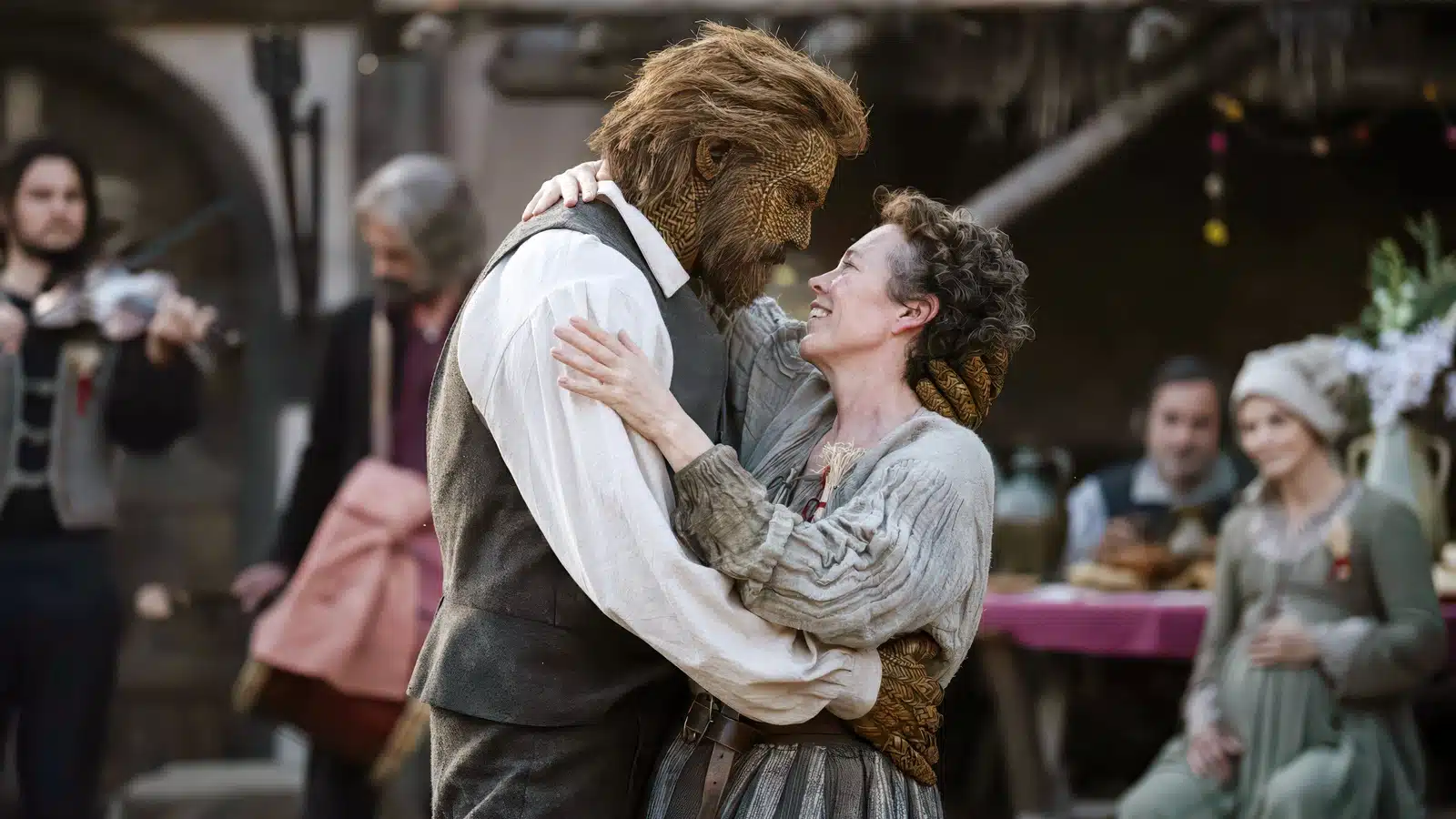
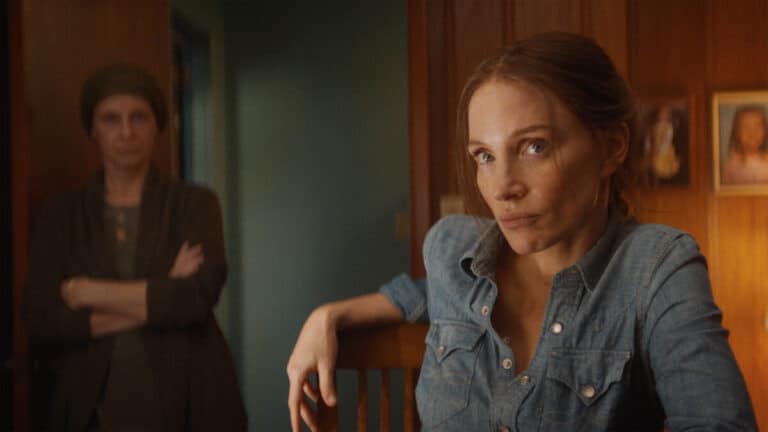
There’s a central irony in Wicker that complicates everything the film has to say about love: this Fisherwoman (Olivia Colman), who has lived her entire life without love, finally discovers it…only to destroy it. The Wicker Husband (Alexander Skarsgård) loves her unconditionally. Yet she burns him. Why?
I think the most crucial moment to understanding what Wicker is about occurs when the Fisherwoman questions the Wicker Husband about his interactions with the village women. Sitting on the porch, the Wicker Husband recounts his conversation with the Baker:
“He also talked of a path going in two directions, which is a fascinating way to think of a path. Of course it’s true that on a path one may walk to and fro. But it hadn’t occurred to me that it may be intrinsic to the path itself to be both. I suppose it’s the pathtaker who decides whether they are going away or going towards.”
Those two directions represent a universal struggle for all human beings. One direction is moving away from a painful past, away from the trauma that has shaped them in unfavorable ways. But other direction moves toward a more promising future, where they dictate how they see the world and how they function within it.
This specifically speaks to our main character, the Fisherwoman. The Wicker Husband presents a chance to take a path toward something. Toward self-love, toward fulfillment, toward growth. The Fisherwoman is commendable for her fierce independence, but the habits that have always protected her also prevent her from embracing something worthwhile. When it comes to love, it’s clear the Fisherwoman has always chosen the path away, not toward.
So what has she been moving away from, exactly? Let’s go through the entire movie and show how the Fisherwoman learns to take that path towards something deeper and more meaningful.
The Fisherwoman is plagued by a tragic past. She lost both of her parents when she was young—her father died in an accident, and her mother took her own life soon afterwards. As she faced such cruelty from the other villagers, she learned to protect herself by becoming fiercely independent, living alone in a cottage outside the village.
But the film never establishes that she stopped wanting love. Maybe she stopped expecting love, or stopped allowing herself to want love, purely as a means of independent survival. But an inability to accept love into her life represents something fundamentally flawed about her.
Honestly, it’s something I can relate to. Our pasts are so filled with ugliness and regret that it can be hard to be kind to ourselves, to love ourselves. And if we can’t love ourselves, then how can we be expected to believe anyone else will? The Fisherwoman’s story is as much about learning to love herself as it is about accepting love from someone else.
The Wicker Husband observes about the Fisherwoman’s parents, “They taught you well, to take care.” Olivia Colman, who plays the Fisherwoman, explained that she interprets this as evidence that the Fisherwoman’s parents loved her, “that she had experienced love in her childhood.” So Colman doesn’t interpret the character as “lonely,” per se, but independent. The co-director of Wicker, Eleanor Wilson (who co-directed alongside Alex Huston Fischer), however, comments on how that independece led the Fisherwoman to believe she isn’t worthy of love.
While the Fisherwoman’s parents loved her, they weren’t able to be there for her as she grew and became part of the world. This guidance was missing from childhood forward, and it stunted the Fisherwoman. She responded to that trauma by withdrawing further into herself, keeping the world at a distance.
This isolation translates to marriage and her apparent indifference towards it. Such independence is further emboldened by the village’s marriage customs, particularly the iron collar, which practically chains a woman to her husband and removes all of her agency. To the Fisherwoman, this form of marriage represents a loss of freedom she has worked her entire life to establish. We empathize with her in moments where wives are being chained up around the neck. Because who would want a life like that? Is that true love?
But when we observe the Fisherwoman’s loneliness, a complication arises: what if her independence is both a genuine source of strength and a defense against rejection? A rejection of love, since she finds herself unlovable?
The story then forces her to reckon with this tension.
After several interactions with the villagers, most notably when she gets the egg that marks her next for marriage, she commissions the Basket Weaver (Peter Dinklage) to make her a Wicker Husband. While her character might have specifically done this to silence the villagers, you can also think of the egg as the impetus for her Odyssey-esque journey where she is forced to embrace a husband-and-wife life, to accept someone into her life that will love her, despite her reservations about being loved.
During the marriage ceremony, the Fisherwoman’s independence never takes a backseat as she denies using the collar. The Wicker Husband does not protest—as we’ll learn, his only concern is her happiness, because when she’s happy, he’s happy. That, to him, is true love.
This version of love is comforting to a woman who wants to retain her independence, and the inner-workings of their relationship reflect that. At first, they don’t have any deeper conversations. During the day, they do their respective work, with her catching fish and him tending to the home. And at night, well…they get down to it. It’s nothing but sex in the evening, until they fall asleep, wake up the next day, and the cycle repeats. Their relationship is, in many ways, a functional one that doesn’t disrupt her cultivated life of independence.
Here, another intriguing complication is introduced: the Fisherwoman has commissioned someone she believes was designed to love her. But is that the safest possible way for someone afraid of rejection to experience affection?
This idea adds complexity to her initial happiness. Yes, she has begun to accept love, but she’s chosen a relationship in which she assumes betrayal is impossible. In addition, a deeper journey is taking place beneath the surface: she might have paid for a husband, but no amount of money can erase her childhood-induced trauma. An arduous journey awaits her.
Every 2026 movie I’ve seen, ranked. Became a dad, so catching up. Updated: October 17

For a moment, let’s step away from the Fisherwoman to focus on the villagers. After all, their stories occupy a decent portion of the movie. And I think this structural choice allows the Fisherwoman’s story to gain depth. Because the village isn’t just some outside community but an extension of the Fisherwoman’s world and everything she fears. In this way, you can think of Wicker as a myth or a folk tale, where the settings and characters serve as archetypes, as representations of realities we all deal with.
At first the villagers ridiculed the Fisherwoman because she had no husband. But now they’re jealous because they perceive her marriage to be better than theirs. They see the Fisherwoman’s blissful expressions. They observe how she dances with her husband. They feel their connection. They hear her cries of joy in the night. They sense her genuine happiness when someone loves her unconditionally. And instead of feeling happy for her, they’re forced to recognize how such shared love is missing from their own relationships.
In particular, the Tailor’s Wife’s (Elizabeth Debicki) story provides a meaningful contrast to the Fisherwoman. The Tailor’s Wife craves independence as well. She wants to take part in the Tailor’s business. She wants her home life to stand as an example of a healthy marriage. But secretly, she’s trapped in an unsatisfying marriage, one where she isn’t treated as an equal, instead treated as a docile prop. Thus, the Tailor’s Wife becomes a distorted reflection of the Fisherwoman: someone who also wants freedom but doesn’t know how to achieve it.
And rather than confronting the problems within her own marriage, the Tailor’s Wife sets out to destroy the Fisherwoman’s by instilling self-doubt—and it works. After all, as the Fisherwoman says, it’s “easier to believe the bad than the good.” And for the Fisherwoman, it’s easier to believe the Wicker Husband doesn’t love her and would cheat on her.
Anyone who has struggled to love themselves can relate to this. The bad parts of ourselves often occupy far more space in our minds than the good. We fixate on our mistakes, our regrets, all the things we wish we could change. And eventually, those negative thoughts become so overwhelming that we start to believe we deserve them. We isolate ourselves, retreating into a world that reinforces our worst assumptions about who we are. Instead of moving toward self-love and acceptance, we take the familiar path away from them. The village’s reaction forces the Fisherwoman’s worst instincts to kick in, and she fears the Wicker Husband’s ability to continually love her.
Later in the movie, after she believes she’s lost the Wicker Husband, the Fisherwoman says to the Basket Weaver, “It wasn’t real anyhow. You made him to be with me so it was just some pathetic fantasy.” We’ll address the Basket Weaver’s response to her soon, but let’s focus on that quote for now, because it tells us everything about the Fisherwoman and how she viewed herself throughout her marriage to the Wicker Husband.
The Wicker Husband had previously spoken about choosing which direction to travel, but by that point, thanks to the Tailor’s Wife, the Fisherwoman is already consumed by suspicion. The idea that it’s “easier to believe the bad than the good” speaks specifically to the psychological journey the Fisherwoman is on, one intensified by the tension between a loving husband and a jealous village.
Anyone who has had trouble loving themselves can relate to this: the “bad” parts of yourself occupy your brain space way more than the good parts. The bad parts can drive negative emotions that overwhelm us, that cause us to regret and self-hate, to isolate ourselves and trap ourselves in a world that befittingly punishes us for being “bad.” And it’s really, really, really hard to overcome that.
This insurmountable pull comes to a head when the Fisherwoman burns her husband. She effectively retreats toward the worldview that protected her for so many years: that other people cannot be trusted, that vulnerability is dangerous, that independence is safer. The true tragedy here is that the village doesn’t have to take away her happiness—it only has to convince her to destroy it herself, that it’s not sustainable, that she isn’t worthy of such love. And she’s convinced before long, leading to her decision to burn the Wicker Husband.

The Fisherwoman instantly regrets burning her husband. Her guilt only reinforces the negative feelings she’s harbored about herself for so long.
But one key detail disrupts everything: the Wicker Baby. Even before she learns the truth about the baby’s origin (the Bottlewasher’s Widow commissions the Basket Weaver to make a child, only for the Tailor’s Wife uses the baby to suggest the husband has been unfaithful) and understands her Wicker Husband did not cheat on her, the Fisherwoman is compelled to care for the baby. Despite that temptation towards self-sabotage, she cannot bring herself to abandon a child and leave it to a secluded life, for she understands what it can do to a person.
This moment of forced self-reflection is so crucial. Instead of protecting herself from emotional pain, she accepts responsibility for a vulnerable presence. She chooses attachment, a life not controlled by the fear of rejection, despite everything that has happened. By observing the baby in this manner, perhaps it’s what allows the Fisherwoman to grant herself some grace, to recognize her own past and all the ways it unfairly shaped her.
So let’s go back to what the Fisherwoman says to the Basket Weaver: “It wasn’t real anyhow. You made him to be with me so it was just some pathetic fantasy.” To which the Basket Weaver responds: “Pardon me, I did not build you some f*ckable furniture. His life was his own. Despite my attempts to redirect his affections…well, if he said he loved you, it’s because he did.”
This is a huge reveal. Because one could be tempted to read the Wicker Husband character exactly as the Fisherwoman did: that he was designed to love her, that she didn’t earn that love. “What would he know of love?” the Fisherwoman responds to the Basket Weaver after his revelation. In this light, the Wicker Husband serves as an inaccurate portrayal of real love. Because it’s too difficult to erase the past and all your “bad” parts in order to love someone unconditionally. It’s simply not feasible…right?
Perhaps that’s true. But that doesn’t make the Wicker Husband’s love any less pure. In this archetypal way, he isn’t meant to reflect the full human experience, but a very achievable aspect of it: that we are capable of undying love, of achieving happiness by putting loved ones before ourselves. Of course we’ll go through fluctuations. We’ll be tempted by the dark thoughts. We’ll experience bouts of selfishness. We’ll forget to love ourselves, to allow ourselves to be loved. But no matter how dark things get, we can always come back to the center.
In response to the Fisherwoman’s question, “What would he know of love?” the Basket Weaver responds, “I imagine he learned it from you.” The Fisherwoman is so clouded by negative thoughts, by the idea that she isn’t lovable, that she doesn’t allow herself the ability to transmit love to someone else. Her parents did love her. So that love is a part of her past, no matter how far away in the rearview mirror it sits. That love rests inside her. She just needs to channel it.
And now she gets another chance to. Because the Basket Weaver finds the burned husband, repairs him, reunites him with the Fisherwoman. But their reunion comes with a price: he will now mold from the inside. He won’t last forever. Her husband is no longer the seemingly indestructible, perfect companion she commissioned. His existence is uncertain.
In this predicament lies an important lesson: she can only fully embrace love after recognizing that it cannot guarantee her protection from suffering. Love can foster such positivity. When love is fully working, what comes with it is undying forgiveness, compassion, empathy. But the ability to find true love, the true path, ultimately rests within ourselves.
The final act of Wicker offers a revealing contrast. The Fisherwoman has learned something through her mistakes. But the villagers remain as clouded as ever, committed to their destructive understanding of relationships. And the Basket Weaver punishes them for it.
He does so by offering them their own artificial spouse, fulfilling their vision of marriage as something they can acquire, possess, exploit. When they look at the Fisherwoman and the Wicker Husband, they don’t see a couple, they don’t see love, but a shortcut towards achieving a blissful, successful marriage that satisfies all their base needs. The Tailor’s Wife seeks to replace herself, while The Butcher looks to replace a young wife he’s already tired of. And the Blackthorn Wife, covered in a sharp exterior that will cut through the Butcher’s seedy presence, makes them pay.
The villagers continue seeking relationships that will protect their existing lives. But the Fisherwoman chooses a relationship that requires her to change. The movie ends with her quite literally traveling down a path. What is she heading towards? We don’t know. She doesn’t know. But that uncertainty is perhaps the most essential component of a rich life. It’s what strengthens us and drives us as we determines a healthier, more loving future.


Film Colossus Supporters get access to the Frameshift and Active Viewing courses, an ad-free site, the Watch More Films newsletter, and the ability to request movies for analysis. Your support also directly keeps Film Colossus alive while I try to scale it into something sustainable, as it's just me, Chris, who does everything here.
Or create a free account. You gain access to the Active Viewing course and Watch More Films.
Join the Film Colossus community, get the newsletter, and unlock member features as they're added.