Newsletter Subscribe
Enter your email address below and subscribe to our newsletter
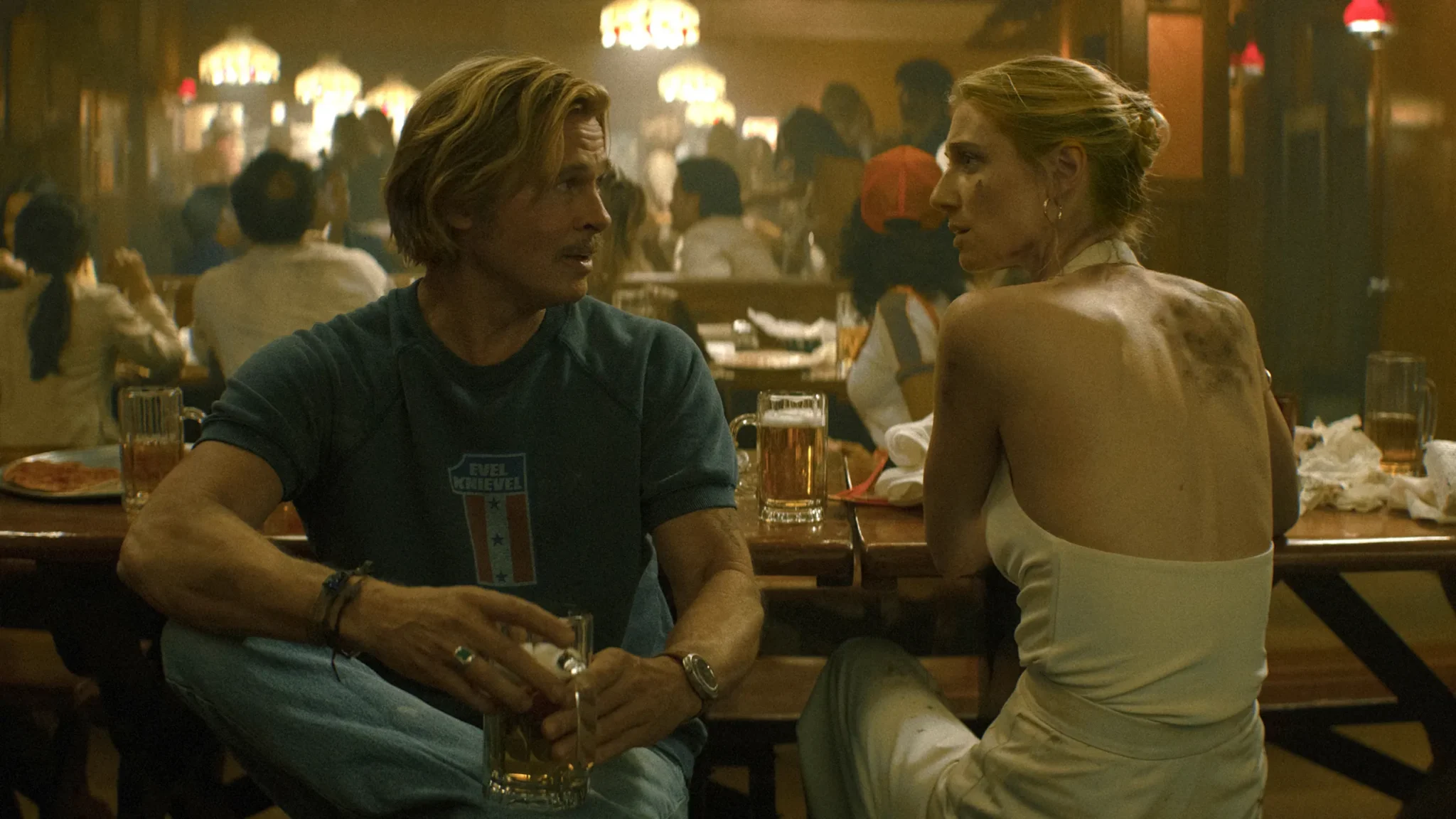
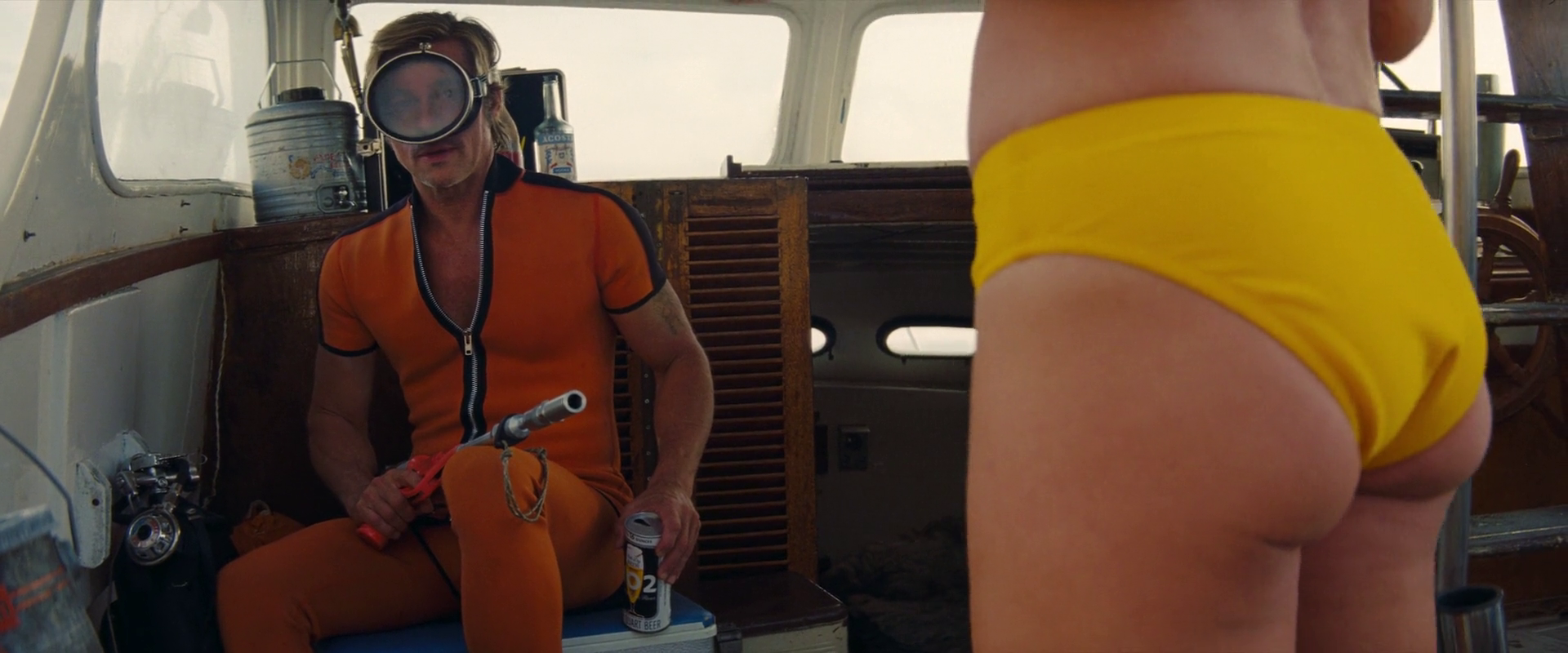
The key to understanding The Further Mis-Adventures of Cliff Booth is to pay really close attention to the film’s bookends. By that, I mean how it opens and how it ends.
We don’t start with Cliff Booth. Instead, we start by watching a movie playing in a theater where Cliff’s the projectionist. The movie is called Soul Brothers Die Hard and the first scene we see is a conversation between two pimps. It may initially seem pointless but it’s actually incredibly important.
At the end, Cliff wins the showdown against the Verdusco brothers but is mortally wounded and can’t escape from the building burning down. Instead of fretting, he calmly quotes the final line from Soul Brothers Die Hard: “This don’t mean shit to me.”
I’m going to zoom out just a little bit to make the relationship between the scenes all the more clear.
Broadly speaking, Cliff’s life becomes like a movie. We can restate that as: life imitates art.
That may seem like a generic, pointless statement. But there’s more to it than that. Remember Karen’s speech?
- Karen Crosby: Okay, look, I like movies as much as anybody, but I consider them to be entertainment, not art. To me, that is not an unjust criticism. Movies are supposed to be fun. Best movie this year so far is Star Wars, right? But only an illiterate would think that was art.
- Cliff: What’s your definition of art?
- K: Well, not a technically superior rendition of Flash Gordon.
- Toni Peters: What about something really good?
- K: Like?
- T: The Godfather.
- K: Good gangster movie. That was the question, right?
- T: It was. Do you consider The Godfather art?
This is where Karen gives her speech:
What I will give you is that it’s artistic. Is it Camus’ The Stranger? Is it even Kerouac? It’s a movie adaptation of a trashy supermarket novel surprisingly artistically rendered. We are talking about Hollywood movies, right? Can they be entertaining? They can be. Is a hamburger tasty? It can be. But just because some ex-con knows how to flip a good burger, does that make him a chef? Is a burger a culinary accomplishment? It makes him a line cook making the least-demanding item on the menu for the least-demanding customer who will gobble up anything as long as it’s not lousy. That’s what movies are. Hamburgers shoveled to the undiscerning masses. The closest thing those masses have to any real opinion is whether or not that burger made them cry.
I think people who think movies are art are film critics, film buffs, filmmakers. And after being a critic, I speak with authority when I say: they are the biggest joke of all, because if they were really as we made them out to be, they would not have spent their lives examining the subtle distinction between a Big Mac and a Whopper…. Although, if I’m honest, I was the same. I wanted to write about Midnight Cowboy. I wanted to write about Bonnie and Clyde. Not Dr. f*****g Doolittle.
Karen directly argues that movies aren’t art, that they’re the equivalent of fast food hamburgers.
So you have Cliff, whose life becomes like a movie. And you have Karen who says that movies aren’t art. Notice, then, that Karen falls for Cliff.
Let’s abstract again and say Karen represents an elitist view. If that were true, you’d assume the film would reflect that in some way. Well, what do we notice about Karen? She dresses fancier than anyone else in the film. She talks with an accent, which already makes her sound smarter than everyone else. Oh, and don’t forget the scene where she goes from the fancy dress of a movie premiere to the figure-eight racing track where she sticks out like a sore thumb. And what happens? Mud sprays from the track and coats Karen. She then changes into an oversized t-shirt from the raceway and throws her fancy dress in the trash. It’s only after this dismantling of her elitist presentation that she and Cliff finally kiss.
If Karen represents an elitist view, what does Cliff represent? You guessed it: movies.
That’s why the film starts with him in a movie theater. It’s why it ends with him quoting a movie. It’s even why we see him going from job to job to job to job: each job is like a different role in a different genre film. There’s the film where he’s a bartender at a rowdy bar, like Tom Cruise in Cocktail. Or one where he’s a demolition derby racer. Or one where he’s a restaurant manager. Or one where it’s just him and his dad. Or one where it’s a romance between the gruff stuntman and the fancy agent.
Every 2026 movie I’ve seen, ranked. Became a dad, so catching up. Updated: October 17
There’s even that moment where Charlie says they should make a movie about Cliff’s life.
Cliff is cinema.
But, and this is a curveball, he’s also Quentin Tarantino.
Have you ever heard Tarantino talk about what’s essentially his origin story? This comes from Tarantino’s book from 2022, Cinema Speculation. In the opening chapter, Quentin talks about his mom dating a professional football player named Reggie. While the two couldn’t bond over sports, Reggie loved Blaxploitation movies. So the first time the two met was to go see a film called Black Gunn. The leading actor? NFL running back Jim Brown.
Tarantino in Cinema Speculation:
So, in a huge movie theater that was practically the size of the Metropolitan Opera House, I made my way to the snack bar. Then, loaded down with ten dollars’ worth of junk, found my way back to my seat as the lights began to dim. Then, on a Downtown Saturday Night, Jim Brown’s new movie, Black Gunn, began flickering through the film’s projector’s shutter gate for an extremely excited audience of about eight hundred and fifty black folks, eight hundred of them male.
And frankly, I’ve never been the same.
To one degree or another I’ve spent my entire life since both attending movies and making them, trying to re-create the experience of watching a brand-new Jim Brown film, on a Saturday night, in a black cinema in 1972…When Jim Brown sat behind his desk…and white gangster henchmen threaten him, and Gunn hits a button under the desk and sawed-off…dropped in his lap…the massive theater full of black males cheered in a way that nine-year-old little me had never experienced in a movie theater before. At the time—living with a single mother—it was probably the most masculine experience I’d ever been part of.
And when the movie ended with a freeze-frame of Jim Brown as Gunn, the guy behind Reggie and me proclaimed out loud, “Now that’s a movie about a bad motherf*****.”
Now let’s go back to Soul Brothers Die Hard. The fictional film’s main character is played by Roderick Harrison. Harrison’s a former NFL player. Does that sound familiar? Harrison is supposed to be like Jim Brown. And Soul Brothers Die Hard is in the vein of Black Gunn.
Black Gunn was the film that caused Tarantino to become the filmmaker he became. It’s part of his identity. We see the same thing with Cliff. His life is already like a movie, but he specifically ends The Further Mis-Adventures by essentially recreating the end of Soul Brothers Die Hard, which is just a reference to Black Gunn.
Did you catch at the end of Cliff’s fight with Eddie there’s a moment where he goes to land the final blow and the image pauses? That’s a reference to how Black Gunn “ended with a freeze-frame of Jim Brown.”
Fincher talked about this in an interview with Dazed:
For Quentin, I think it’s a facet of himself that he’s exploring in Cliff Booth. Cliff Booth is a throwback to the kind of male character Quentin adores. He talked about The Wild Bunch, and Steve McQueen in The Getaway. He likes those men of few words who embody the thing they’re trying to get across.”
What Cliff Booth gets across is that movies are art because life imitates art and people imitate movies.
And Tarantino has famously said that he’d only make 10 movies. After number 10, he’ll never make another. The final film was supposed to be The Movie Critic. It was supposed to be set in California in 1977. Along the way, he transformed the entire thing into The Further Mis-Adventures of Cliff Booth. Karen’s speech about movies? That was from The Movie Critic.
And that brings us back to the start of the film. The opening dialogue where the one character explains how you “keep a woman happy”. I can’t write the full speech, otherwise Google would probably de-monetize the article. But the short of it is that the character is a pimp who talks about how women want to be cared for and how you do that. His answer is…body-on-body calisthenics.
But the important thing is how he frames this. He says that a lot of pimps will get women to work, but a true “mack” keeps them working, and keeps multiple women working. Quote: “That’s a Big Mac. And everybody knows secret sauce is what makes a Big Mac.” That’s when Rod’s character asks, “So what’s the secret sauce, Big Mac?” Eventually, he reveals “the key”. The key is “different positions. See, you ain’t gotta f*** her better than every other man. You got to **** her differently than any other.”
Remember what Karen said about Big Macs? When you do, suddenly that opening conversation takes on an entirely new meaning. It becomes a conversation about being a filmmaker. The women? The audience (and the critics).
So Karen is the audience, the critic. And Cliff is cinema. Now Cliff’s life makes sense. We the audience are amused by the fact that Cliff goes from working as a projectionist to serving as a fixer to bartending to caring for his dad to destruction derby driving, etc. etc. We never know what he’s going to do next. Just like we don’t know what the film is going to do next. And it’s this exact characteristic that makes Karen fall for him. It’s not just because he’s handsome or charming, it’s because everything she learns about him, everything she experiences with him, surprises her.
Tarantino isn’t concerned with making a “better” movie according to some objective, intellectual standard like what Karen seems concerned with. He cares about creating a cinematic experience that’s different from everything else. The secret sauce is what separates an ordinary movie from one people remember for the rest of their lives.
Tarantino didn’t direct The Further Mis-Adventures of Cliff Booth because it would have been his tenth and final film. He wasn’t ready for that. I think Tarantino’s kind of nervous to cross that finish line. And he wrote Cliff Booth as a kind of deathbed manifesto about filmmaking. That’s why it includes his origin story as a filmmaker and ends with the demise of this character that embodies everything Quentin believes about cinema. It’s obviously not Tarantino’s final statement, as the tenth movie is still yet to be, but I think he had to get sentimental with Cliff Booth and get these ideas out there in order to feel the necessary closure to move ahead with the grand finale. Because, ultimately, the tenth film means the end for Tarantino the filmmaker. So Cliff Booth is dedicated, like a song on the radio, to everything Tarantino has been as a filmmaker, everything he wished he could be, and everything he’ll never get to be.
When asked about his final film, Tarantino said: “I’ve got to not know what I’m doing again. I’ve got to be in uncharted territory.”
That sounds about right.


Film Colossus Supporters get access to the Frameshift and Active Viewing courses, an ad-free site, the Watch More Films newsletter, and the ability to request movies for analysis. Your support also directly keeps Film Colossus alive while I try to scale it into something sustainable, as it's just me, Chris, who does everything here.
Or create a free account. You gain access to the Active Viewing course and Watch More Films.
Join the Film Colossus community, get the newsletter, and unlock member features as they're added.